Gabriel G Tabarani
In the Middle East, military threats rarely remain rhetorical for long. When tensions rise between Washington and Tehran, oil traders react within minutes, insurers reprice risk, and militaries quietly reposition assets. Yet the deepest impact is often felt far from the immediate theater of confrontation, in fragile states where geopolitics seeps into daily economic life. There, geography becomes destiny, and foreign policy becomes a household concern.
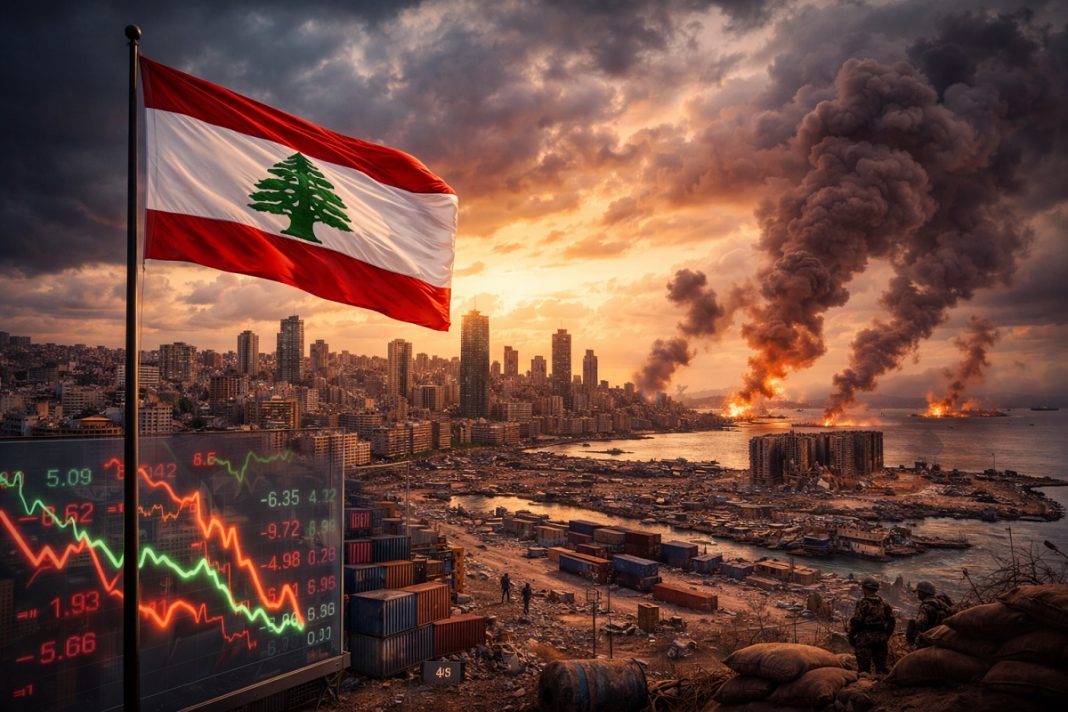
Lebanon sits squarely in that vulnerable category. It is not a decision-maker in the American-Iranian standoff, nor a principal actor in their rivalry. But history has made it one of the arenas where regional tensions are translated into local realities: border flare-ups, calibrated shows of force, and messages sent by actors who are not always states. In such an environment, even the possibility of escalation is enough to move markets and rattle confidence. Capital does not wait for rockets; it reacts to risk.
This sensitivity would be manageable if Lebanon were economically resilient. It is not. The country has endured one of the most severe financial collapses in modern history. Its currency has lost more than 95 percent of its value in just a few years. Gross domestic product, once hovering around $50–55 billion, has shrunk dramatically. Savings have been trapped in a crippled banking system. For many Lebanese families, purchasing power has been hollowed out to a fraction of what it was.
In such a setting, regional tensions are not abstract diplomatic episodes; they are direct economic shocks. A spike in geopolitical risk can mean a weaker currency, delayed investments, a shorter tourist season, or remittances held back until the picture clears. Each factor may seem small in isolation, but together they define the survival prospects of a fragile economy.
At the heart of Lebanon’s predicament lies a structural issue that is as political as it is economic: the state does not fully monopolize the decision over war and peace. The presence of a powerful armed non-state actor alongside the national military creates a duality of authority in the most sensitive domain of sovereignty. In political economy terms, this translates into a permanent risk premium on the country. Investors—domestic before foreign—do not ask only about returns. They ask who controls escalation, who guarantees stability, and who has the final say. When the answers are blurred, long-term capital retreats and is replaced, if at all, by short-term, easily reversible flows.
Across the southern border, Israel views the landscape through a strictly security lens, prioritizing deterrence and preemption. From its perspective, preventing threats from maturing is a strategic necessity. But for Lebanon, even limited confrontations can have outsized economic consequences. Modern economies are acutely sensitive to instability. One disrupted tourist season can erase hundreds of millions of dollars in revenue. Damage to infrastructure can set back entire regions for years. In a country already struggling with unreliable electricity and strained public services, any additional shock multiplies existing weaknesses.
International estimates placing reconstruction and recovery needs after recent escalations in the tens of billions of dollars underscore the scale of the problem. These figures are not just about rebuilding roads or buildings; they represent lost opportunities. Every dollar spent repairing avoidable damage is a dollar not invested in productive growth, education, or sustainable infrastructure. For a state with chronic fiscal deficits and limited access to financing, reconstruction can become another burden rather than a springboard.
Perhaps the most corrosive condition for Lebanon is the gray zone in which it is trapped: neither full-scale war nor stable peace. This prolonged uncertainty is toxic for an emerging economy. It suppresses positive expectations without creating the mobilization dynamics of a wartime economy. It encourages delay—of investments, expansions, and reforms. It also accelerates emigration. For many young Lebanese, leaving is no longer an emotional decision but a rational economic calculation.
The social consequences are stark. Poverty has surged. The middle class—the backbone of stability in any society—has thinned. Remittances from the diaspora, while vital, increasingly serve as a lifeline for basic consumption rather than as capital for growth. An economy sustained by money sent from abroad and by intermittent aid is, in effect, borrowing time from its own future. Its most valuable asset—human capital—departs quietly, plane ticket by plane ticket.
And yet, Lebanon is not devoid of strengths. It has a highly educated workforce, a historically dynamic service sector, and a vast and successful diaspora. These are real foundations for recovery. But they require a basic precondition: a state whose sovereign decisions are clear and centralized, especially on matters of security. Without that, financial reforms and international support packages can only act as temporary painkillers, not cures.
No country can build a modern economy while functioning as a geopolitical instrument for others. The success stories of recent decades share a common trait: they reduced political risk instead of merely managing it. Lebanon, by contrast, continues to accumulate it.
The central question today is no longer who wins the next political or military round. It is who saves what remains of a viable state. Markets do not negotiate, and economic history is unforgiving to countries that linger too long in uncertainty. Caught between potential regional escalation and ongoing domestic collapse, Lebanon faces a stark choice: evolve into a normal state with a unified decision-making structure and relative stability, or remain an open arena managed through recurring crises while its economy and society continue to pay the price.
This article was originally published in Arabic on the Asswak Al-Arab website