Gabriel G Tabarani
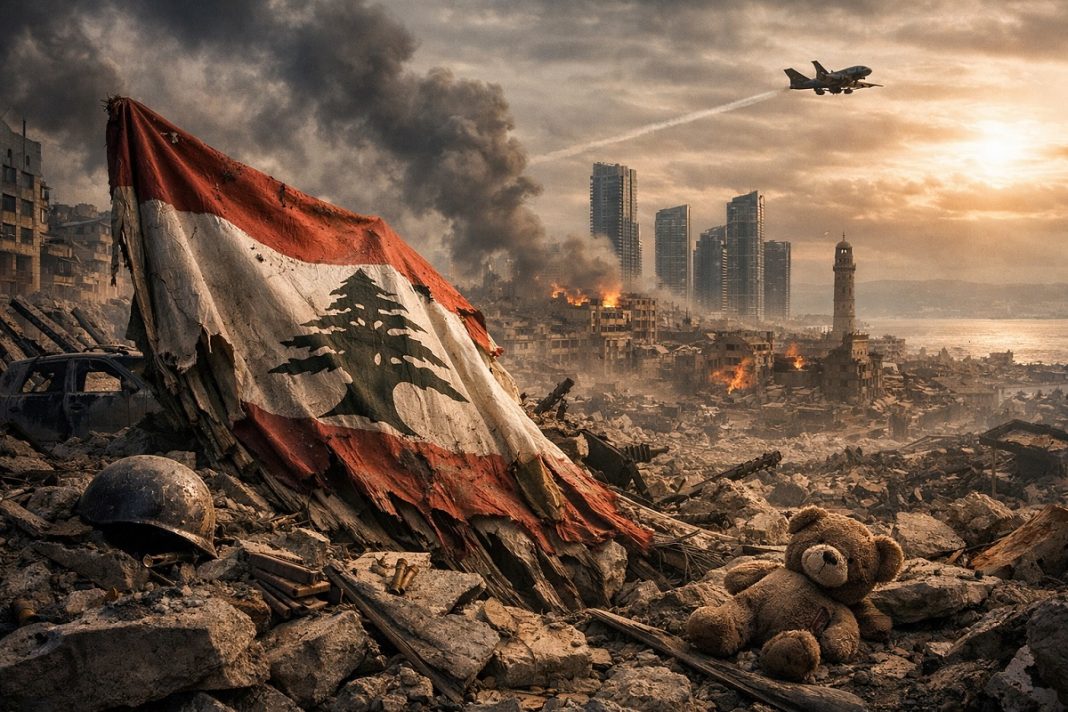
Lebanon is not entering a new war. It is returning to a familiar one.
Each time the southern front ignites, the same assumption resurfaces: that military force can reorder this fragile country or impose a new balance upon it. Yet Lebanon’s modern history suggests the opposite. External intervention has never resolved its crises. It has only reshaped them—often in more dangerous and enduring ways.
In the mid-1980s, the scholar Fouad Ajami offered an early diagnosis of this pattern. Writing after Israel’s 1982 invasion, he argued that the war had done more than dislodge one armed actor (the Palestine Liberation Organization). It had transformed Lebanon’s internal landscape. A marginalized Shiite community, long excluded from power, emerged from the experience with a new political consciousness—one rooted not only in grievance, but in a sense of historical purpose. What began as an effort to eliminate a threat ultimately helped produce a more resilient one.
That insight feels uncomfortably relevant today.
Israel’s current campaign against Hezbollah is driven by a clear objective: to push the Shiite group away from its northern border and degrade its military capacity. But wars in Lebanon rarely remain confined to their stated goals. What unfolds on the ground is not only a contest of firepower, but a reconfiguration of political meaning.
Hezbollah enters this confrontation in a more fragile position than it has occupied in years. Lebanon’s economic collapse, combined with growing criticism of the group’s alignment with Iran’s regional agenda, has eroded some of its domestic standing—even within parts of its traditional base. Meanwhile, the Lebanese state, however weak, has made tentative attempts to reassert the principle that decisions of war and peace should not rest with any single armed faction.
But war has a way of rearranging such equations.
As airstrikes intensify, as entire communities are displaced, and as the south once again becomes a landscape of loss, political debate narrows. Questions about sovereignty and reform give way to a more immediate and existential one: Who protects us? In such moments, Hezbollah’s identity as a resistance force can regain traction in his community, even among those who had grown skeptical of its role.
This is the paradox at the heart of Lebanon’s recurring conflicts. Military pressure aimed at weakening an armed group can simultaneously restore the very conditions that sustain it. Resistance, as Ajami understood, is not only a matter of ideology. It is born from collective experience—especially from the perception of humiliation and vulnerability.
The stakes today, however, are higher than they were four decades ago.
Lebanon is no longer a country emerging from civil war with the capacity to rebuild. It is a state already hollowed out by financial collapse, institutional decay and a profound loss of public trust. The buffers that once allowed Lebanese society to absorb shocks have largely disappeared. What remains is a system struggling to function under the weight of accumulated crises.
This fragility is compounded by a deeper transformation: Lebanon is no longer merely a battleground for competing regional interests. It has become structurally embedded within them. Hezbollah is not simply a Lebanese actor; it is part of a broader Iranian strategy that views Lebanon as a forward line in its confrontation with Israel.
That reality limits Lebanon’s agency. Decisions about escalation are shaped not only in Beirut, but within a wider regional calculus. And it complicates any attempt to imagine a purely domestic resolution.
It also reshapes the economics of war.
For decades, Lebanon relied on Gulf states to finance reconstruction after each round of destruction. That model is no longer assured. The current regional confrontation involving Iran is already recalibrating priorities across the Gulf, where political considerations increasingly shape financial commitments. Aid that was once extended as a matter of course is now more conditional, more cautious and less certain.
At the same time, international support has become tied to structural reforms that Lebanon has consistently failed to deliver. The result is a widening gap between destruction and recovery. Reconstruction is no longer a guaranteed outcome of war; it is an open question.
In this environment, each new escalation does more than damage infrastructure. It erodes the very possibility of rebuilding. The cost of conflict is no longer measured only in what is destroyed, but in what can no longer be restored.
This raises a more difficult question: What comes after the fighting?
Even if Hezbollah is significantly weakened, there is little evidence that Lebanon’s political system is capable of absorbing the consequences. In a country where power vacuums rarely remain empty, the risk is not stability, but fragmentation—or the emergence of new, potentially more radical actors.
The contradiction is stark. Efforts to contain a threat proceed without a credible vision for what follows its containment. In Lebanon, that gap has historically been filled not by order, but by renewed instability.
None of this suggests that the status quo is sustainable. Hezbollah’s position within Lebanon—and Lebanon’s position within a wider regional confrontation—remains deeply contested. But neither does it suggest that force alone can resolve these tensions.
Lebanon’s problem has never been purely military. It is political, structural and profoundly internal. Attempts to reshape it from the outside have consistently underestimated the resilience of its internal dynamics—and the ways in which violence can reinforce them.
The lesson is not new. What is new is the cost of ignoring it.
Lebanon no longer has the luxury of repeating its past. Yet it remains trapped within it.
And that may be the most dangerous reality of all: in Lebanon, wars do not end because they fail—but because they succeed in ensuring that another one will follow.
This article was originally published in Arabic on the Asswak Al-Arab website