Gabriel G Tabarani
Wars are rarely confined to the places where they are fought. They ripple outward, unsettling markets, reshaping alliances, and creating opportunities for those positioned to seize them. The conflict in Iran is no exception. While missiles and counter-strikes dominate headlines, a quieter contest is unfolding—one centered not on territory, but on energy. And in that contest, Algeria is emerging as an unlikely beneficiary.
Algiers has responded to the war with studied restraint. Despite longstanding political ties with Tehran, rooted in shared rhetoric of resistance and overlapping regional interests, Algeria has avoided taking a confrontational stance. It has neither condemned Washington outright nor rushed to defend Iran. Instead, it has chosen ambiguity—a deliberate posture designed to preserve flexibility in a rapidly shifting landscape.
That choice is not ideological. It is economic.
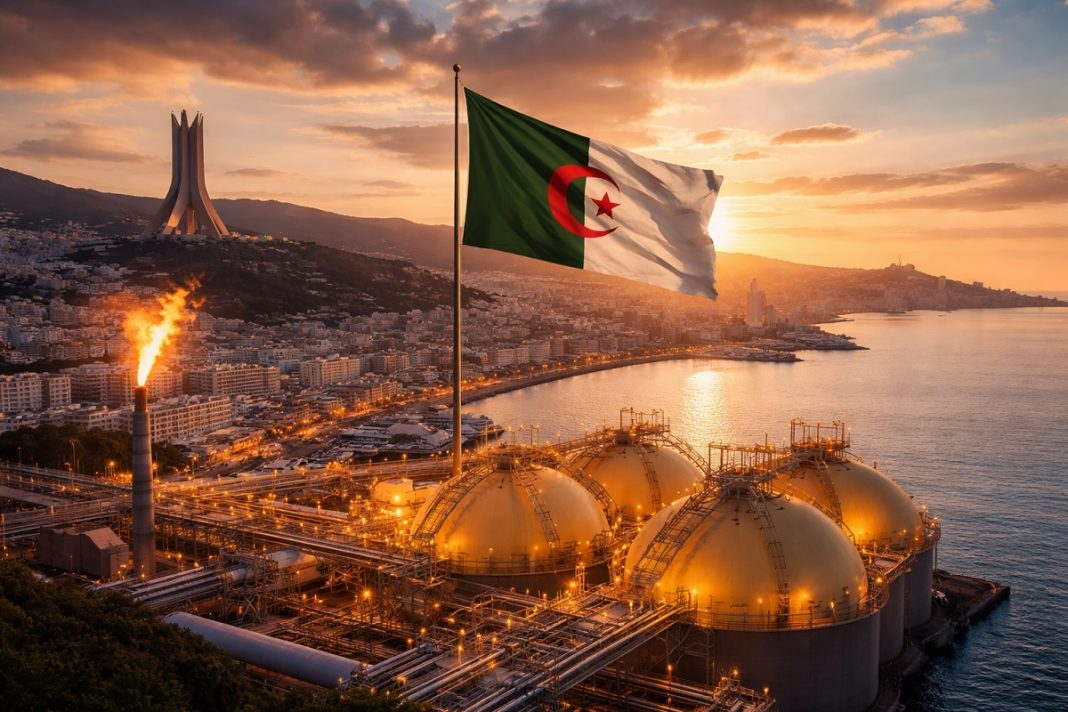
Algeria understands that its greatest leverage in this moment does not lie in diplomacy or military alignment, but in natural gas. With an estimated 50 to 55 billion cubic meters of gas exported annually, and hydrocarbon revenues exceeding $50 billion in recent years, the country occupies a critical position in Europe’s energy architecture. As instability in the Middle East disrupts supply chains—particularly liquefied natural gas flows—European capitals have turned once again to Algeria, seeking reliability in an increasingly unreliable market.
The response from Algiers has been measured, but far from passive. Officials have signaled an interest in renegotiating contracts, reportedly aiming for price increases of up to 20 percent. This is not opportunism in the crude sense. It is strategy. Algeria is leveraging a moment of global vulnerability to recalibrate its role—from a dependable supplier to a more assertive energy actor.
Yet its ambitions are tempered by structural constraints. Much of Algeria’s export infrastructure, including the TransMed pipeline to Italy, dates back decades and has suffered from declining efficiency. Domestic consumption has also risen steadily, reducing the surplus available for export. Algeria, in other words, cannot dramatically increase output overnight. But it does not need to. In a tight market, price can matter as much as volume.
This evolving role carries geopolitical implications beyond Europe.
Algeria’s rivalry with Morocco has deepened in recent years, extending beyond the long-standing dispute over Western Sahara into a broader competition for influence in West Africa and the Sahel. Morocco has made significant diplomatic gains, particularly after the United States recognized its sovereignty over Western Sahara in 2020, a move that shifted regional alignments. In response, Algeria has sought to reassert itself—not through grand gestures, but through targeted economic engagement.
Energy has become its instrument of choice.
In recent months, Algeria has expanded its footprint across the Sahel, signing cooperation agreements with countries such as Ivory Coast and launching oil and gas projects in Niger. Its state-owned energy company, Sonatrach, has positioned itself as a key player in regional development, investing in infrastructure and resource extraction. These moves are not merely commercial. They are part of a broader effort to translate economic presence into political influence.
Morocco, for its part, is pursuing a different strategy—one built on long-term infrastructure, including a proposed gas pipeline linking Nigeria to Europe and major port projects along the Atlantic coast. But these initiatives face delays, funding challenges, and security risks. Algeria’s approach, though less ambitious on paper, offers immediacy.
Still, the picture is not without complications.
Iran’s preoccupation with its own survival has weakened its ability to project power abroad, particularly in regions like the Sahel where informal networks once played a stabilizing role. For Algeria, this creates a security vacuum at its southern flank. The same war that boosts its economic standing may, paradoxically, increase its exposure to instability.
This is the central tension of Algeria’s position.
It is gaining economically from a crisis that could undermine its broader strategic environment. Managing that contradiction requires a careful balancing act—maintaining ties with traditional partners while deepening engagement with new ones, particularly in Europe. It also demands a level of pragmatism that has long defined Algerian foreign policy: cautious, adaptive, and resistant to rigid alignments.
In the end, Algeria is not choosing sides. It is choosing leverage.
As the war in Iran continues to unsettle the global order, Algeria is quietly repositioning itself—not as a participant in the conflict, but as a country capable of shaping its economic consequences. It is not the loudest actor in this moment, nor the most visible. But it may be one of the most effective.
In a world where wars are fought on battlefields but decided in markets, Algeria appears to be winning a conflict it never set out to fight.
This article was originally published in Arabic on the Asswak Al-Arab website