Gabriel G Tabarani
In the Middle East, wars are not waged by weapons alone. They are also fought through signals — layered, contradictory, and often deliberately ambiguous. Israeli Prime Minister Benjamin Netanyahu’s recent decision to authorize direct talks with Lebanon, even as he escalates military strikes, is not merely a tactical contradiction. It is a strategic message: diplomacy, in this moment, is being conducted under fire.
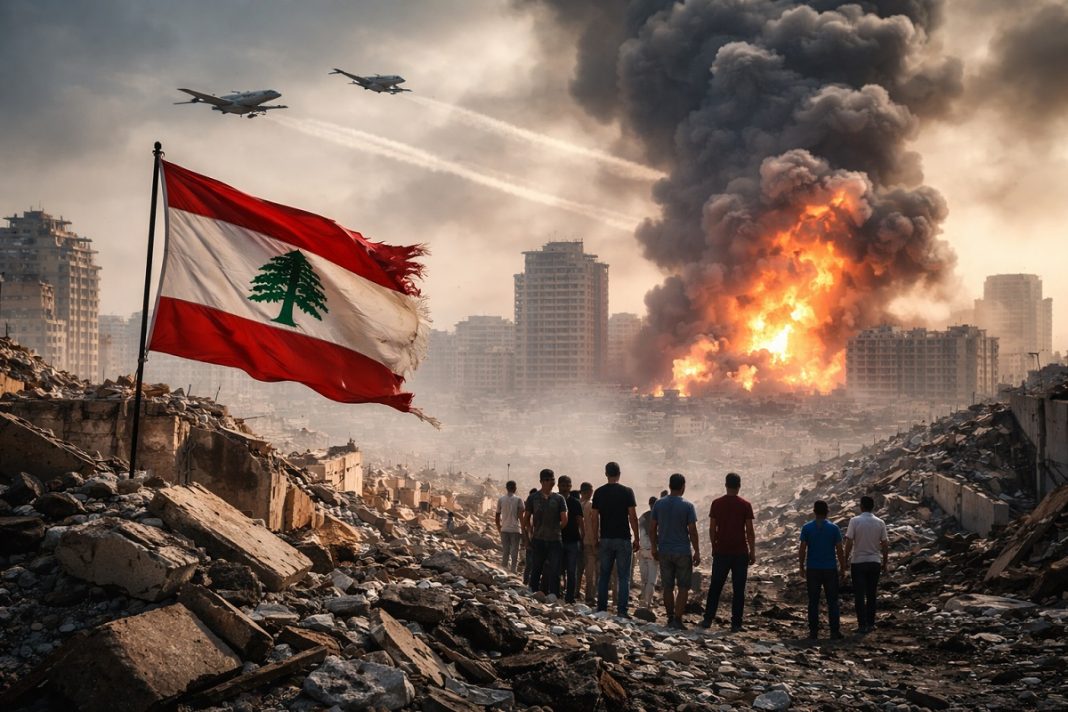
This is not unprecedented in the region’s history. But the dissonance now is sharper. The scale and speed of the recent airstrikes on Beirut —concentrated, devastating and executed within 10 minutes— were not merely military operations. They were political acts, intended to reshape the terms of engagement before negotiations had even begun. In such a context, diplomacy does not run alongside war; it becomes an extension of it.
From Beirut, the central question is unavoidable: can negotiations meaningfully emerge under such conditions? Lebanon’s own history suggests otherwise. From the Taif Agreement to the uneasy arrangements that followed the 2006 war, one lesson stands out: there is no sustainable peace without a minimum level of stability — and no stability when violence remains an open-ended instrument of policy. In a country where a large share of the population now lives on the edge of economic collapse, war is no longer a choice. It is an imposition.
The Lebanese dilemma, however, is not confined to its confrontation with Israel. It lies in the nature of the state itself. Israel’s demand to disarm Hezbollah collides with a deeper reality: Hezbollah is not simply an armed group, but an entrenched political and social force. Any attempt to impose disarmament from the outside —particularly under military pressure— risks not only derailing negotiations but destabilising Lebanon from within.
This complexity cannot be fully understood without accounting for the decisive regional factor: Iran. Hezbollah operates within Lebanon’s internal balance, but it is also strategically linked to Tehran, which views the Lebanese front as one of its most consequential levers in its broader confrontation with Israel and the United States. In this sense, the current escalation cannot be read solely as a localized conflict. It is part of a wider regional contest in which fronts function as instruments of signaling. This raises a fundamental challenge for diplomacy: how can a durable understanding be reached in Beirut when key levers of escalation and restraint may lie beyond it?
The paradox runs deeper still. The very state being asked to assert sovereignty is being systematically weakened in ways that make such sovereignty difficult to exercise. Lebanon, exhausted economically and institutionally, struggles to manage its daily crises. Expecting it to confront a force as entrenched as Hezbollah without risking broader instability borders on strategic denial.
Israel, for its part, appears to be pursuing a dual-track approach: intensifying military pressure to raise the cost of the status quo while opening a diplomatic channel to reshape it. Yet this approach contains a structural contradiction. The more intense the strikes, the less political space exists within Lebanon for compromise. Public opinion, under bombardment, does not moderate — it hardens. It is difficult, if not impossible, to persuade a society under daily attack of the merits of negotiation.
The risk, then, is that efforts to weaken Hezbollah by pressuring the Lebanese state will instead further erode that state, creating a vacuum filled by the very actors such pressure seeks to contain. This is not a hypothetical scenario. It is a pattern that has repeated itself in Lebanon before.
The United States occupies a pivotal yet uncertain position in this equation. Washington has pressed for talks and urged restraint, yet it has not articulated a comprehensive framework capable of bridging the gap between Israeli demands and Lebanese capacities. Calls to strengthen the Lebanese armed forces are not new, but they have yet to translate into the sustained capabilities needed to underpin any future arrangement.
This raises a question that deserves more serious consideration in Beirut: whether Lebanon can reframe the issue of international guarantees. Not merely through military assistance, but through a broader architecture — one that includes credible border monitoring, clearly defined reciprocal commitments, and mechanisms of accountability. In other words, a shift from fragile balance to institutionalized restraint.
Even this, however, runs into a deeper uncertainty: whether the international community still has the appetite to invest in Lebanon’s stability, or whether the country has come to be viewed as a chronic crisis — one to be managed rather than resolved.
What Lebanon faces today is not simply another cycle of escalation. It is a defining moment in determining its place within a rapidly shifting regional order. Either it reasserts itself — however partially — as a functioning state, or it continues its drift toward becoming an open arena where conflicts intersect without resolution.
No peace can be built atop ruins that are still being bombed. When jets speak, diplomacy does not merely fall silent — it loses meaning.
If the upcoming talks in Washington are to hold any real promise, their credibility will not be tested in official statements but in whether the sound of war can be reduced enough for the language of politics to be heard. For now, the signs are not encouraging — but they do not allow the luxury of despair.
This article was originally published in Arabic on the Asswak Al-Arab website