Gabriel G Tabarani
By any recent standard, American diplomacy in the Middle East has entered a strange new phase. President Trump’s cease-fire plan for Gaza, unveiled last year and now edging into its reconstruction stage, was billed as an ambitious attempt to stabilize a devastated territory and chart a path beyond the rubble of war. Yet what has emerged instead is something far more unsettling: a scheme that risks turning a fragile peace process into a vehicle for unprecedented personal power.
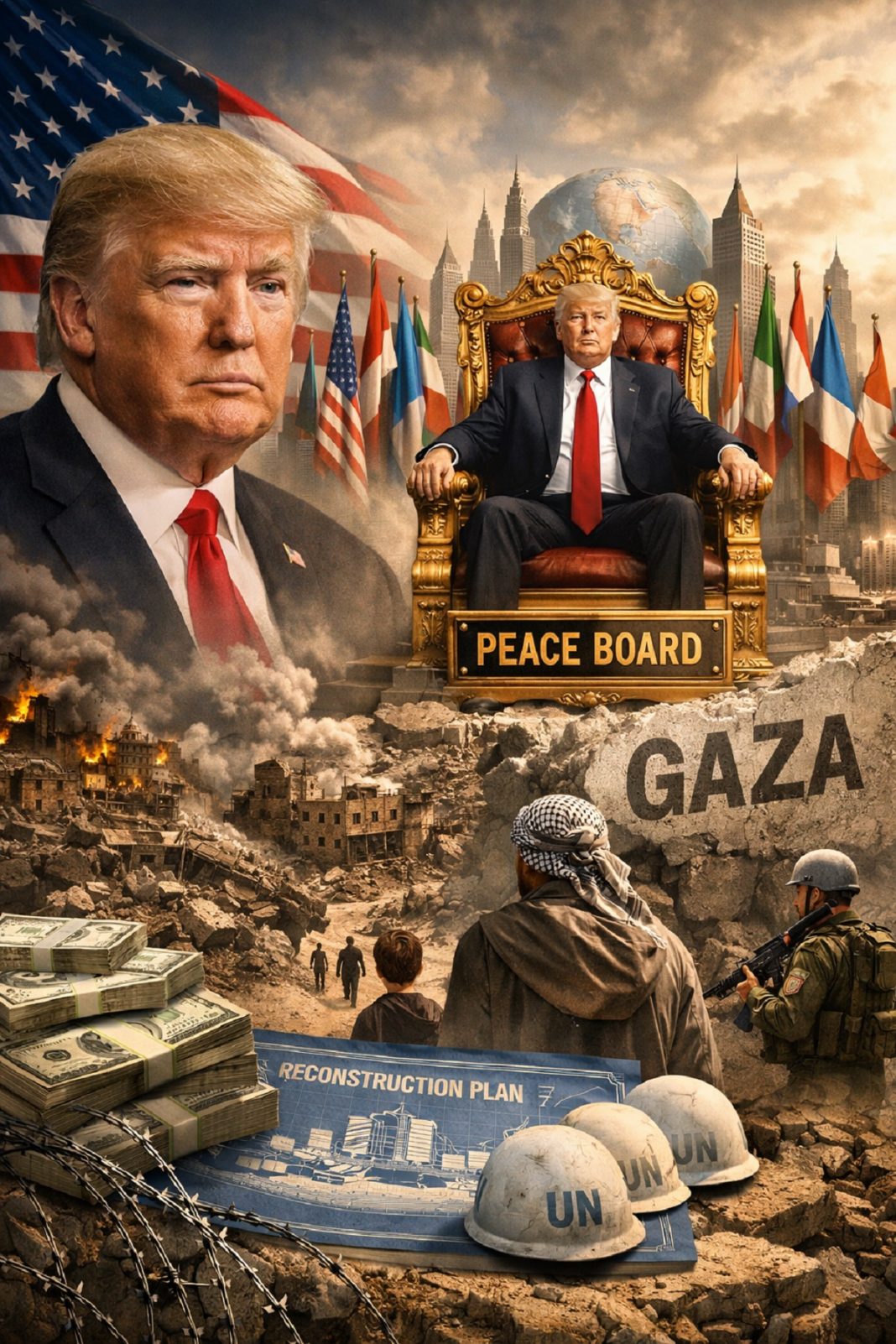
At the center of the plan is a tangle of new institutions. One is a Gaza Executive Board meant to oversee rebuilding through a technocratic committee. Another, more sweeping creation is Trump’s self-styled “Board of Peace,” a body whose mandate—at least on paper—extends far beyond Gaza, promising to promote stability and lawful governance “the world over.” It is chaired by Trump himself, stocked with handpicked heads of state and structured so that no major decision can occur without his approval. The arrangement bears less resemblance to any recognized international body than to a privately held company, with the president in the role of chief executive and ultimate arbiter.
Supporters describe this as bold leadership. Critics see something else entirely: a transparent power grab that threatens to undermine the very peace it claims to advance. The charter for the Board of Peace gives Trump veto power over all decisions, allows him to interpret the rules as he sees fit and even offers permanent seats to countries willing to pay more than $1 billion. It does not require that the funds raised be spent on Gaza’s reconstruction. It does not even mention Gaza in its title.
This would be troubling in any context. In the context of Gaza—where cease-fire lines are brittle, Hamas remains armed, Israel occupies more than half the territory and humanitarian needs are staggering—it is alarming.
The Trump administration argues that its plan aligns with a United Nations Security Council resolution authorizing an international role in Gaza’s redevelopment. But the resemblance is thin. The U.N. resolution envisioned a transitional body focused narrowly on reconstruction and funding coordination. Trump’s version repurposes that mandate into something that looks more like a shadow global council, one in which power flows upward to a single chair rather than outward to a community of states.
Israel, for its part, has already bristled. It objected sharply when the administration invited senior figures from Qatar and Turkey—countries it views as sympathetic to Hamas—onto the Gaza Executive Board. The Israeli opposition piled on, accusing Prime Minister Benjamin Netanyahu of diplomatic failure. These disputes may seem procedural, but they strike at the heart of a deeper problem: legitimacy. Any governing structure for postwar Gaza must be trusted by Israelis, Palestinians and regional actors alike. A body perceived as an American fiefdom chaired by a polarizing U.S. president is unlikely to meet that test.
History offers a sobering contrast. When the United States has successfully brokered peace in the Middle East, it has done so not by aggrandizing itself, but by carefully balancing pressure, incentives and institutional restraint. The 1978 Camp David accords, which produced a durable peace between Egypt and Israel, succeeded in part because President Jimmy Carter insulated the talks from domestic political pressures, separated bilateral issues from harder Palestinian questions and paired territorial withdrawal with layered security guarantees. The 1994 Israel-Jordan treaty followed a similar pattern: phased negotiations, tangible incentives and sustained U.S. engagement that respected the limits of American authority.
Where Washington has failed, the lessons are equally clear. The Oslo process of the 1990s collapsed under the weight of vague commitments, deferred “final status” issues and inadequate preparation of domestic publics for compromise. Spoilers on both sides exploited those gaps, and the United States proved unable—or unwilling—to impose meaningful consequences for violations.
Seen against that record, the design of Trump’s Board of Peace looks less like a breakthrough and more like a repeat of past mistakes, magnified by personal ambition. Durable mediation depends on credibility as an honest broker. Yet Trump’s open alignment with Israel, his threats of punitive tariffs against countries that decline to join his board and his insistence on chairing it himself all erode the perception of neutrality that effective mediation requires.
More fundamentally, the board risks distracting from what actually matters in Gaza. The territory’s future hinges on three interlocking challenges: security, governance and reconstruction. None of them can be solved by a global council with a grandiose charter. Security will require Hamas’s disarmament, credible multinational monitoring and Israeli withdrawal to agreed lines—steps that demand painstaking negotiation and regional buy-in, not a top-down edict. Governance will require a legitimate Palestinian authority capable of commanding local trust, not a technocratic committee seen as foreign-imposed. Reconstruction will require billions in sustained funding tied to clear benchmarks, not discretionary payments funneled through an opaque board.
If Washington is serious about peace, it should draw on its own best precedents rather than inventing new ones. That means inserting the president into negotiations at decisive moments, but not enthroning him as a permanent global chair. It means creating phased approaches with binding timetables and enforceable consequences, not vague promises overseen by a body with no meaningful accountability. It means pairing early humanitarian relief and infrastructure rebuilding with a clear political horizon that links Gaza’s stabilization to broader negotiations over Palestinian statehood.
It also means resisting the temptation to turn diplomacy into spectacle. Peace processes thrive on patience, quiet pressure and institutional humility. They falter when leaders mistake personal authority for international legitimacy.
The tragedy of Gaza is not just its physical devastation, but the long history of missed chances that preceded it. Another failure would not merely prolong Palestinian suffering or deepen Israeli insecurity; it would further discredit the idea that American leadership can still serve as a stabilizing force in a fractured region.
The United States has, in the past, shown how to mediate with firmness and restraint, ambition and realism. If it wants this effort to succeed, it should remember those lessons. Gaza does not need a new throne room for presidential power. It needs a peace process that is boring, disciplined and fair—and one that puts the hard work of reconstruction and reconciliation ahead of the allure of personal legacy.
This article was originally published in Arabic on the Asswak Al-Arab website