Gabriel G Tabarani
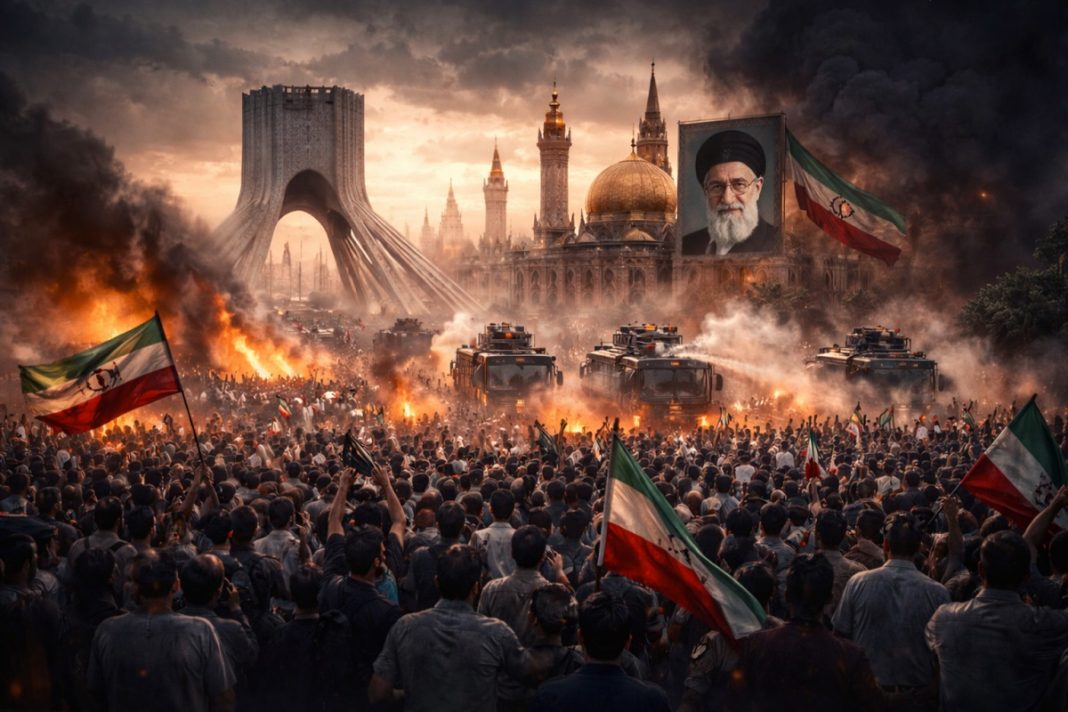
Iran is once again in the grip of mass protest, violent repression, and profound uncertainty. What began in late December as demonstrations driven by economic desperation—sparked by a collapsing currency and soaring prices—has rapidly evolved into a broader political confrontation between a restless society and a beleaguered state. Hundreds, possibly thousands, have been killed or detained. Images of bloodied streets, shuttered internet access, and silent cities circulate despite official efforts to seal the country off from the world.
The central question confronting Iran today is not whether unrest can be crushed in the short term, but whether the political system can continue to survive the accumulation of crises that now define it.
The pattern is painfully familiar. Economic grievances ignite protests. Protests escalate into political defiance. Slogans move from demands for relief to outright rejection of the system itself. The state responds with repression—first censorship, then arrests, then bullets. Calm returns, but only briefly. Each cycle leaves behind deeper resentment, weaker legitimacy, and a population less afraid than before.
What makes the current moment distinct is not merely the scale of unrest, but the context in which it is unfolding. Iran enters this crisis after years of economic mismanagement, severe sanctions, environmental strain, and demographic pressure. Its economy is hollowed out, its currency battered, and its social contract in tatters. Large segments of society no longer believe that elections, institutions, or official promises offer any path to change.
At the same time, Iran’s regional position has deteriorated sharply. Costly foreign entanglements have yielded diminishing returns. Allies and proxies once central to projecting influence have been weakened or removed from the battlefield. Military confrontations over the past two years—some fought directly on Iranian soil—have punctured long-cultivated narratives of deterrence and strength. Whatever nationalist unity those conflicts briefly generated has since dissipated, replaced by anger at a leadership seen as prioritizing ideology and confrontation over the welfare of its citizens.
Legitimacy, always the system’s most fragile pillar, has eroded further. Voter participation has collapsed to historic lows. Protesters increasingly reject not only specific policies or officials but the political order as a whole. Perhaps most consequentially, fear itself appears to be receding. Citizens continue to return to the streets despite knowing the likely cost.
And yet, revolutions are not made by courage alone.
Authoritarian systems do not fall simply because they are unpopular or unjust. They collapse when the instruments of coercion fracture, when elites split, and when an alternative political vision emerges that can mobilize society beyond spontaneous revolt. None of these conditions has yet fully materialized in Iran. The security apparatus remains cohesive. The state retains formidable surveillance capabilities. The opposition, though determined, remains fragmented and largely leaderless.
This reality complicates external responses—especially those of the United States.
Public declarations of support for protesters may inspire hope, but they also carry risks. Foreign threats and dramatic rhetoric can reinforce the regime’s long-standing narrative that dissent is the product of outside manipulation. That narrative has often been used to justify even harsher repression and to discredit genuine domestic grievances. Military intervention, in particular, is unlikely to deliver liberation and far more likely to unleash chaos, nationalism, and mass civilian suffering.
History offers little comfort to those who believe regime change can be engineered from abroad. External force has rarely produced stable or democratic outcomes in the region. In Iran’s case, it would almost certainly derail the organic, if halting, evolution of opposition politics inside the country.
None of this argues for passivity. But it does argue for restraint, discipline, and strategic humility.
There are forms of pressure that weaken authoritarian systems without strengthening their worst instincts. Targeted sanctions against individuals responsible for repression can raise costs without deepening collective suffering. Diplomatic isolation can signal moral clarity without resorting to force. Sustained efforts to counter internet blackouts can help protesters communicate, organize, and bear witness. Support for human rights documentation ensures that today’s crimes are not erased tomorrow.
Most importantly, external actors must recognize the limits of their influence. Iran’s future will not be decided in foreign capitals. It will be shaped by the slow, painful contest unfolding inside the country—between a society demanding dignity and a state determined to survive at any cost.
Even if the current uprising is suppressed, the underlying dynamics will not disappear. Each crackdown further alienates the population. Each unfulfilled promise deepens cynicism. Each act of violence narrows the regime’s room for maneuver. Survival becomes more dependent on force and less on consent—a trajectory that may preserve power in the short term while accelerating decay in the long run.
Iran today exists in a dangerous space between endurance and exhaustion. The system may persist, but it is increasingly brittle. The people may be pushed back, but they are no longer silent or resigned. Something fundamental has shifted: the question many Iranians are now asking is no longer who should rule, but what kind of system should exist at all.
For outside powers, the challenge is to avoid confusing noise with leverage and slogans with strategy. The struggle underway in Iran is not a spectacle to be claimed or a crisis to be exploited. It is a reckoning decades in the making. Those watching from afar would do well to remember that the most consequential revolutions are rarely the ones announced with certainty—but the ones that unfold unevenly, painfully, and on their own terms.
This article was originally published in Arabic on the Asswak Al-Arab website