Gabriel G Tabarani
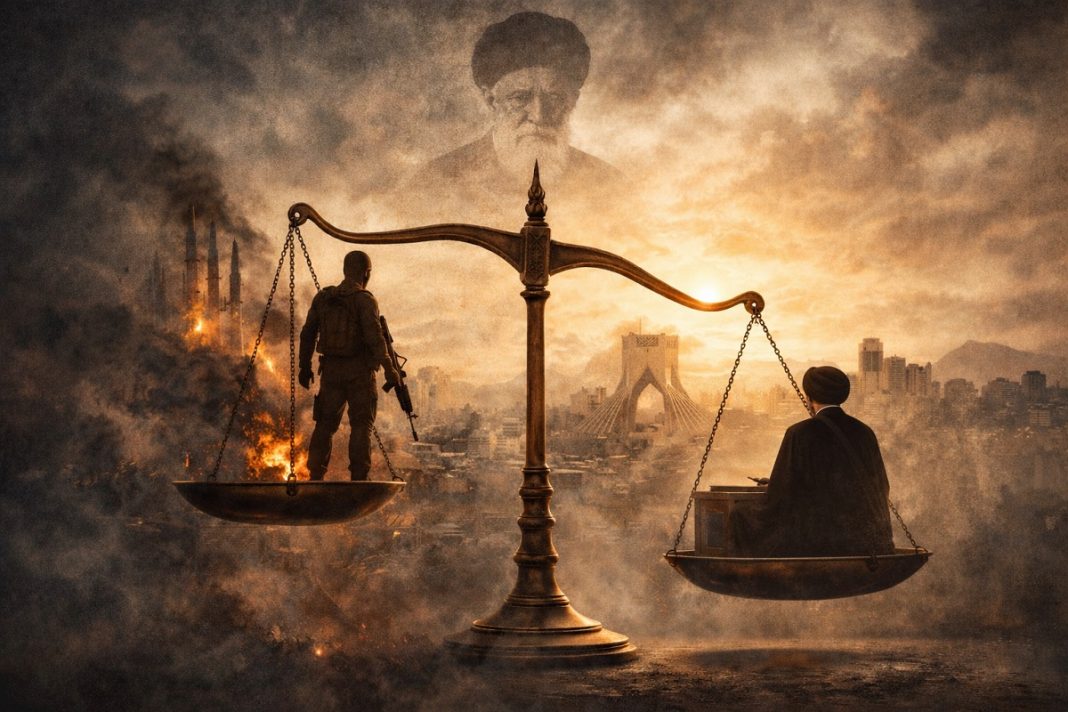
Iran is not simply entering a post-Khamenei era. It is entering a struggle over who truly governs the Islamic Republic—and on what terms.
The death of Ali Khamenei has removed more than the country’s highest authority. For over three decades, he functioned as the system’s ultimate arbiter, balancing rival centers of power while ensuring that none—especially the Islamic Revolutionary Guard Corps (IRGC)—could dominate outright. With him gone, the system has not collapsed. But it has lost its center of gravity.
The swift appointment of Mojtaba Khamenei by the Assembly of Experts was intended to project continuity and prevent a destabilizing vacuum. Instead, it revealed the fragility of the current order. Mojtaba may enjoy proximity to the security establishment, but he lacks the political stature and balancing authority his father cultivated over decades. That deficit matters. It makes him less a referee among factions and more dependent on the very forces he is supposed to oversee.
No institution stands to benefit more from this shift than the IRGC. Over the years, it has evolved from a revolutionary military force into a central pillar of Iran’s political and economic system. It commands armed power, controls vast business networks, and maintains deep influence across the region. In a moment of uncertainty, such assets translate into leverage.
Yet the IRGC’s rise comes with a paradox. Its relative power inside Iran has increased—but its absolute power has been weakened.
Recent military confrontations have exposed the limits of Iran’s strategic model. Key elements of its military infrastructure have been degraded. Its regional networks have come under sustained pressure. Its economy, already strained by sanctions, faces mounting internal and external constraints. In many ways, the very policies that elevated the Guards have also brought the country to the edge of strategic exhaustion.
This contradiction places the IRGC in an awkward position: it is both the strongest actor in the system and the most implicated in its failures.
For years, Iran’s governing model rested on a symbiotic relationship between the supreme leader and the Guards. Khamenei, aware of his limited popular legitimacy, relied on the IRGC to consolidate authority and suppress challengers. In return, he expanded its role in politics, security, and the economy. Over time, this partnership blurred the line between state and military, creating a system in which power was shared—but carefully managed.
That management is now gone.
The likely outcome, at least in the short term, is a more openly militarized state—one in which the IRGC exerts greater influence over both domestic governance and foreign policy. Such a trajectory would likely reinforce Iran’s confrontational posture toward the United States and Israel while tightening control at home.
But this path is neither stable nor inevitable.
Iran today faces a convergence of pressures that coercion alone cannot resolve. Its economy is battered, its society is fatigued, and its political legitimacy is frayed. The tools that once sustained the system—security dominance, ideological mobilization, and regional projection—are yielding diminishing returns. Continuing along the same path may preserve control, but it risks deepening structural decline.
This is where a second, less visible possibility emerges: the reassertion of pragmatic elements within the system.
These actors—many of them veterans of the Islamic Republic rather than outsiders—do not seek to dismantle the regime. Their aim is more modest, but no less consequential: to recalibrate it. They recognize that perpetual confrontation abroad and rigid control at home have become liabilities. For them, survival may require adaptation.
The challenge, however, is that pragmatists lack the coercive tools that define power in Iran. They do not command armed forces or security networks. Their influence depends on something more fragile: their ability to persuade both the elite and the public that an alternative course is possible.
And here, Iranian society becomes central.
Over the past decade, repeated waves of protests have revealed deep discontent across social classes. While these movements have not toppled the system, they have exposed its limits. Economic hardship, political repression, and a lack of future prospects have eroded the social contract that once underpinned the regime.
Iran’s younger generation, in particular, represents a critical variable. With no memory of the 1979 revolution, it evaluates the state not by its founding ideals but by its present performance. It is more connected, more skeptical, and less willing to accept indefinite sacrifice in the name of abstract goals. Any faction seeking to shape Iran’s future will need to reckon with this demographic reality.
The implications extend beyond Iran’s borders.
The country’s internal trajectory is deeply intertwined with regional stability and global markets. A more hard-line, militarized Iran could seek to compensate for internal weakness through external escalation, raising tensions across the Middle East and threatening key energy routes. Conversely, a more pragmatic Iran—however limited its transformation—could open space for de-escalation, particularly in areas such as maritime security and energy flows.
This dual possibility places external actors, especially the United States, in a delicate position. Policies that rely solely on pressure risk reinforcing the very forces they aim to weaken. At the same time, engagement without leverage may yield little. The most effective approach may lie in calibrated incentives—incremental steps that reward shifts in behavior without assuming a wholesale transformation.
None of this guarantees change. The IRGC remains a formidable force, and the system’s core structures remain intact. But moments of transition often create openings that would otherwise be unthinkable.
Iran is now in such a moment.
The question is no longer simply who succeeds Khamenei. It is what kind of state emerges in his absence: one defined by the logic of permanent militarization, or one that—however cautiously—seeks to rebalance itself.
The outcome will not only determine Iran’s future. It will help shape the trajectory of an entire region.
For now, the real war for Iran is not being fought on battlefields. It is unfolding within the state itself—and its result remains undecided.
This article was originally published in Arabic on the Asswak Al-Arab website