Gabriel G Tabarani
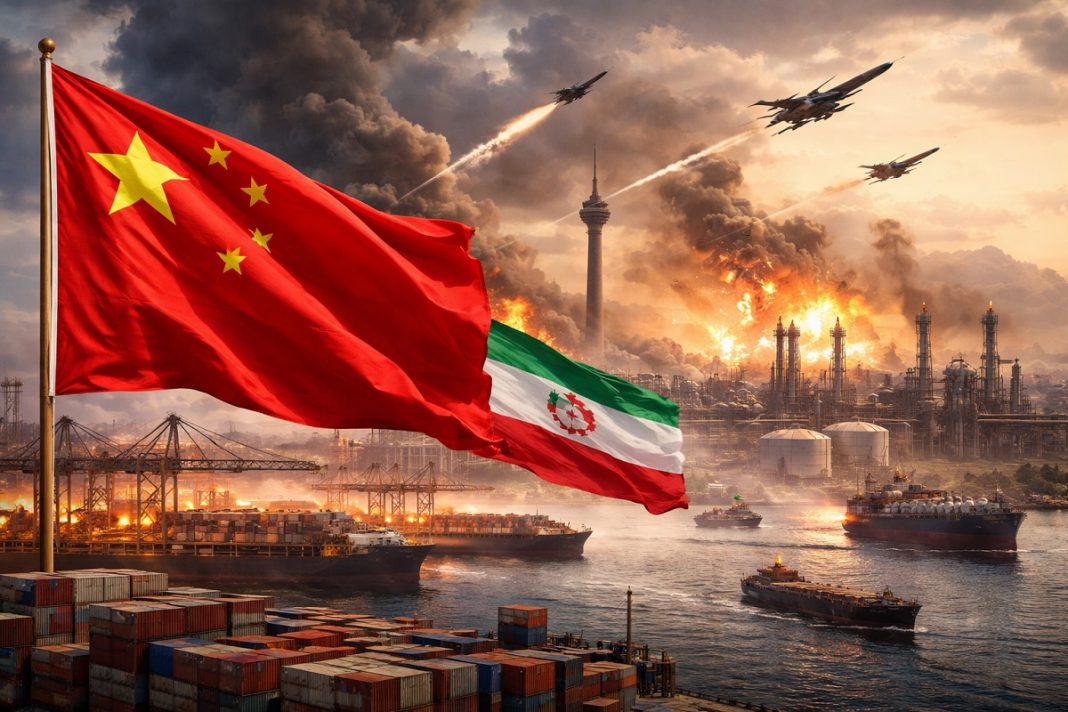
The military escalation involving Iran, the United States and Israel is not merely another crisis in the Middle East. It also places China before a complex strategic test. A wider conflict around Iran threatens Beijing’s vital interests in energy and trade, while exposing the vulnerability of its expanding ambitions in the region—particularly those linked to the Belt and Road Initiative.
China is today the world’s largest importer of oil, and the Middle East remains central to its energy security. Roughly50 to 60 per cent of Chinese oil imports originate in the Gulf region. Any major disruption in the area—or in critical maritime chokepoints such as the Strait of Hormuz, through which a significant share of global oil shipments pass—would immediately reverberate through China’s economy and the wider global market.
Yet the Middle East matters to Beijing for more than energy. The region also occupies a key place in China’s broader vision of transcontinental connectivity. Since launching the Belt and Road Initiative in 2013, Beijing has sought to reshape global trade routes through an expansive network of railways, ports and logistics corridors linking Asia with Europe and Africa.
Within this geo-economic framework, Iran holds a particularly strategic position. Situated at the crossroads between Central Asia, the Middle East and Turkey, the country sits along potential overland routes that could connect western China to European markets. Its access to the Gulf and the Gulf of Oman also makes it relevant to maritime trade networks stretching across Eurasia.
These geographical considerations partly explain the 25-year comprehensive cooperation agreement signed between China and Iran in 2021. The deal envisaged long-term cooperation in energy, infrastructure and industrial sectors. For Tehran, the agreement represented an opportunity to deepen ties with a major economic power capable of easing the pressure of Western sanctions. For Beijing, it offered a way to consolidate its economic footprint in a region critical to both its energy supplies and its wider connectivity strategy.
Yet developments since then have revealed a more nuanced reality. Despite expanding economic exchanges and purchasing substantial volumes of Iranian oil, China has remained cautious about transforming the relationship into a political or security alliance. International sanctions on Iran and the risks associated with operating in an unstable regional environment have made many Chinese companies reluctant to invest heavily in the country.
More importantly, Beijing’s regional strategy extends far beyond Iran. Over the past decade China has built extensive economic ties across the Middle East, including with Saudi Arabia, the United Arab Emirates, Turkey and Israel. Some of China’s most significant infrastructure and energy investments in the region are located in Gulf states that are also among its most important energy suppliers.
This web of economic relationships encourages Beijing to maintain a careful balance among competing regional actors. China has little interest in aligning itself too closely with any single side in the region’s rivalries. Doing so would risk undermining its broader economic partnerships and jeopardising the stability required for its long-term projects.
As a result, China’s diplomatic posture in regional crises has tended to emphasise restraint and de-escalation. Beijing generally prefers to call for dialogue and political solutions while avoiding direct involvement in conflicts. This approach reflects a broader feature of China’s rise: the expansion of influence primarily through trade, investment and infrastructure rather than through military alliances or security commitments.
But the current tensions around Iran highlight the growing limits of this model. China’s economic interests in the Middle East have become so extensive that regional instability now directly affects its strategic calculations. Energy supplies, shipping routes and infrastructure projects that underpin China’s global trade networks all pass through a region prone to recurrent geopolitical shocks.
In this sense, the crisis surrounding Iran exposes a deeper paradox in China’s emergence as a global power. Over the past three decades Beijing has dramatically expanded its economic presence abroad while largely avoiding the political and security responsibilities traditionally associated with great powers. Instead of building military alliances, China has focused on constructing ports, railways and industrial zones.
Yet in regions such as the Middle East the boundary between economics and geopolitics is difficult to sustain. Trade corridors require a minimum level of political stability, while large-scale investments depend on security conditions that cannot always be guaranteed by commercial engagement alone. Conflicts such as the one now threatening Iran therefore represent a real test of China’s approach to global influence.
For Iran, China has become an indispensable economic partner, particularly in the context of Western sanctions. Chinese markets absorb the bulk of Iranian oil exports, and economic cooperation with Beijing offers Tehran a degree of financial breathing space. Nevertheless, the relationship remains fundamentally asymmetrical: Iran depends far more on China than China depends on Iran.
For Beijing, meanwhile, Iran is only one element within a much broader regional strategy. The Belt and Road Initiative is built on the principle of diversification, ensuring that China’s trade networks do not rely on a single corridor or partner. In recent years Beijing has expanded alternative routes through Central Asia, Pakistan and the Gulf, seeking to mitigate the risks associated with geopolitical volatility.
Still, the crisis around Iran underscores a reality China can no longer ignore. As its economic reach expands across politically fragile regions, the separation between commercial influence and strategic responsibility becomes increasingly difficult to maintain. Trade routes cannot be insulated entirely from the conflicts that surround them.
This is the essence of the dilemma now confronting Beijing. China has succeeded in building global influence through economic power, yet it remains reluctant to assume the political and security burdens that historically accompanied great-power status.
The turmoil surrounding Iran may therefore represent more than another episode in the Middle East’s cycle of crises. It may also mark a revealing moment in China’s global rise—raising a question that Beijing will face with growing urgency in the years ahead: can a great economic power protect its expanding interests in an unstable world without eventually becoming a fully fledged geopolitical actor?
This article was originally published in Arabic on the Asswak Al-Arab website