Gabriel G Tabarani
Oil markets do not price events. They price probabilities.
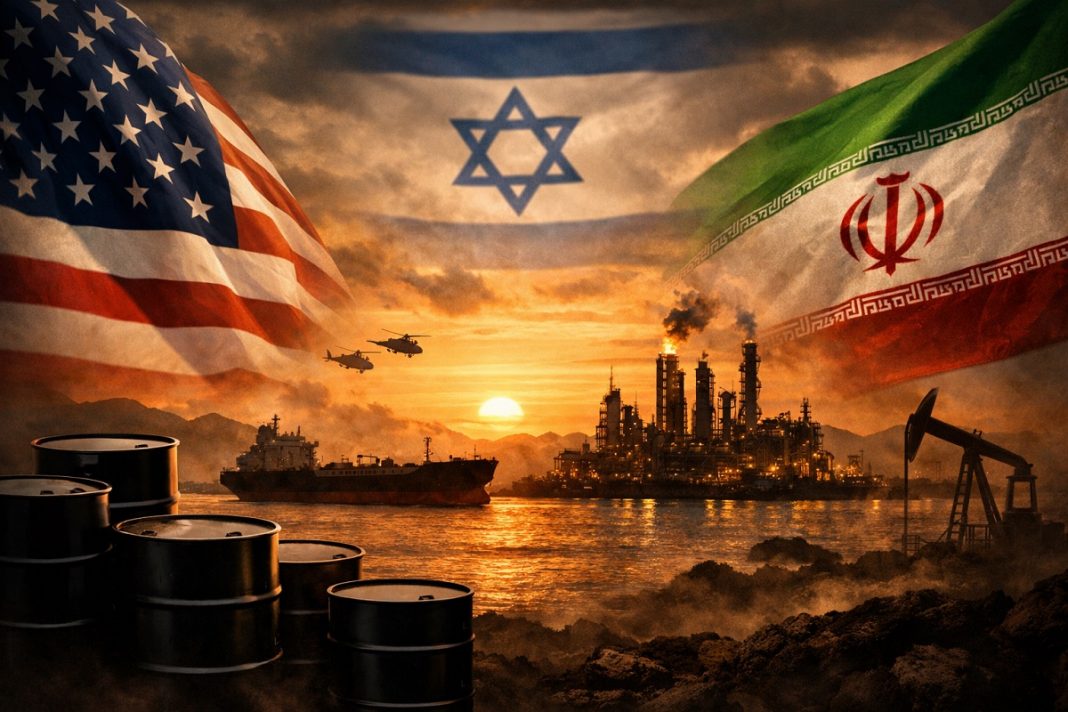
That distinction matters now, as the United States and Iran inch through another round of negotiations under the watchful eye of Israel. The price of Brent crude — hovering in the high $60s — does not signal a supply crisis. Global production is steady. Demand is growing, though moderately. OPEC+ remains disciplined. By conventional metrics, the market looks balanced.
And yet, oil is trading with a geopolitical premium.
That premium reflects not disruption, but uncertainty — the possibility that diplomacy fails, that deterrence misfires, or that a third actor recalculates the balance.
The Strait of Hormuz remains the world’s most sensitive energy chokepoint, carrying roughly a third of globally traded seaborne crude. It does not need to close to move markets. A spike in military rhetoric, a limited strike, a maritime incident — any of these could be enough to lift insurance costs, rattle futures markets and push prices upward. Oil does not wait for explosions. It anticipates them.
The renewed negotiations between Washington and Tehran offer a narrow path toward reducing that premium. The United States seeks enforceable limits on Iran’s nuclear program and broader regional posture. Iran seeks sanctions relief and economic reintegration. Both have incentives to avoid escalation: Washington remains sensitive to gasoline prices in a politically charged environment, and Tehran needs economic breathing room after years of financial constraint.
But this is not a bilateral equation.
No assessment of the talks is complete without factoring in Israel.
For Israel, the Iranian file is existential. Its experience with the 2015 nuclear agreement hardened skepticism toward diplomatic arrangements that, in its view, leave core capabilities intact. Any framework that does not sufficiently address Iran’s nuclear trajectory, missile arsenal or regional networks will be judged incomplete in Jerusalem. That judgment matters.
Because even if Washington and Tehran reach an understanding, the durability of that agreement will depend partly on whether Israel considers the arrangement stabilizing — or dangerously permissive.
Markets understand this. The risk is not merely a direct U.S.–Iran confrontation. It is the possibility of an Israeli calculation that alters the strategic environment — whether through overt military action, covert operations or intensified deterrence signaling. Such moves would not need to trigger full-scale war to unsettle oil markets. They would simply need to introduce doubt.
That doubt is what traders are pricing.
For now, the market does not appear to be pricing imminent war. Nor is it pricing durable peace. Instead, oil is trading on what might be called managed tension — a condition in which all parties test limits but avoid crossing thresholds.
If an agreement emerges, it is likely to be partial rather than transformative. It may reduce immediate escalation risks and compress the geopolitical premium embedded in crude prices. But it is unlikely to resolve the deeper structural rivalry between Iran and Israel, or the political volatility that accompanies shifts in U.S. leadership.
Investors have learned that agreements can be reversed. Policies can be recalibrated. Red lines can move.
This fragility explains the restrained behavior of prices. The world is no longer expecting a massive oil glut, nor is it bracing for sudden shortages. Instead, markets are adjusting to a landscape where the most plausible outcome is neither war nor reconciliation, but prolonged strategic ambiguity.
For major producers, this ambiguity cuts both ways. Many Middle Eastern budgets are calibrated to higher oil prices than today’s levels. A sharp drop would strain fiscal balances. A sharp spike would threaten global growth and inflation dynamics. Stability — even if imperfect — remains preferable to volatility.
And yet stability here does not mean calm. It means containment.
The most likely near-term outcome is a limited understanding that lowers the temperature without extinguishing the fire. Such an agreement could modestly ease pressure on prices, but it would not eliminate the underlying risk premium. As long as Israel remains unconvinced that Iran’s strategic capabilities are durably constrained, and as long as U.S.–Iran relations are vulnerable to domestic political shifts, oil will remain tethered to geopolitics.
In that sense, the market’s posture is rational.
It is not pricing a coming war. But neither is it pricing peace.
It is pricing managed tension — and that may prove to be the most enduring equilibrium of all.
This article was originally published in Arabic on the Asswak Al-Arab website