Gabriel G Tabarani
For a brief moment last summer, it appeared that the United States might finally have found a path toward ending Sudan’s catastrophic civil war. After more than two years of fighting that have destroyed the state and produced the world’s worst humanitarian crisis, Washington convened an unusual diplomatic grouping — Egypt, Saudi Arabia, the United Arab Emirates and the United States — to press Sudan’s warring generals toward a cease-fire. The logic was sound. These countries were not neutral mediators; they were the war’s most important external patrons. If they could align, the thinking went, Sudan’s guns might finally fall silent.
They did not.
Instead, the war has grown more brutal and more international. In October, as diplomatic talks stalled, the paramilitary Rapid Support Forces (R.S.F.) overran the Darfur city of El Fasher after an 18-month siege. At least 7,000 people were massacred. Tens of thousands vanished. Fighters filmed themselves torturing civilians, circulating the videos like trophies. Three months later, the killing continues, the humanitarian catastrophe deepens, and the conflict edges closer to a regional explosion.
What is happening in Sudan is no longer simply a civil war between rival generals. It is a test case for a new kind of conflict — one in which nation-states collapse into territories controlled by armed networks that answer less to local populations than to foreign sponsors with money, weapons and geopolitical ambitions. And unless the United States is willing to engage at the highest level, Sudan risks becoming the spark that ignites a much wider conflagration across the Horn of Africa, the Red Sea and the Sahel.
Sudan’s internal fault lines are old and familiar. Since independence in 1956, power has been monopolized by military elites centered in Khartoum, while the peripheries — Darfur, the Nuba Mountains, eastern Sudan — were neglected or violently repressed. Many Sudanese supported the 2019 revolution that overthrew Omar al-Bashir precisely because it promised an end to this pattern. But those hopes were betrayed when the generals, Abdel Fattah al-Burhan of the Sudanese Armed Forces (S.A.F.) and Mohamed Hamdan Dagalo, known as Hemedti, of the R.S.F., seized power — and later turned on each other.
What has changed is the international environment in which this familiar tragedy is unfolding. In previous Sudanese wars, the path to peace was ultimately domestic. External actors mattered, but they did not determine the conflict’s basic structure. Today, the opposite is true. Both sides are sustained by foreign backers who see Sudan not as a society in collapse, but as a strategic asset.
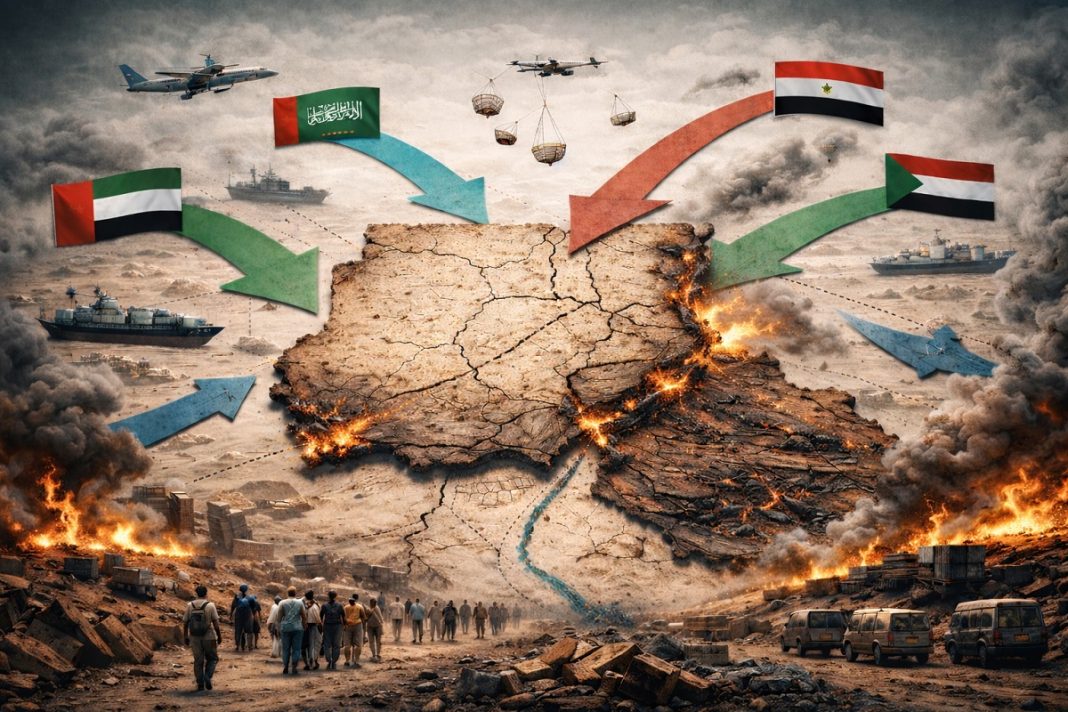
Egypt and Saudi Arabia back the S.A.F., viewing Burhan as a guarantor of stability and a bulwark against political Islam. The United Arab Emirates, despite official denials, has become the R.S.F.’s most important sponsor, supplying weapons and logistical support routed through neighboring states. Investigators have traced military cargo flights and the deployment of advanced drones and foreign mercenaries to Emirati channels. Meanwhile, Turkey and Egypt funnel arms to the S.A.F., and Russia has maneuvered between both camps while pursuing access to Sudan’s Red Sea coast.
The result is a war that sustains itself regardless of Sudanese public opinion. The country’s people overwhelmingly want the fighting to stop. Half the population now requires emergency food aid. A quarter have been displaced. Entire cities lie in ruins. Yet both armies continue to fight because their supply lines run outward, not inward. This is war without boundaries.
Nowhere is this dynamic clearer than in the role of the United Arab Emirates. Abu Dhabi’s refusal to acknowledge its involvement has made meaningful diplomacy nearly impossible. Analysts point to a decade-long patron-client relationship between Emirati leaders and Hemedti, forged during the war in Yemen, where R.S.F. fighters served as ground troops for the Saudi-Emirati coalition. Others highlight Emirati hostility toward Islamist movements allied with the S.A.F., or commercial ties to Sudan’s gold trade. But the deeper explanation lies in the intensifying rivalry between the U.A.E. and Saudi Arabia for influence across the Red Sea and Horn of Africa.
That competition is already playing out in Libya, Yemen, Syria and Somalia. In Sudan, it has become lethal.
The Trump administration deserves credit for recognizing that any solution runs through the Gulf. Secretary of State Marco Rubio revived high-level diplomacy that had languished for years. But diplomacy requires discipline as well as initiative. When negotiations faltered last fall, a private, forceful message from President Trump to Emirati leaders might have created space for compromise. Instead, public remarks after meetings in Riyadh hardened positions. Within days, El Fasher fell.
The consequences now extend far beyond Sudan. The war is entangling Chad, South Sudan, Libya and Somalia. It intersects dangerously with rising tensions between Ethiopia and Eritrea, where many of the same regional players back opposing sides. Sudan’s Red Sea coastline — once peripheral — has become a geostrategic prize, attracting China, Turkey, Russia and the Gulf states, while Israel watches closely, mindful of past weapons smuggling and current shipping threats.
This is why Sudan matters. Not only because of the immense human suffering, but because it illustrates how fragile states can be transformed into arenas for international competition, with civilian lives reduced to collateral damage.
There is no easy exit. Any peace deal will be fragile. Burhan struggles to control his own coalition. Hemedti commands a predatory force that thrives on chaos. And Sudan’s civilian democrats — the true representatives of the 2019 revolution — are currently the weakest actors at the table.
Still, the alternative to sustained diplomacy is far worse. A cease-fire will require pressure on all external sponsors, not just one. It will require coordination with the United Nations and the African Union, institutions that once helped stabilize Sudan but have since been sidelined. And it will almost certainly require the return of peacekeepers to protect civilians — an expensive, imperfect tool, but far less costly than allowing the war to burn on.
Sudan has become a prototype of a new kind of international war. Whether it also becomes a prototype for successful peacemaking will depend on whether global and regional powers are willing to subordinate rivalry to restraint. If they are not, the tragedy of Sudan will not remain Sudan’s alone.
This article was originally published in Arabic on the Asswak Al-Arab website