Gabriel G Tabarani
Revolutions rarely end with a clear announcement. More often, they fade gradually, transforming over time into systems that begin to resemble the very orders they once set out to overthrow.
Iran may now be approaching such a moment.
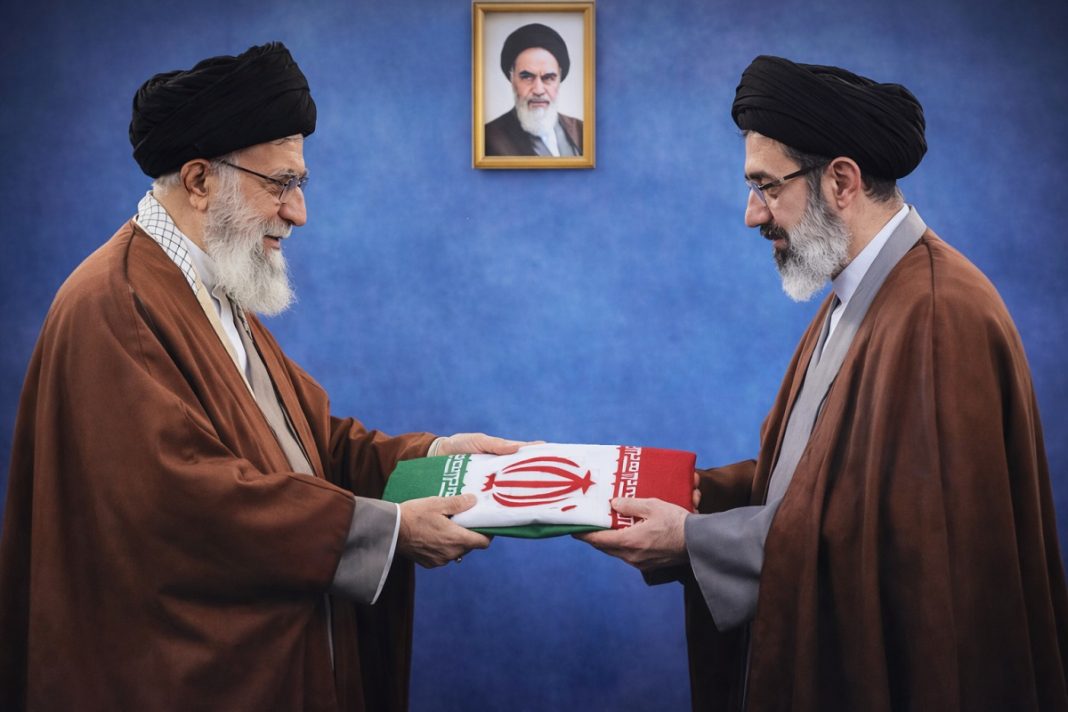
The rise of Mojtaba Khamenei to the position of Supreme Leader, succeeding his father, marks more than a change in leadership. It may represent a deeper shift in the nature of the Islamic Republic itself. For the first time since the 1979 revolution, the country appears to be witnessing the transfer of ultimate authority from father to son within a political system that was originally founded on the rejection of hereditary rule.
This paradox is striking. The Islamic Republic emerged from a revolution that sought to dismantle dynastic power and replace it with a form of governance grounded in religious legitimacy and revolutionary ideals. Yet more than four decades later, the system now finds itself navigating a moment that seems to echo the very political structure it once opposed.
But the meaning of this transition goes beyond symbolism.
Like many revolutionary regimes, the Islamic Republic now faces the challenge that inevitably comes with time: the disappearance of the founding generation. The leaders who shaped the revolution and built the institutions of the new state have largely passed from the political scene. For decades, Ayatollah Ali Khamenei represented one of the last figures with direct ties to the revolutionary era.
His successor does not carry that same historical legitimacy. And that may be precisely the point.
The Islamic Republic today is no longer a revolutionary movement seeking to reshape society or export its ideological model abroad. It has evolved into a governing system primarily concerned with preserving its stability in a turbulent regional and international environment. In such systems, institutional continuity often becomes more important than ideological purity.
From this perspective, the emergence of a successor closely linked to the existing power structure may reflect an attempt to reduce the risks associated with leadership transitions. The process of selecting a Supreme Leader has historically been opaque and politically delicate, dependent on complex negotiations within the clerical and political elite. Continuity within a familiar network of authority may offer a degree of predictability in an otherwise uncertain moment.
Yet the more profound transformation in Iran may lie not in who occupies the office of Supreme Leader, but in how power within the state has evolved.
Over the past three decades, the Islamic Revolutionary Guard Corps has gradually become one of the most influential institutions in Iran. Originally created as a revolutionary force tasked with defending the new political order, the Guards have expanded their role far beyond the military sphere. They now play a central part in Iran’s security architecture, regional strategy, and even large segments of its economy.
As their influence has grown, the balance of power inside the Islamic Republic has subtly shifted. The system increasingly rests on a combination of religious legitimacy and institutional power, with the security establishment serving as a key pillar of stability.
In this context, the emergence of a new leader closely connected to the existing security and political networks may reflect the consolidation of this evolving structure.
Iran may therefore be moving toward a hybrid political model—one that preserves the religious symbolism and ideological language of the revolution while relying more heavily on state institutions, particularly the security apparatus, to manage governance and stability.
Such transformations are not unusual in political history. Revolutionary systems often evolve over time into more pragmatic structures once the initial ideological fervor of their founding period fades. What begins as a movement driven by revolutionary mobilization gradually becomes a state concerned primarily with continuity and order.
But this transition is unfolding at a particularly sensitive moment for Iran.
The country faces a convergence of pressures: geopolitical tensions, economic challenges shaped by years of sanctions, and a society that has shown increasing signs of political and social restlessness. Periodic waves of protest in recent years have highlighted the gap between segments of Iranian society and the political system that governs it.
While external threats can sometimes strengthen internal cohesion in the short term, they do not erase underlying social and economic pressures. In fact, prolonged crises can amplify them if living conditions deteriorate or public expectations remain unmet.
This is why the leadership transition in Tehran may prove more consequential than it initially appears.
The forces that supported continuity may expect the country to remain on its existing strategic course. Yet the realities confronting Iran—regional uncertainty, economic strain, and a changing society—may eventually push the system toward gradual adaptation.
History shows that political systems often select leaders who represent stability during moments of crisis. Yet those same leaders sometimes find themselves compelled to introduce adjustments once they confront the practical demands of governance.
Whether Iran’s new leadership will follow such a path remains uncertain. What is clear, however, is that the Islamic Republic has entered a new phase in its evolution.
The revolutionary generation that shaped the state is gone. The regional and international environment that defined its early decades has changed dramatically. And the country now faces the challenge of navigating a future in which ideological legacy and political reality may not always move in the same direction.
Seen in this light, the current moment in Tehran may mark more than a simple transfer of power.
It may represent the beginning of a broader transition—from a system defined primarily by revolutionary identity to one increasingly shaped by the imperatives of state survival in a far more complex world.
And in the life of any political order, such moments of transformation are often the ones that define its future most profoundly.
This article was originally published in Arabic on the Asswak Al-Arab website