Gabriel G Tabarani
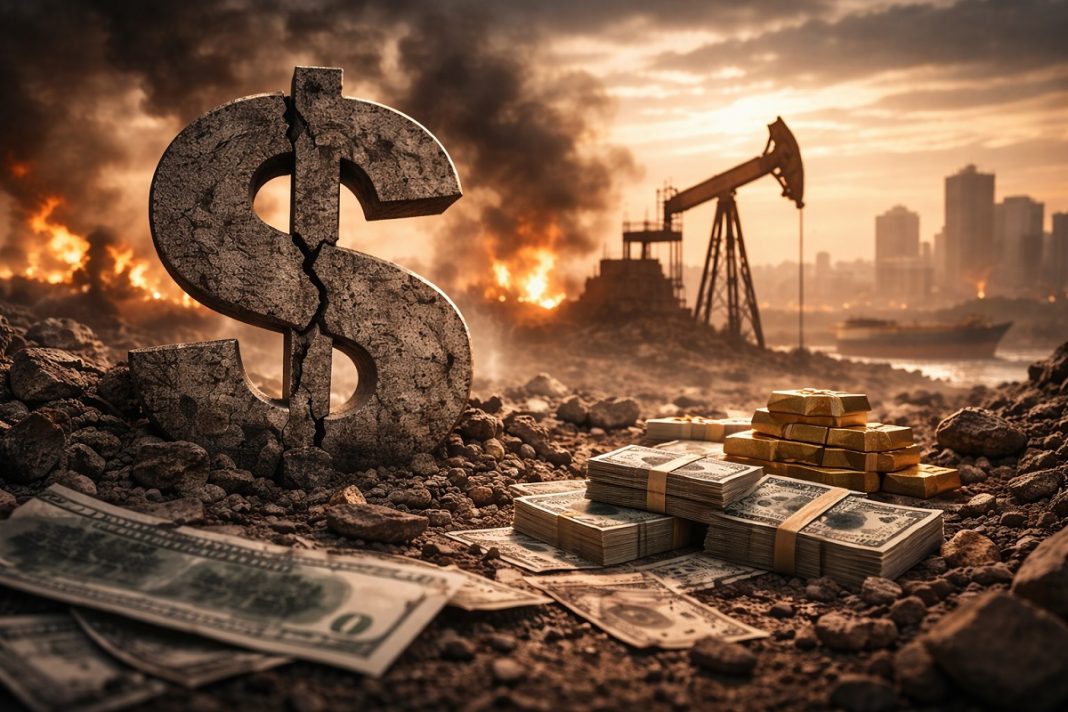
The war in the Middle East is no longer confined to its security and political dimensions; it now reaches into the very core of the global financial system. The US dollar stands before a complex test, one whose consequences may not be immediate but carry profound long-term implications. A recent report by Deutsche Bank underscores that this conflict does not merely threaten regional stability, but also touches one of the key pillars of American economic dominance: the petrodollar system that has underpinned the dollar’s status as the world’s primary reserve currency for decades.
This system, which emerged in the 1970s through the pricing of oil in dollars, was never just a financial arrangement. It evolved into an integrated framework linking security, energy, and finance. The United States provided a security umbrella to ensure the steady flow of oil from the Gulf, in exchange for pricing it in dollars and recycling revenues into US financial markets. This arrangement created a structural and sustained global demand for the dollar, reinforcing its dominance in trade and reserves.
What the current war reveals, however, is that this equation is no longer as resilient as it once seemed. Attacks on energy infrastructure and threats to critical maritime routes such as the Strait of Hormuz have exposed the limits of US capacity to guarantee supply security in an increasingly complex regional environment. As confidence in this security framework erodes, questions naturally arise about the continued logic of relying almost exclusively on the dollar—particularly among major energy-importing nations seeking greater stability in supply chains.
More importantly, the war did not occur in isolation. It is unfolding within a broader context of structural shifts that were already underway. The reorientation of global oil trade, with Asia—led by China—becoming the primary destination for Gulf exports, has reshaped economic power balances. In this evolving landscape, a new logic is emerging: why should oil continue to be priced in dollars when its largest consumers are no longer in the United States? This question, once theoretical, is now increasingly central to global economic and political discourse.
Within this context, the war cannot be separated from a series of developments pointing to a gradual erosion of dollar dominance. Russia, following Western sanctions, has expanded the use of local currencies in its trade. China has pushed for partial pricing of its oil imports in yuan. Meanwhile, several countries in the Global South have begun exploring alternatives to dollar-dominated payment systems. These trends do not signal the imminent collapse of the dollar, but they do reflect a growing willingness to reduce dependence on it—a willingness reinforced by recurring geopolitical crises.
Despite these signals, the dollar retains significant strengths that are difficult to challenge in the near term. It is not merely a currency used to price oil; it is the backbone of the global financial system, supported by the depth of US financial markets, investor confidence, and the absence of a fully viable alternative. The euro struggles with internal fragmentation, the yuan remains constrained by political and financial controls, and other currencies lack the scale to function as global substitutes.
This reality makes a rapid collapse of the dollar unlikely, but it does not preclude a gradual decline in its dominance. Economic history shows that global currencies rarely fall abruptly; instead, they erode over time as shifts in economic power take hold. What we may be witnessing today is not a replacement of the dollar by a single alternative, but a slow transition toward a more multipolar monetary system in which several currencies share influence.
The Gulf war adds a critical dimension to this trajectory by striking at the very nexus between security and energy upon which the petrodollar was built. If the United States is no longer able to guarantee the uninterrupted flow of oil with the same effectiveness, the incentive to rely on the dollar diminishes—even if it does not disappear entirely. In this light, any move toward pricing oil in alternative currencies, even partially, becomes a meaningful indicator of shifting global dynamics.
Yet the most significant challenge may lie beyond currency itself, in the broader transformation of the global energy landscape. The world is accelerating its transition toward alternative energy sources, driven by environmental, economic, and security considerations. If this trend continues, global demand for oil—and by extension, for the dollar linked to it—may decline structurally. This represents a deeper and more enduring threat than any change in pricing mechanisms alone.
Taken together, these developments suggest that the world is entering a transitional phase in which the model of unipolar dominance that prevailed after World War II is no longer sustainable. The rise of China, growing energy self-sufficiency among nations, and repeated geopolitical shocks are pushing toward a more complex and multipolar system.
Gulf countries, long the cornerstone of the petrodollar system, now find themselves at the center of this transformation. While they remain closely tied to the dollar through reserves and investments, they are simultaneously expanding relationships with other economic powers and seeking to diversify their partnerships. This dual approach reflects the nature of the current moment: not a rupture with the old system, but no longer an unquestioned commitment to it.
The current war may accelerate these trends, but it will not determine their outcome. Structural changes in the global financial system unfold over long periods and require the emergence of institutional alternatives, which are not yet fully developed. Nevertheless, the accumulation of pressures—from geopolitical conflicts to shifts in energy—could ultimately lead to a gradual reshaping of the existing order.
In the end, the dollar does not appear to be on the verge of collapse, but it is no longer untouchable. What the Gulf war reveals is that the foundations of the global financial system are not as solid as they once were, and that the world is moving into a new phase where security and economics intersect in redefining power. In that world, the dollar may remain a central player—but it will no longer be the only one.
This article was originally published in Arabic on the Asswak Al-Arab website