Gabriel G Tabarani
The rivalry between the United States and China is usually framed through aircraft carriers, advanced chips, and trade wars. Military deployments and technology controls dominate headlines, reinforcing the idea that global leadership is decided by firepower and industrial capacity. Yet this focus obscures a deeper and more consequential force—one that operates quietly but relentlessly over time: demography.
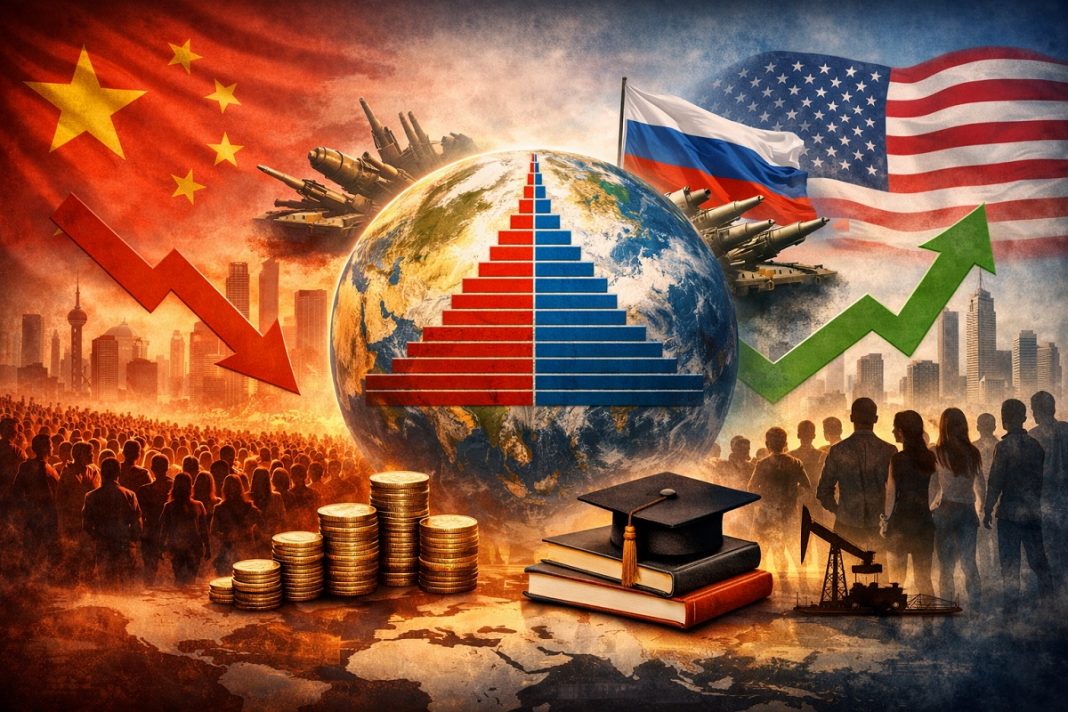
Recent data have made this reality harder to ignore. China’s birthrate has fallen to its lowest level since the founding of the People’s Republic in 1949, confirming that population decline is no longer a future concern but a present fact. At the same time, population growth in the United States has slowed to one of the weakest rates in its modern history, driven by falling fertility and a sharp drop in immigration. These parallel trends are not merely domestic challenges. They are reshaping the long-term balance of global power.
In the modern economy, strength is no longer defined primarily by land, raw materials, or sheer industrial output. It is defined by people—their health, education, productivity, and capacity to innovate. Since World War II, the overwhelming share of global economic growth has come from investments in human capital. Countries with large, skilled, and adaptable populations gain advantages that compound over decades. Those with shrinking or aging populations face constraints that no short-term policy can easily overcome.
China’s rise over the past forty years illustrates this dynamic. Market reforms mattered, but so did a massive demographic dividend. From the late 1970s through the early 2010s, China benefited from a rapidly expanding working-age population that was healthier, better educated, and increasingly urban. This surge powered manufacturing, exports, infrastructure development, and state capacity, helping propel China into the ranks of great powers.
That dividend has now turned into a drag. China’s fertility rate has fallen to roughly one child per woman, far below replacement level. According to United Nations projections, the country’s population will soon begin to shrink, while its working-age population is expected to decline by more than 100 million by 2040. At the same time, the number of people over 65 will rise sharply, placing heavy strain on public finances and slowing economic growth. With fewer young workers and rising social costs, sustaining innovation and productivity will become increasingly difficult.
Unlike many advanced economies, China has little ability to offset these trends through immigration. Cultural, political, and institutional barriers make large-scale immigration highly unlikely. As a result, demographic headwinds will remain a structural feature of China’s future, limiting its long-term capacity to translate economic weight into sustained global leadership.
Russia’s situation is even more severe. Its population is shrinking, life expectancy remains well below that of advanced economies, and the country suffers from persistent brain drain and weak knowledge production. While Moscow has shown an ability to project geopolitical influence beyond what its economy would suggest, this strategy is costly and difficult to sustain. The Russian case illustrates how military ambition can collide with demographic limits, making long-term power projection increasingly fragile.
The United States, by contrast, still occupies a comparatively favorable demographic position—but one that is steadily eroding. Fertility has fallen to about 1.6 children per woman, immigration has slowed dramatically, and gains in life expectancy and educational attainment have stalled. Yet the United States remains the only advanced economy likely to see continued growth in its working-age population into the 2040s. It also retains the world’s largest concentration of highly educated workers, leads in research and innovation, and commands a dominant share of global intellectual property.
The greater risk for the United States is not being overtaken by a rival, but undermining itself. Persistent underinvestment in education, public health, and workforce participation—combined with political polarization around immigration—could gradually weaken America’s capacity for leadership. A society that struggles to sustain its human capital may also lose its willingness to bear the economic and political costs of maintaining an international order.
Beyond the U.S.–China rivalry, demographic trends are also elevating new actors. Countries such as India, Indonesia, and the Philippines possess young and growing populations that will translate into economic and strategic weight over the coming decades. By 2040, India’s working-age population could exceed China’s by more than 200 million people, reshaping both regional and global alignments.
Demography does not determine destiny, but it sets the boundaries of what is possible. Power in the twenty-first century will not be decided only in naval theaters or technology labs, but in classrooms, hospitals, and labor markets. Countries that recognize population as a strategic asset—and invest accordingly—will be best positioned to shape the global order. Those that ignore it may find that influence fades long before ambition does.
This article was originally published in Arabic on the Asswak Al-Arab website