Gabriel G Tabarani
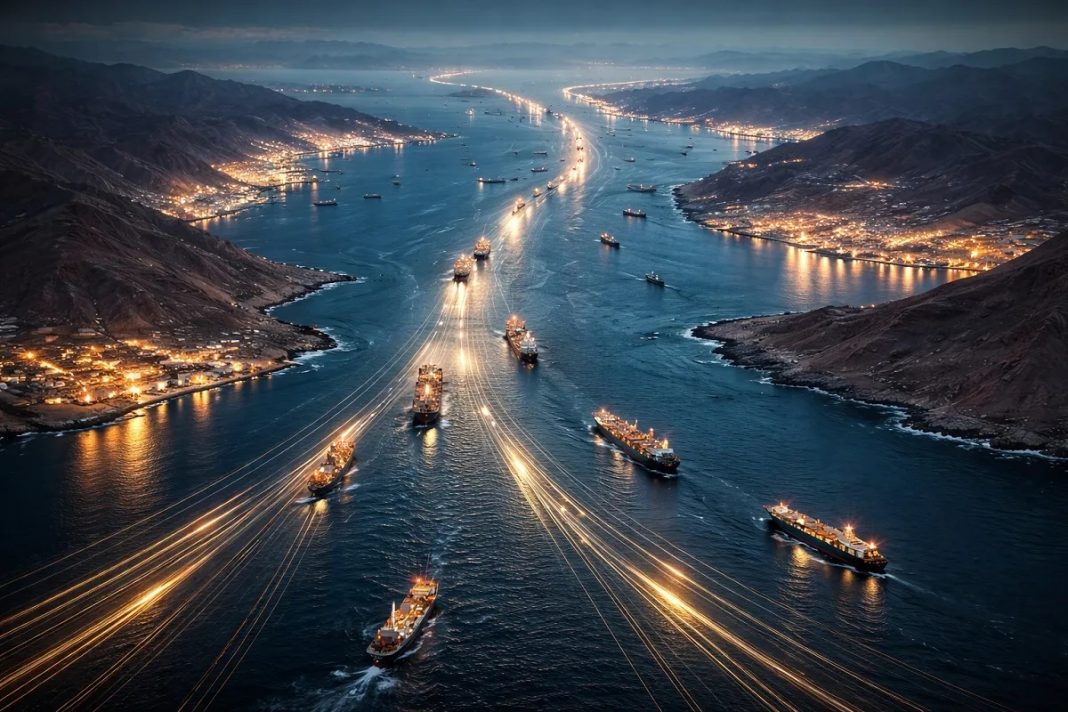
The Red Sea has reemerged as one of the most consequential fault lines in today’s Middle East. No longer a distant maritime corridor connecting Suez to the Indian Ocean, it has become a strategic arena where regional rivalries, fragile states, and global trade intersect in combustible ways. What once functioned as a buffer between Africa and the Arabian Peninsula is now the transmission belt of their crises.
The surge in Houthi attacks on commercial shipping since late 2023 has underscored a central reality: instability at sea begins on land. Missiles launched from Yemen’s western coast are not isolated naval disruptions; they are extensions of a prolonged civil war intertwined with broader regional confrontation. The same logic applies along the Horn of Africa, where the reappearance of Somali piracy reflects governance failures, economic marginalization, and the diversion of international naval attention elsewhere. Maritime insecurity in the Red Sea is a symptom of unresolved terrestrial conflict, not merely a lapse in naval patrols.
The economic reverberations have been swift and global. Traffic through the Suez Canal has declined sharply, freight costs have multiplied, and rerouting vessels around the Cape of Good Hope has added weeks to shipping times. Energy prices and food supply chains have felt the strain. Egypt’s canal revenues have suffered, while European and Asian markets face higher transportation costs. A missile launched near Hodeidah can inflate grocery bills in Berlin or disrupt wheat deliveries to East Africa. The Red Sea has become a pressure point in the global economy.
Unlike the Cold War era, today’s contest in the Red Sea is not defined by superpower dominance. It is shaped by assertive regional middle powers projecting influence across both shores. Gulf states have invested heavily in ports, logistics corridors, and strategic infrastructure from Sudan to Somaliland. Türkiye has entrenched itself in Somalia through military cooperation, infrastructure projects, and political backing. Egypt views developments through the lens of Nile water security and Suez Canal stability. Israel’s evolving security calculus, particularly amid Houthi threats and shifting regional alignments, has expanded its interest in maritime defense along this corridor.
These engagements are not purely economic. Ports are instruments of statecraft. Infrastructure projects carry geopolitical weight. Military bases and training missions signal long-term strategic commitments. The Red Sea’s coastline has become dotted with foreign facilities, commercial concessions, and security partnerships that blur the line between investment and influence.
At the same time, local actors in the Horn of Africa are far from passive. Governments and elites in Ethiopia, Somalia, Sudan, Eritrea, and Djibouti have learned to navigate — and sometimes exploit — the ambitions of external powers. Competition among Gulf states and other regional actors offers opportunities to extract financial support, diplomatic backing, or military assistance. Yet this dynamic also deepens fragmentation. Domestic political rivalries are increasingly amplified by external alignments, turning internal disputes into proxy contests.
Sudan’s devastating war illustrates how quickly regional rivalries can entrench and prolong internal conflict. Yemen demonstrates how maritime chokepoints can be weaponized. Ethiopia’s search for sea access has intensified tensions with Somalia and Eritrea, adding another volatile layer to the Red Sea equation. What emerges is not a coherent security architecture but a crowded strategic landscape marked by overlapping ambitions and fragile institutions.
The risks are compounded by structural vulnerabilities. The Horn of Africa continues to grapple with some of the world’s lowest human development indicators, weak governance, and recurring armed conflicts. The collapse of state authority in parts of Yemen and Sudan feeds directly into maritime insecurity. Illegal fishing, arms trafficking, smuggling networks, and human trafficking flourish where oversight is thin. War economies bleed into coastal zones, and coastal instability reverberates inland. The sea and the land are locked in a mutually reinforcing cycle of fragility.
Meanwhile, global powers remain present but increasingly reactive. The United States focuses primarily on freedom of navigation and counterterrorism, wary of deeper entanglement. China’s economic footprint has expanded through infrastructure investments and a military base in Djibouti, reflecting a broader strategy of securing trade routes. Yet neither Washington nor Beijing appears willing — or able — to impose a comprehensive order. The result is a multipolar contest without a stabilizing center of gravity.
The Red Sea is gradually crystallizing into competing alignments. Some actors prioritize port access, maritime control, and strategic logistics networks. Others emphasize sovereignty and territorial integrity, wary of arrangements that might redraw borders or empower secessionist entities. These divisions are not formal alliances but fluid configurations shaped by evolving crises. As tensions in Gaza, Yemen, and the wider region persist, the maritime theater remains highly susceptible to escalation.
Yet the region’s story is not solely one of confrontation. The Red Sea also embodies profound interdependence. Trade routes link African producers to Gulf markets. Energy flows sustain global economies. Shared ecological challenges, from water scarcity to climate change, demand cross-shore cooperation. Migration patterns and cultural ties have connected these societies for centuries. The very geography that makes the Red Sea a strategic chokepoint also makes it a potential platform for collaborative security and development.
Transforming the corridor from a zone of rivalry into one of cooperation would require a shift in mindset. Maritime security cannot be detached from governance reform on land. Investment strategies must prioritize sustainable development rather than narrow geopolitical gain. Regional frameworks would need to become inclusive rather than exclusionary, recognizing that stability on one shore depends on stability on the other.
For now, however, the trajectory remains uncertain. The convergence of war in Gaza, unresolved conflict in Yemen, civil war in Sudan, and tensions in the Horn of Africa places extraordinary strain on this narrow stretch of water. The Red Sea is no longer a peripheral theater; it is a central artery of Middle Eastern and global stability.
In such a crowded and volatile environment, the margin for miscalculation is thin. A single strike on a vessel, a contested port agreement, or an escalation between regional rivals could widen into a broader confrontation. The Red Sea has become both mirror and magnifier of the Middle East’s shifting order. Whether it evolves into a battlefield of permanent rivalry or a corridor of pragmatic coexistence will depend less on distant superpowers and more on the choices made by the region’s own actors.
This article was originally published in Arabic on the Asswak Al-Arab website