Gabriel G Tabarani
It seems that the Arab world has entered a new and unmistakable phase of narrative tightening—one shaped by sweeping cybercrime laws, expanding digital surveillance, and the gradual extinguishing of spaces once claimed by independent journalism. This is happening just as the rest of the world confronts its own anxieties about misinformation, democratic backsliding, and the fragility of the press even in places where it was once considered secure. In our region, where freedom of expression has always been precarious, these global and local pressures converge with unusual force. They raise a pressing question: what can journalism still achieve when the ground beneath it is shifting so quickly, and who will defend it if this moment passes without serious reflection?
The struggle for press freedom in the Arab world is not a story of dramatic breakthroughs. It is a quieter, more grinding narrative—one defined by small acts of resistance, calculated caution, and a steady erosion of faith in the idea that truth alone can keep power in check. Despite the bravery of countless reporters, the region’s media landscape is marked by deep contradictions: citizens who believe their freedoms are guaranteed, institutions that insist they are protected, and systems of control that work relentlessly to ensure they do not expand.
Surveys show that majorities in countries such as Kuwait, Jordan, Lebanon, and Tunisia believe freedom of the press exists to a “great or medium extent.” Yet this sense of freedom often reflects disengagement more than reality. Many citizens rarely test the limits of expression, and those who do quickly discover how conditional it is. The distance between what people believe and what journalists experience has widened into a striking gap—an illusion of openness masking an architecture of control.
For journalists, these limits shape daily life. They are embedded in laws that criminalize broad categories of speech, in licensing systems that keep independent media on a short leash, and in economic conditions that make dissent a privilege few can afford. In Jordan, for example, nearly all journalists acknowledge practicing self-censorship—less out of ideological alignment than out of economic necessity. The risk of losing a job, facing a lawsuit, or being detained over a social media post is enough to silence many voices before a story is even written.
Media ownership reinforces this dynamic. State broadcasters still dominate, and many privately owned outlets are linked—directly or indirectly—to political or commercial interests that discourage confrontation with power. The idea of “public service media,” central to many democratic systems, rarely exists in practice in the region. Independent nonprofit outlets do operate, but they remain vulnerable to sudden closures, arbitrary licensing decisions, and financial strain.
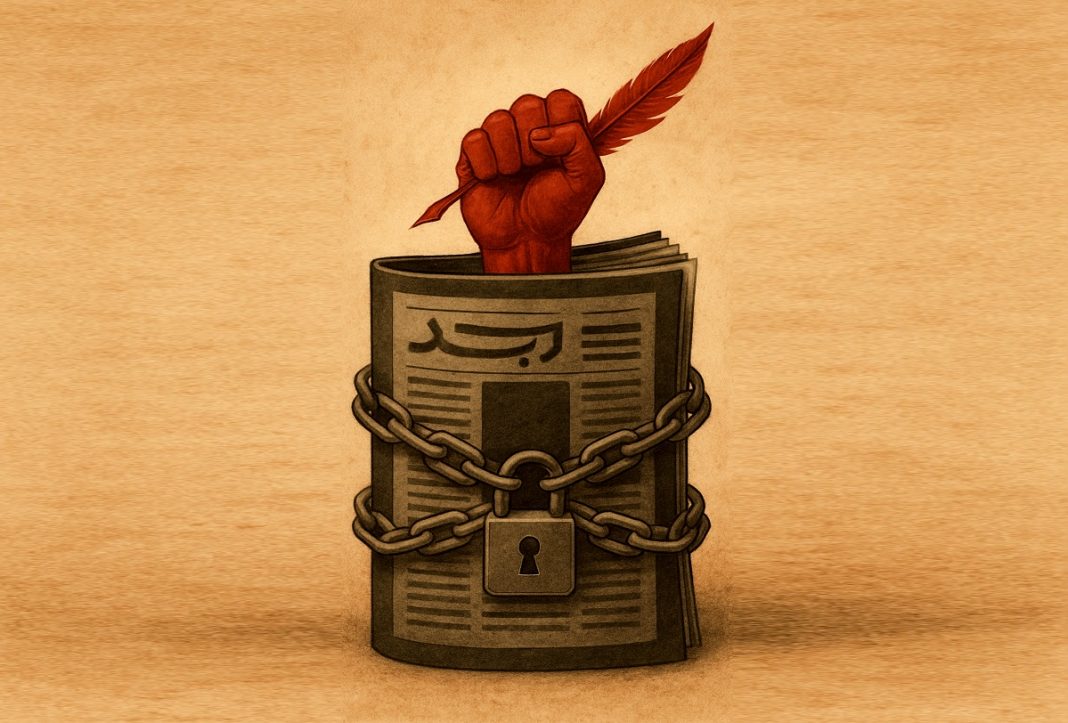
The legal environment offers little refuge. Cybercrime laws, increasingly common throughout the Middle East, have become some of the most effective tools for stifling critical reporting. An article that passes without notice in print can trigger detention once it appears online. The broad wording of these laws means that almost any expression—whether a post, a comment, or a headline—can be construed as defamation, incitement, or a threat to public order. With the judiciary often aligned with executive authority, journalists have scant protection when targeted.
The pattern is familiar across borders. Since the collapse of the Arab Spring’s early promise, governments have reasserted their grip on information. Egypt has jailed scores of journalists. The Gulf states deploy advanced surveillance technologies to monitor and shape online discourse. In Libya, Syria, and Yemen, the threat of violence has made reporting nearly impossible. The region as a whole remains one of the most dangerous and restrictive environments for journalists anywhere in the world.
Yet repression alone does not explain the stagnation. After years of conflict and economic hardship, many citizens have become wary of political engagement. For some, stability—even an authoritarian version of it—seems preferable to the turbulence that public dissent can unleash. This exhaustion weakens the constituency for press freedom and leaves journalists increasingly isolated. The silence of the public can be as damaging as the pressure of the state.
Global experience underscores the limits of journalism under such conditions. Reporting, no matter how determined, cannot by itself stop authoritarian drift. In countries such as South Korea and Brazil, the press helped expose corruption and executive overreach, but change only occurred because courts, legislatures, and civil society acted on those revelations. Where these institutions are weak or co-opted, journalism becomes a lone voice, shouting without echo. The Arab world contains many cases that resemble the latter more than the former.
Even so, the region is not without resilience. A new generation of independent digital platforms—some donor-funded, others driven by small teams with remarkable tenacity—continues to produce strong investigative work. Their journalists often pay a price, but international scrutiny has at times provided a narrow buffer. The rise of social media, especially among the region’s overwhelmingly young population, has opened channels for expression that are harder to police completely. Authoritarian governments are discovering that controlling digital discourse is more difficult than controlling traditional media.
Still, the path ahead is uncertain. Technology may empower journalists, but it also arms governments with more sophisticated tools. International pressure may create pockets of protection, but it rarely reshapes the system. Without deeper institutional reform—independent courts, genuine checks on executive power, and an active civil society—journalism cannot fulfill its role as a guardian of public life.
And yet journalists continue. They continue because they believe the public deserves better than silence, and because the act of reporting itself remains one of the few defenses against unchecked power. Their persistence is inspiring, but it should not be mistaken for sustainability. Courage alone is not a media system. It can illuminate the darkness, but it cannot dismantle it.
For that, entire societies must decide that silence is no longer acceptable. Only then can journalism in the Arab world evolve from a profession of risk into an institution capable of accountability and meaningful change.
This article was originally published in Arabic on the Asswak Al-Arab website