Gabriel G Tabarani
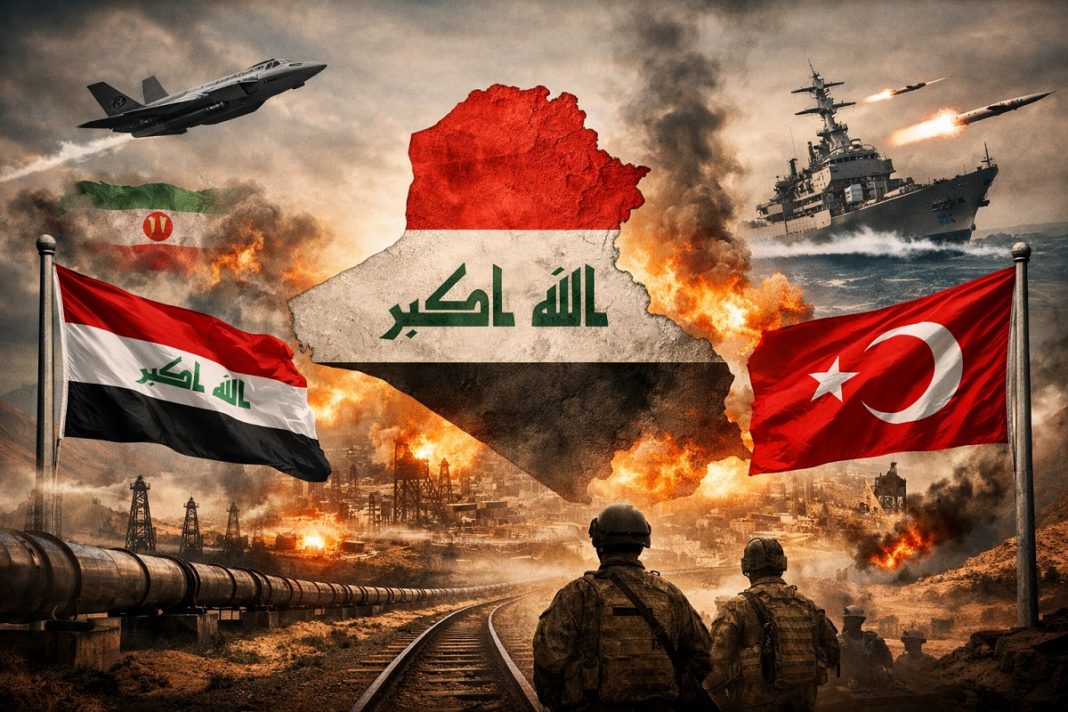
On Saturday morning (28 February 2026), the Middle East crossed another threshold. A coordinated U.S.–Israeli naval and air assault on targets inside Iran marked a dramatic escalation in a conflict that had long been simmering at the edges. What had been a shadow confrontation has now edged closer to open war.
But while attention is fixed on Tehran, Washington and Tel Aviv, another theater may prove just as consequential: Iraq.
If the confrontation widens, Iraq is unlikely to remain peripheral. It sits at the intersection of American military presence, Iranian influence networks, fragile state institutions and rising regional ambitions. And for Turkey, Iraq is not merely a neighbor caught in the crossfire. It is the central pillar of Ankara’s emerging regional strategy.
Over the past several years, Turkey has been methodically deepening its engagement with Iraq — economically, militarily and institutionally. What once revolved primarily around cross-border security operations against the Kurdistan Workers’ Party (PKK) has evolved into a broader effort to embed Turkey within Iraq’s economic and strategic architecture.
The logic is straightforward. Security vulnerabilities cannot be managed indefinitely through periodic military incursions. They require structured cooperation. At the same time, economic interdependence can transform contested geography into shared infrastructure.
Ankara’s most ambitious expression of this vision is the Development Road Project — a proposed corridor linking Iraq’s Al Faw Grand Port in the south to Turkey’s border and onward to Europe through railways and highways. For Iraq, the project promises diversification beyond oil and a new logistical identity. For Turkey, it secures a strategic transit role between the Gulf and European markets, particularly as competing connectivity initiatives reshape the region.
Under normal conditions, such projects unfold slowly, negotiated through budgets and bureaucracies. In wartime conditions, they become geopolitical assets — or liabilities.
The escalation between the United States, Israel and Iran raises immediate questions about Iraq’s stability. Iran-backed militias operate across Iraqi territory. American forces remain present. Iraqi political factions are deeply divided. If Tehran responds asymmetrically, Iraq could become an arena for retaliatory pressure, whether through proxy activity or political paralysis.
That would place Turkey’s long-term bet under strain.
Energy cooperation provides another example of Ankara’s calculated engagement. The Kirkuk–Ceyhan pipeline, long a source of tension between Baghdad and the Kurdistan Regional Government, has reemerged as a focal point of trilateral coordination. Meanwhile, a recently negotiated oil-for-water arrangement channels revenues from Iraqi oil exports via Turkey into water infrastructure projects inside Iraq — a reminder that climate vulnerability and resource scarcity are increasingly inseparable from regional security.
These arrangements reflect a broader Turkish strategy: institutionalize interdependence before instability can unravel it.
Yet war compresses timelines. Political fragmentation in Baghdad could intensify. Infrastructure corridors that promise integration could instead become strategic choke points. Foreign alignments may harden under pressure, reducing the space for the kind of calibrated diplomacy Turkey has been attempting.
Complicating matters further is the deep entanglement between Turkey’s domestic Kurdish policy and developments in Iraq and Syria. Ankara’s efforts to reset its internal Kurdish question are closely linked to security dynamics across its southern border. Any escalation in Iraq would reverberate directly inside Turkey’s political system.
This is why Iraq now represents more than a diplomatic priority for Ankara. It is a stress test.
Turkey’s regional posture in recent years has rested on four pillars: improved coordination with Washington, normalization with Arab states, recalibration of the Kurdish issue and institutionalized economic partnerships. Iraq is the one arena where all four converge. It is where American–Iranian rivalry is most visible. It is where economic corridors are being negotiated. It is where security cooperation must translate into durable structures.
The U.S.–Israeli strike on Iran does not automatically derail Turkey’s strategy. But it heightens its vulnerability.
If Iraq can remain insulated from full-scale spillover, Ankara’s model — combining security coordination with economic integration — may gain credibility. If, however, Iraq becomes a battlefield for regional retaliation, the Development Road could stall, energy cooperation could fracture and Turkey’s carefully built partnerships could be overtaken by hard power dynamics.
In moments of regional upheaval, geography matters more than rhetoric. Iraq’s location — between Iran and the Arab world, between American bases and Turkish borders — makes it unavoidable.
As war expands, the question is no longer whether Turkey has a strategy in Iraq. It is whether Iraq can withstand the shockwaves long enough for that strategy to survive.
This article was originally published in Arabic on the Asswak Al-Arab website