Gabriel G Tabarani
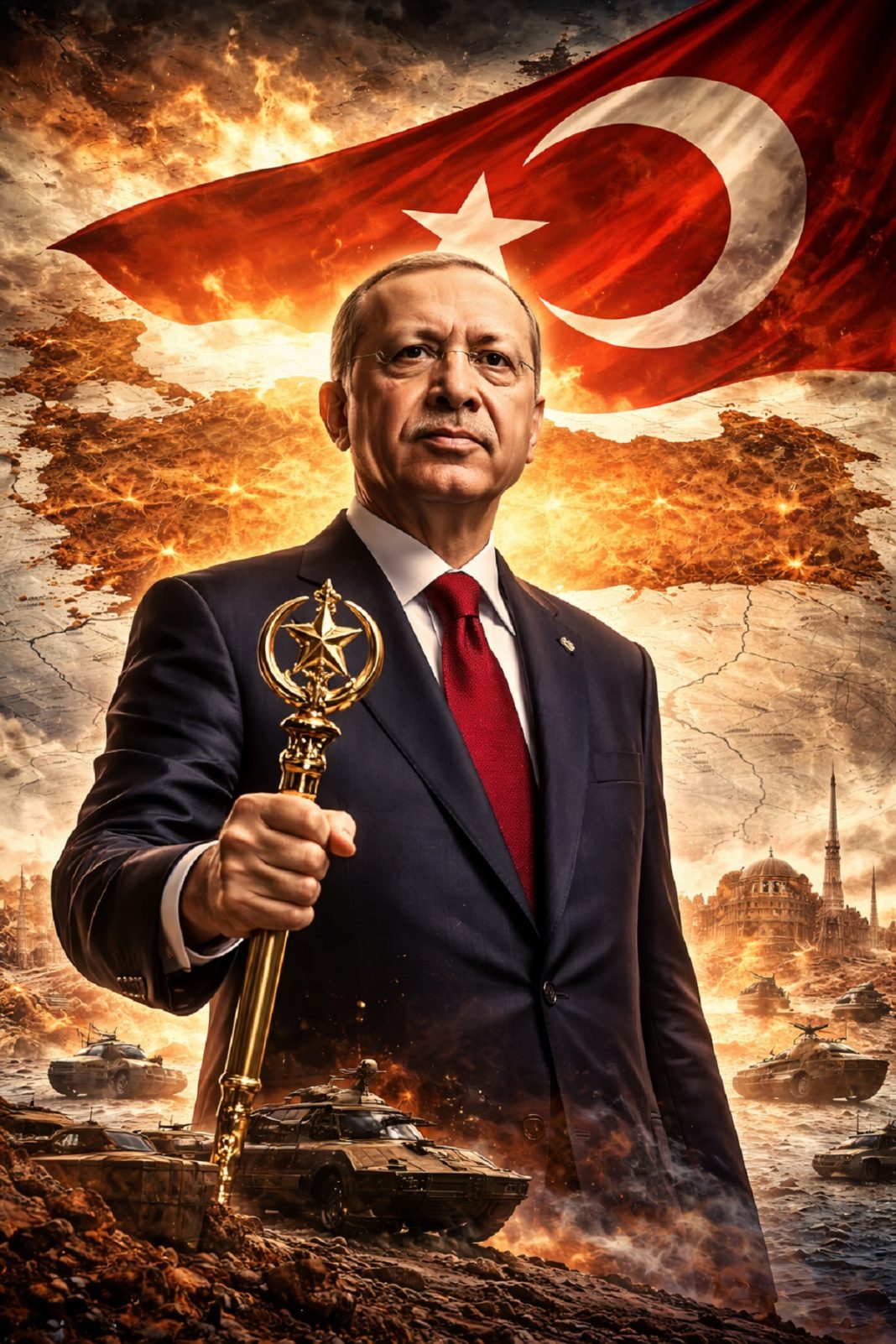
Recep Tayyip Erdogan has always governed as if history were personal. Power, in his worldview, is not merely exercised; it is embodied. For more than two decades, Erdogan has fused his political survival with a narrative of national destiny, presenting himself not simply as Turkey’s leader but as the custodian of a civilizational revival. Today, that ambition has reached its most explicit form: the attempt to position himself as the architect of a new regional order centered on Ankara and led by his own authority.
What distinguishes the current phase from earlier chapters of Erdogan’s rule is not greater confidence but greater exposure. In the past, Erdogan thrived on improvisation—creating crises, escalating tensions, then pivoting abruptly when circumstances demanded. This method allowed him to extract concessions, dominate domestic narratives, and remain indispensable to multiple sides at once. Ambiguity was his shield.
That shield is thinning.
Over the last two years, Erdogan has shifted from tactical disruption to strategic assertion. He no longer merely seeks relevance; he seeks leadership. His rhetoric has grown overtly imperial in tone, invoking historical destiny, multiethnic order, and a civilizational mission that extends well beyond modern Turkey’s borders. The fall of the Assad regime appeared to offer confirmation that history was finally bending in his direction. For Erdogan, Syria became proof that patience, coercion, and persistence could remake the region.
Yet ambition alters the rules of the game. Improvisation works when expectations are low and commitments reversible. Leadership does not.
Erdogan’s vision today resembles a personalized grand strategy: a Turkish-anchored order stretching from the Caucasus to the Levant, governed not by liberal norms but by strong states, transactional deals, and illiberal solidarity. It is a vision shaped as much by Erdogan’s resentments as by his aspirations—resentment of Western dominance, of institutional constraints, and of the post–Cold War order that never fully accepted him as an equal.
But this project rests on Erdogan himself more than on durable structures. That is its central vulnerability.
Domestically, Erdogan governs through hyper-centralization. Decision-making is concentrated in the presidency, institutions are subordinated to loyalty, and dissent is criminalized rather than absorbed. This model has ensured personal control, but it has hollowed out the state’s capacity for sustained policy execution. For a leader pursuing regional dominance, this creates a paradox: the more power Erdogan accumulates personally, the less capable the system becomes of supporting his ambitions.
Economically, the contradiction is sharper still. Erdogan speaks the language of empire while presiding over an economy constrained by inflation, capital flight, and eroded investor confidence. Grand visions require deep pockets and long time horizons. Erdogan has neither. As a result, his regional initiatives increasingly depend on external financiers—particularly Gulf states—whose priorities do not align fully with his own. Influence purchased on credit is influence easily diluted.
Erdogan’s revived outreach to Kurdish actors illustrates both his adaptability and his limits. After years of uncompromising nationalism, he now frames Turkish-Kurdish-Arab cooperation as the foundation of regional stability. This rhetorical shift is striking—but it is also instrumental. It serves domestic electoral needs, regional optics, and historical symbolism all at once. Whether it can survive renewed tensions or political setbacks remains uncertain. For Erdogan, inclusion is tactical, not systemic.
Externally, Erdogan faces a strategic environment far less forgiving than the one he navigated a decade ago. Israel’s rise as a dominant military actor in the region represents a fundamental obstacle to Erdogan’s aspirations. Unlike earlier rivals, Israel does not merely contest narratives; it imposes facts on the ground. In Syria, Erdogan’s desire for a strong, centralized state aligned with Ankara collides directly with Israel’s preference for fragmentation and buffer zones. This is not a disagreement that can be managed through rhetoric or mediation. It is a structural clash.
At the same time, Erdogan’s relationship with the United States has entered a new but unstable phase. Transactional engagement offers him visibility and short-term leverage, but not strategic security. American endorsement fluctuates with personalities and elections. It cannot substitute for the institutional trust Erdogan has systematically eroded over the years. Nor can it neutralize congressional skepticism or allied hedging.
This leaves Erdogan in an increasingly familiar position: outwardly assertive, inwardly constrained. His political instincts tell him to double down—to escalate rhetoric, dramatize threats, and frame resistance as proof of destiny denied. Yet every escalation raises the cost of retreat. The more Erdogan defines himself as the indispensable leader of a regional project, the harder it becomes to recalibrate when reality intrudes.
The deeper risk is personal as much as political. Erdogan has spent years collapsing the distinction between himself and the state, between his ambitions and Turkey’s fate. If the regional order he promises fails to materialize, the disappointment will not be abstract. It will attach to him. A leader who governs through historical grandeur leaves little room for managed decline.
Erdogan is not about to disappear from the regional stage. His instincts for survival remain formidable, and his ability to adapt should not be underestimated. But the era in which improvisation could masquerade as strategy is ending. What confronts Erdogan now is not merely opposition abroad or discontent at home, but the limits of personalization itself.
History may matter deeply to Erdogan—but history is rarely kind to leaders who mistake ambition for capacity, or symbolism for power.
This article was originally published in Arabic on the Asswak Al-Arab website