Gabriel G Tabarani
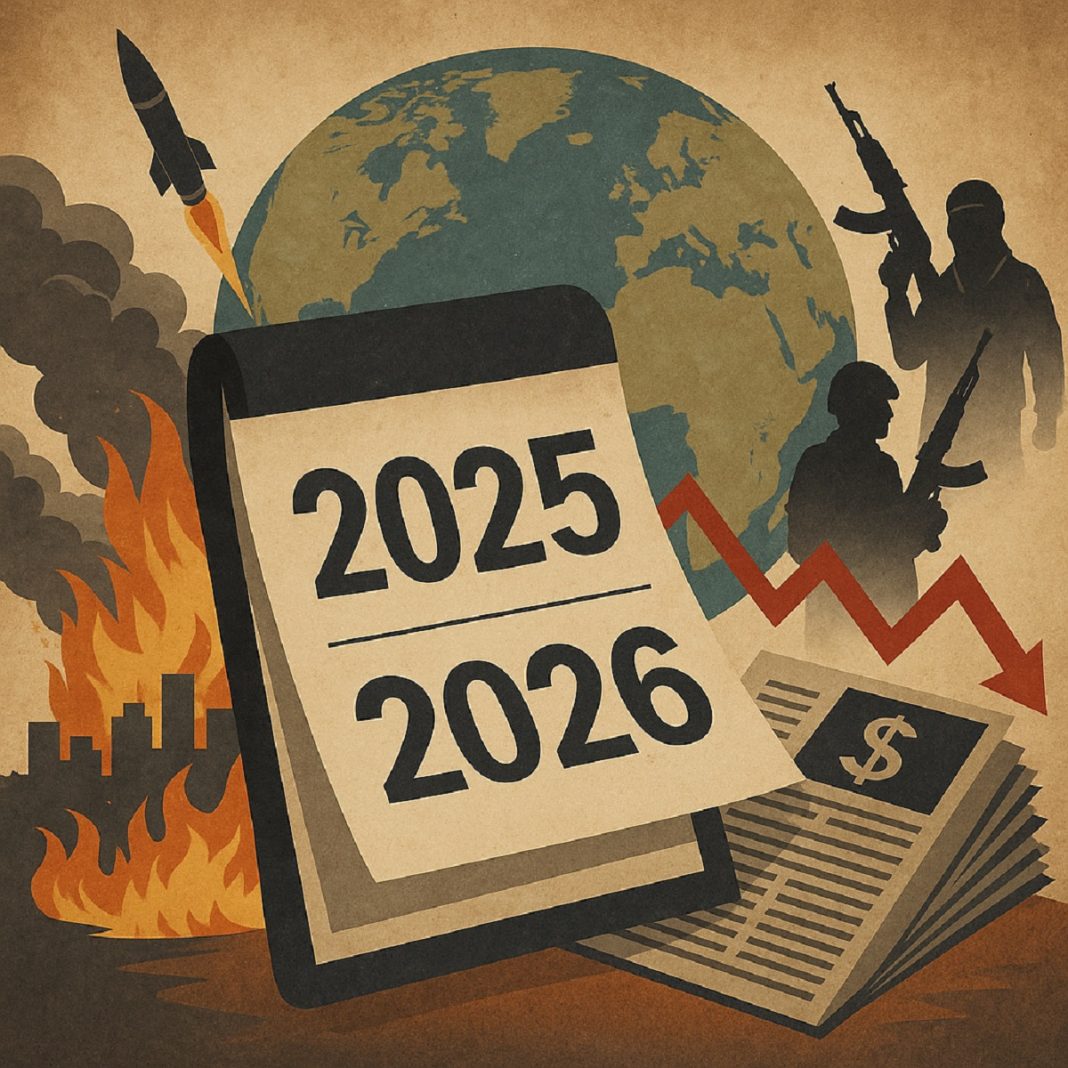
As one year ends under the weight of crises and another begins without guarantees, the world finds itself crossing into a phase in which the economy is no longer simply a vehicle for prosperity but a central arena of conflict. Markets that once promised exchange and integration have become instruments of leverage and pressure. International relations are increasingly governed by power rather than partnership, and interests are measured by the ability to permit or deny, to connect or to cut off. What was once heralded as globalization’s peace dividend has given way to a globalization of caution—an age defined by mutual suspicion.
Globalization has not collapsed, but it has fundamentally changed. Trade continues, but it is politicized. Investment flows, but under the shadow of uncertainty. Interdependence, once seen as a stabilizing force, is now widely regarded as a vulnerability. Governments across regions and ideologies have come to the same conclusion: whoever controls the critical arteries of the global economy—finance, energy, technology, food systems, and maritime routes—can shape outcomes without firing a single shot.
The United States, which for decades built and anchored a global economic system revolving around its institutions and currency, has discovered that this system no longer belongs to it alone. Tools long used to pressure rivals are now being turned back against American interests. China, having absorbed the lesson, has moved decisively to reduce its exposure and expand its capacity to respond, building parallel systems across energy, manufacturing, and technology. Europe, caught between its aspiration for strategic autonomy and its deep security and economic dependencies, continues to search for direction in a world that increasingly punishes hesitation.
At the same time, a growing number of middle powers—in Asia, Latin America, and Africa—are asserting themselves. They no longer see their countries merely as stages for great-power competition but as actors with leverage of their own: critical minerals, emerging consumer markets, logistics corridors, and the ability to tilt outcomes without full alignment. The global order is no longer defined by rigid bipolarity but by a dense web of overlapping interests and risks.
In this environment, the Arab world cannot afford the illusion of standing outside the game. Lebanon offers a stark warning. Few countries illustrate more painfully how money can be weaponized and financial systems transformed into instruments of constraint. Trapped between unforgiving global financial regimes and the absence of sovereign economic decision-making, Lebanon paid for this exposure not with missiles but with collapse.
The Gulf states, by contrast, have approached the transformation with greater pragmatism. They recognized early that energy is no longer just a commodity but a strategic asset, and that geography is no longer merely location but connectivity in an interdependent world. Rather than choosing sides, they diversified. Rather than submitting, they balanced. They invested in ports, renewable energy, and technology, forging partnerships east and west alike, understanding that independence today comes not from isolation but from options. Still, even the Gulf is not immune: the more valuable its assets become, the greater the temptation for external powers to test its resilience.
Across North Africa, the picture takes yet another form. Countries there sit at the intersection of Europe, Africa, and the Mediterranean, increasingly called upon to serve as industrial, food, and energy bridges. Morocco is working to secure its place in global value chains; Algeria leverages gas as geopolitical capital; Tunisia and Libya expose how fragile economies can be when left exposed to external shocks. The lesson is increasingly clear: economic sovereignty is not a slogan but a capacity—one that must be built and defended.
The most serious danger, however, does not lie in the multiplication of power centers but in the absence of shared rules. Faced with perceived threats, states retreat inward, erecting barriers of subsidies, controls, and protection. Markets fragment, efficiency erodes, and global tension rises. The logic of “everyone against everyone” may offer short-term reassurance, but it guarantees long-term instability.
History offers a warning. Power exercised without restraint loses legitimacy and hastens its own decline. In the nuclear age, a minimum level of stability emerged only when rules of deterrence were established and reckless escalation constrained. Today, in the age of economic weapons, the world requires a similar awakening—an understanding that markets cannot serve indefinitely as battlefields, and that turning every economic relationship into a pressure point will ultimately dismantle the very system from which all benefit, however unevenly.
As the new year approaches, the world appears neither victorious nor defeated, but suspended at a knife’s edge. One step forward could open the door to collective wisdom; one step back could plunge everyone into a chaos with no winners. We have learned—or should have learned—that when power breaks free from the discipline of reason, it costs its holders their balance before it harms their rivals. And when markets are governed by the logic of war, what remains of partnership and shared humanity quickly dissolves.
The arrival of 2026 is therefore more than a calendar change. It is a test of responsibility and judgment. Either nations recognize that the economy, however powerful, cannot function as a permanent weapon, or they continue down a path of attrition, accumulating losses under the illusion of control. Between those paths lies a narrow hope: that the new year marks the beginning of reflection rather than confrontation, and of restraint rather than escalation.
This article was originally published in Arabic on the Asswak Al-Arab website