Gabriel G Tabarani
As 2026 begins, a dangerous illusion is taking hold in parts of Washington, Tel Aviv, and several Arab capitals: that Iran’s so-called Axis of Resistance has been strategically weakened, contained, or even broken after Israel’s 12-day war with Iran in June 2025 and the cascading blows that followed across Lebanon, Gaza, Syria, and the Red Sea. The battlefield noise has faded, missile alerts have grown less frequent, and frontlines appear calmer. Yet this calm should not be mistaken for defeat. What is unfolding instead is a deliberate Iranian pivot—from visibility to entrenchment, from kinetic confrontation to structural endurance.
The Axis of Resistance has entered a phase best described as strategic dormancy. This is not retreat but recalibration. Tehran and its allies—Hezbollah in Lebanon, the Popular Mobilization Forces in Iraq, and the Houthis in Yemen—have absorbed the lessons of the past two years: centralized command structures are vulnerable, overt escalation invites devastating retaliation, and survival now depends on decentralization, financial self-sufficiency, and ideological reframing. The result is a looser, flatter network that is harder to deter, harder to sanction, and harder to dismantle.
Nowhere is this clearer than in the economic dimension of the axis. Under sustained sanctions pressure, Iran has refined a gray-zone economy that sustains its regional partners through oil smuggling, reconstruction contracts, cryptocurrency, and embedded commercial ventures. What once relied on direct state transfers increasingly operates through front companies, shadow fleets, informal banking, and dual-use reconstruction projects. Hezbollah’s post-war rebuilding in Lebanon, the PMF’s institutional capture of Iraqi state contracts, and the Houthis’ monetization of customs and fuel flows in Yemen are not side effects of conflict; they are the conflict’s new infrastructure.
This economic adaptation has strategic consequences. By embedding militias inside welfare systems, construction markets, and local governance, Iran transforms armed groups into social and financial actors with stakes in stability—on their own terms. Reconstruction becomes both patronage and camouflage. Social services become instruments of control. And economic survival itself is recast as resistance. Tehran’s message, repeated relentlessly in official discourse, is that endurance under pressure is victory. In this framing, sanctions are not a reason to compromise but proof of righteousness.
Ideology has evolved accordingly. The language of revolutionary expansion has given way to a theology of patience. “Economic jihad,” “productive resistance,” and “strategic patience” are no longer slogans but organizing principles. At home, this doctrine seeks to discipline public discontent by sacralizing hardship. Abroad, it binds the axis with a shared moral grammar that legitimizes restraint today in the name of confrontation tomorrow. The result is an alliance that may appear quieter, but is no less committed to long-term confrontation with Israel and the United States.
Critically, the axis’s restructuring is not occurring in isolation. Russia and China play distinct but complementary roles in sustaining Iran’s recovery. Moscow provides diplomatic shielding, narrative support, and selective military spillover, even as its own war constraints limit largesse. Beijing, more discreetly, has become indispensable—supplying dual-use technologies, missile-related inputs, and economic lifelines that allow Iran to rebuild deterrence without open escalation. Together, they anchor Iran within a broader anti-Western ecosystem that blunts isolation and raises the cost of coercion.
None of this means the axis is cost-free or uncontested. Inside Iran, public fatigue is real. Inflation, unemployment, and declining purchasing power have sharpened criticism of external adventurism. Even semi-official media now hint at unease over the fiscal burden of proxy warfare. But the Islamic Revolutionary Guard Corps has adapted here too, internalizing costs through monopolized industries and offshore revenue rather than visible taxation. The burden is diffused, obscured, and politically managed—at least for now.
For the United States and its partners, the implications are sobering. The post-2025 environment has confirmed that punitive sanctions and episodic military strikes can disrupt but not dismantle Iran’s regional system. The axis no longer depends on tight command-and-control or continuous violence to survive. It thrives instead in ambiguity—between war and peace, legality and illegality, governance and coercion. Confronting such a system requires more than pressure; it requires precision.
A credible counter-strategy in 2026 must therefore shift focus. Targeting individuals is insufficient when networks regenerate through institutions. Financial disruption must move beyond blacklists toward dismantling the logistics, insurance, shipping, and crypto ecosystems that sustain gray-zone economies. Supporting local states must mean more than aid—it must involve conditioning legitimacy, reconstruction, and security assistance on measurable reductions in militia autonomy. And the information domain can no longer be neglected: Iran’s narrative of dignified endurance resonates precisely because alternatives appear abstract or inaccessible.
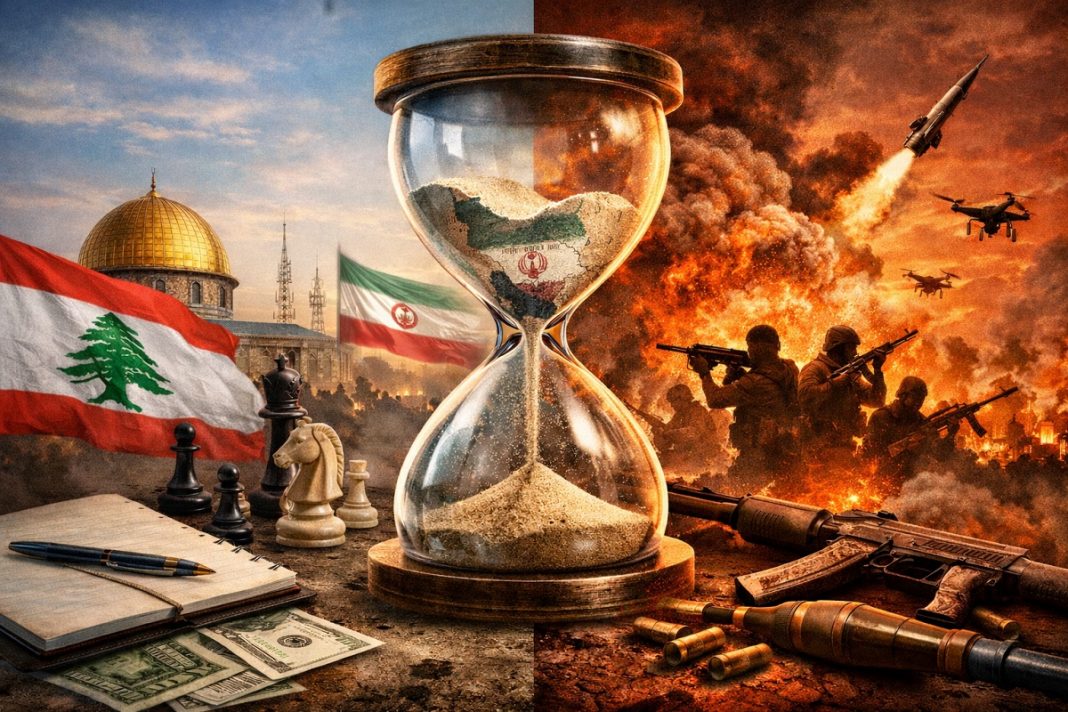
Above all, policymakers must abandon the hope that time alone will weaken the axis. Time, as Tehran understands it, is a weapon. The Axis of Resistance is betting that Western fatigue, regional fragmentation, and political cycles will outlast sanctions regimes and episodic containment efforts. So far, that bet has not been irrational.
As the new year opens, the choice is not between escalation and complacency. It is between continuing to fight yesterday’s version of Iran’s strategy—or recognizing that the battlefield has shifted. Quiet, in the Middle East of 2026, is not peace. It is preparation.
This article was originally published in Arabic on the Asswak Al-Arab website