Gabriel G Tabarani
Not every peace agreement changes history. Some merely freeze a conflict; others redefine the state itself.
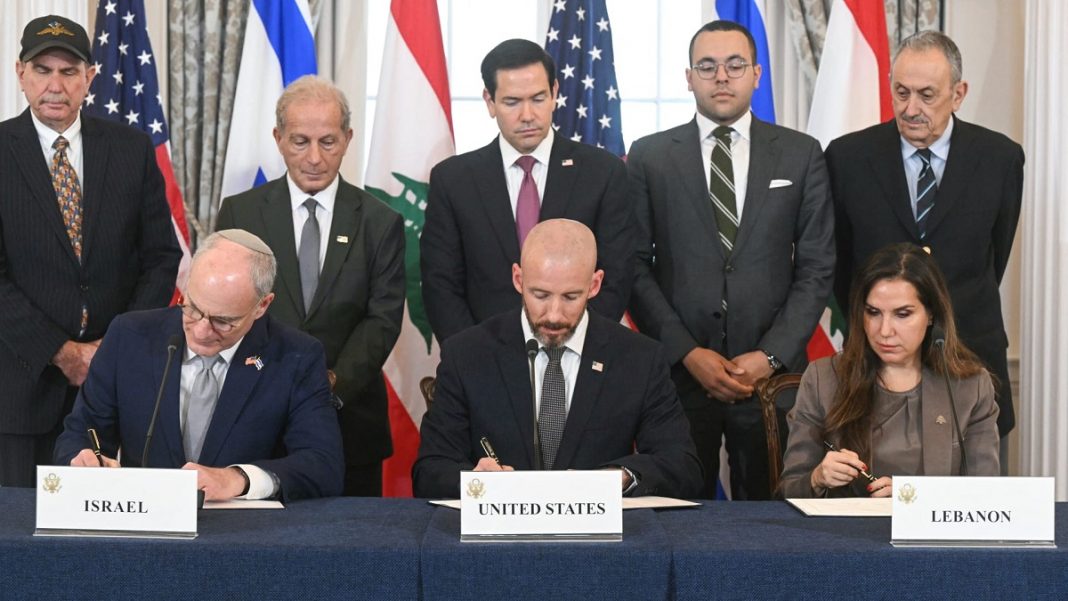
The framework agreement signed in Washington between Lebanon and Israel, under U.S. sponsorship, belongs to the latter category. If implemented, it will not simply reshape relations between two longtime adversaries—it could fundamentally redefine the Lebanese state by answering three questions that have haunted the country for decades: Who decides war and peace? Who monopolizes the use of force? And who truly speaks on Lebanon’s behalf?
These are the questions that matter far more than the immediate political debate over whether the agreement represents victory for one side or defeat for the other.
For the first time in decades, the document goes beyond another ceasefire or a temporary security arrangement. It explicitly commits both countries to ending their state of war, addressing the root causes of their conflict, and negotiating a comprehensive and lasting peace.
Yet the agreement’s greatest significance lies not in its relationship with Israel, but in its relationship with Lebanon itself.
Its central premise is unmistakable: the Lebanese government alone holds the sovereign authority to declare war or peace; the Lebanese Armed Forces alone are responsible for national defense; and no non-state armed group may retain any military or security role anywhere in the country.
This is far more than a technical security arrangement. It is a restoration of the very definition of statehood.
For decades, Lebanon has lived under a destructive duality: a formal state deprived of its sovereign authority, while an armed organization exercised the power to decide when the country would enter war. The consequences have been devastating—successive conflicts, a devastated south, economic collapse, weakened sovereignty, and generations of Lebanese paying the price for decisions they never made.
The framework agreement seeks to reverse that equation.
It does not ask Lebanon to surrender its sovereignty; it asks Lebanon to reclaim it. Nor does it leave the country defenseless before Israel. Instead, it places responsibility for protecting Lebanon’s borders, territory, and citizens where it belongs—in the hands of the Lebanese state.
This is precisely why Hezbollah has rejected the agreement so forcefully.
Its objection is not merely about the mechanics of implementation or security guarantees. The agreement challenges the political order that has prevailed in Lebanon for decades by transferring the exclusive authority over war and peace from an armed movement back to the constitutional institutions of the state.
More importantly, Hezbollah’s position cannot be separated from the broader regional context.
Its rejection appears closely tied to Iran’s ongoing negotiations with the United States. From Tehran’s perspective, Lebanon remains one of several strategic bargaining chips in a wider regional contest. A separate Lebanese-Israeli settlement would effectively remove the Lebanese file from Iran’s negotiating portfolio, allowing Beirut—not Tehran—to determine its own national security future.
In that sense, the agreement threatens not only Hezbollah’s military capabilities but also its political function as the indispensable intermediary between Lebanon and Iran’s regional strategy.
The real confrontation, therefore, is not between supporters and opponents of peace.
It is between two competing visions of Lebanon.
One envisions a sovereign state whose constitutional institutions alone determine questions of war and peace.
The other sees Lebanon as an advanced front in a broader regional struggle, where its borders, institutions, and people remain instruments of a geopolitical confrontation extending far beyond Lebanon itself.
None of this suggests that the agreement is without risks.
Israel will have to demonstrate genuine commitment through a complete military withdrawal, full respect for Lebanese sovereignty, and strict adherence to the agreement’s security provisions. Likewise, any implementation mechanism that evolves into a permanent limitation on Lebanon’s sovereignty or an indefinite military pressure campaign would ultimately undermine the agreement’s legitimacy.
But the more fundamental question remains: what is the alternative?
Another open-ended war whose duration and consequences ordinary Lebanese cannot control?
More destruction in southern Lebanon?
Another generation displaced because strategic decisions are made outside the institutions of the Lebanese state?
Lebanon has already spent half a century testing the logic of armed confrontation. The outcome is painfully clear: a fractured state, a collapsed economy, and a generation of young Lebanese seeking their future abroad rather than at home.
Perhaps it is finally time to test the logic of the state instead.
One of the agreement’s strengths is that it embraces gradualism and reciprocity. The verified dismantling of non-state armed infrastructure is matched by a phased Israeli withdrawal, the gradual deployment of the Lebanese Armed Forces, and extensive international oversight backed by American guarantees.
This is hardly an easy formula.
But it is certainly more realistic than the perpetual promise of “resistance” without a credible political endgame.
Equally important, the agreement links reconstruction to state-building. International assistance is designed not merely to rebuild roads and homes, but to strengthen public institutions and ensure that reconstruction funds do not reinforce the very structures that contributed to Lebanon’s repeated collapse.
Lebanon needs more than reconstruction. It needs the reconstruction of the state itself.
International, Arab, and American support should therefore be viewed not simply as emergency aid, but as part of a long-term project to rebuild state institutions, strengthen the Lebanese Armed Forces, revive the economy, and restore Lebanon’s independent national decision-making.
The agreement may succeed. It may fail. It may be delayed by Israeli politics or obstructed by domestic actors unwilling to surrender the privileges of a parallel state.
Yet its historical importance lies elsewhere.
For the first time in decades, Lebanon has an opportunity to move from perpetual war to politics, from competing centers of military authority to a single sovereign state.
Lebanon does not need another rhetorical victory.
It needs functioning institutions, secure borders, economic recovery, and a government capable of making national decisions on behalf of all its citizens.
Ultimately, the most important agreement is not the one signed between Lebanon and Israel. It is the one Lebanon must reach with itself.
If the Lebanese people succeed in restoring the authority of their own state, peace will become a natural consequence.
But if the decision over war remains outside Lebanon’s constitutional institutions, no international agreement—regardless of the guarantees attached to it—will be able to secure the country’s future.
This article was originally published in Arabic on the Asswak Al-Arab website