Gabriel G Tabarani
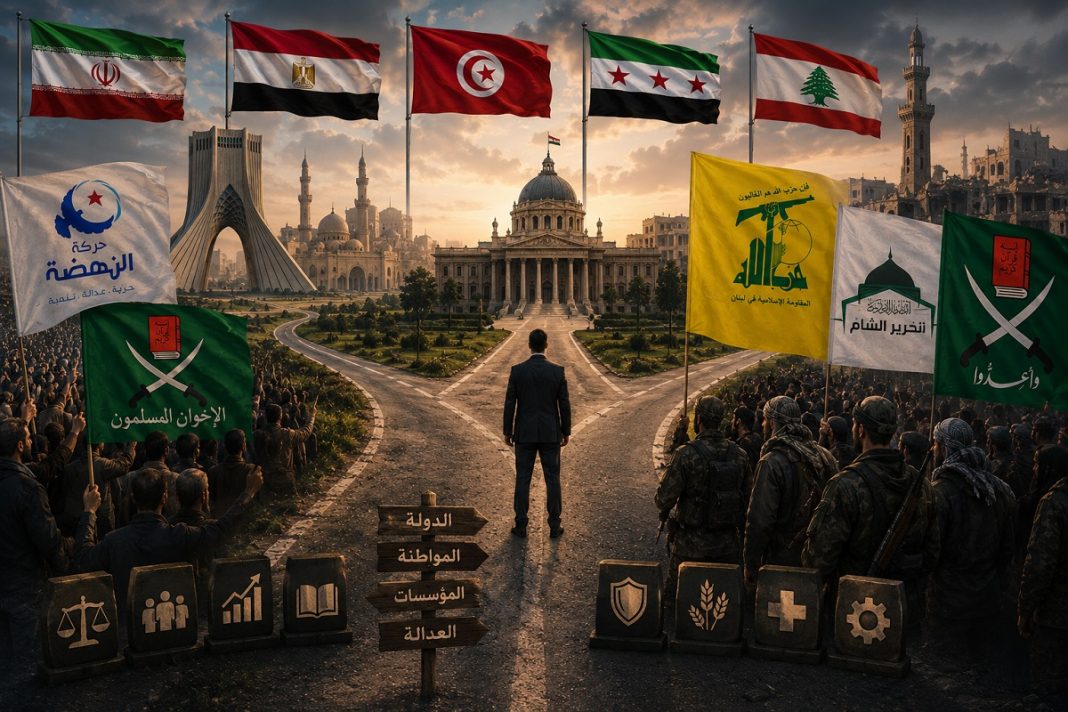
More than four decades after Iran’s Islamic Revolution and more than a decade after the Arab Spring, political Islam finds itself confronting a question that can no longer be postponed: Has its historic project failed, or is it undergoing a deeper transformation—from an ideology seeking to Islamize the state into a set of political movements learning to operate within it?
This is not merely an academic question. From Tehran to Cairo and Tunis, and now increasingly in Damascus, movements rooted in Islamic political thought have traveled a long road from opposition to power. Yet in nearly every case, the arrival in government proved not to be the culmination of their journey, but the beginning of their most difficult test.
When Rached Ghannouchi, the longtime leader of Tunisia’s Ennahda movement, declared in 2016 that his party was moving from “political Islam” toward what he called “Muslim democracy,” many observers viewed the announcement as a tactical adjustment. In retrospect, it looks more like an early recognition of a dilemma that would come to define the experience of Islamist movements across the region.
The challenge was straightforward yet profound: Could a movement inspired by Islam function as a democratic political actor without claiming a monopoly on religious legitimacy? Could it become a party competing over policies rather than identity, governance rather than doctrine?
For decades, Islamist movements built their credibility in opposition. They spoke the language of justice, authenticity, anti-corruption and social solidarity. They benefited from the failures of authoritarian states and the disappointments of secular nationalist projects. In opposition, they could promise renewal. In power, they had to deliver it.
That transition exposed a reality often obscured by ideology. States are not movements. They are not vehicles for moral aspiration alone. They are intricate systems of institutions, bureaucracies, economies, security structures and competing social interests. Governing them requires skills different from those needed to mobilize supporters or articulate grievances.
This is where many Islamist movements encountered what might be called the “state test.”
In Egypt, the Muslim Brotherhood achieved what had long seemed impossible. Mohamed Morsi became the country’s first democratically elected president. Yet the movement quickly found itself trapped between polarization, institutional resistance and its own limited capacity to build broad political coalitions. Within a year, the experiment collapsed, becoming one of the most contested chapters of the Arab Spring.
Tunisia offered a different trajectory. Ennahda chose compromise over confrontation and consensus over domination. It accepted constitutional concessions and, during the political crisis of 2013, stepped aside in order to preserve the democratic transition. Yet moderation did not guarantee political survival. As economic stagnation deepened and public frustration mounted, many voters judged the movement not by its democratic credentials but by the country’s deteriorating conditions. Tunisia revealed a lesson that extends far beyond Islamist politics: identity can win elections, but performance determines legitimacy.
Iran presents a more complex case. Unlike Ennahda, the Islamic Republic never sought to separate religious authority from political authority. It institutionalized their fusion. More than 45 years after the revolution, the system remains intact and capable of reproducing power. Yet Iran today appears less like a completed model than a system under pressure to adapt.
Years of economic strain, social unrest, regional confrontation and generational change have intensified debates about the relationship between state, society and ideology. The central question is no longer simply whether the Islamic Republic will survive, but whether it can evolve. In that sense, Iran may be confronting a challenge different from Tunisia’s or Egypt’s, but no less significant: the transition from revolutionary legitimacy to governmental legitimacy.
These questions now hover over Syria.
The emergence of Ahmad al-Sharaa and Hay’at Tahrir al-Sham at the center of Syria’s political landscape has introduced a new chapter in the story of political Islam. Whatever differences separate Syria’s experience from those of Tunisia, Egypt or Iran, the underlying challenge remains strikingly familiar. The issue is no longer whether a movement can command territory, maintain discipline or wage conflict. It is whether it can govern a diverse society, manage institutions and build a state.
The same dilemma has appeared, in a different form, in Lebanon. Hezbollah’s evolution from resistance movement into a central actor within the Lebanese political system illustrates the tensions that arise when an ideologically driven organization becomes deeply embedded in state structures. Influence, it turns out, brings responsibilities that resistance alone does not.
The broader lesson extends beyond Islamism itself.
The most important political development of the past decade may not be the rise or decline of Islamist movements, but the growing realization that no ideology—Islamist, nationalist, liberal or otherwise—can substitute for the state. The Arab world’s modern crises have repeatedly demonstrated that slogans, however compelling, cannot replace institutions, economic management, public accountability or effective governance.
This is why Ghannouchi’s concept of “Muslim democracy” remains relevant even today. Its significance lies not in offering a definitive solution, but in recognizing a fundamental truth: politics is a domain of human negotiation, compromise and imperfection. It cannot be governed indefinitely through claims of ideological certainty or exclusive access to truth.
The real question, then, is not whether the age of political Islam has ended. It is whether movements that emerged from political Islam can successfully transform themselves into parties of government—judged by their policies and achievements rather than by their ideological identities.
The answer remains unresolved in Tunisia. It remains unresolved in Egypt. It remains unresolved in Iran. And Syria may soon find itself confronting the same test.
Perhaps the irony is that Islamist movements often achieved their greatest successes while outside power, only to face their greatest challenges once they acquired it. Opposition allows movements to make promises. Government compels them to produce results.
And in a region exhausted by conflict, polarization and unmet expectations, citizens increasingly seem less interested in whether a state is religious or secular than in whether it is capable. That may be the most important political shift underway in the Middle East today: the gradual transition from the politics of identity to the politics of the state.
This article was originally published in Arabic on the Asswak Al-Arab website