Gabriel G Tabarani
For much of the past three decades, Gulf sovereign wealth funds were judged by a relatively straightforward metric: returns.
The logic was simple. Oil revenues generated fiscal surpluses, which governments channelled into sovereign wealth funds that invested across global markets. The objective was to preserve wealth, diversify national balance sheets and generate income for future generations. Success was measured in portfolio performance and asset growth.
Today, that logic is no longer sufficient.
The most important question facing Gulf sovereign wealth funds is no longer how much money they make. It is what capabilities they create.
This shift reflects a profound transformation in the global economy. The era of hyper-globalisation that shaped investment strategies from the 1990s through the early 2010s is giving way to a world increasingly defined by geopolitical competition, technological rivalry and economic security. Supply chains, semiconductor production, artificial intelligence and critical infrastructure have become matters of national strategy rather than merely commercial opportunity.
In this environment, capital is no longer simply a financial resource. It is a geopolitical asset.
No region illustrates this transformation more clearly than the Gulf.
The Gulf states collectively control some of the largest pools of sovereign capital in the world. The UAE’s sovereign funds together manage assets approaching $2 trillion. Saudi Arabia’s Public Investment Fund has surpassed $1 trillion in assets and sits at the centre of the Kingdom’s Vision 2030 agenda. Qatar Investment Authority manages roughly $360 billion through a globally diversified portfolio spanning infrastructure, real estate, finance and technology.
These funds were originally designed to address a familiar challenge: how to transform finite hydrocarbon wealth into sustainable long-term prosperity. Increasingly, however, they are being asked to serve a far broader purpose.
Today, Gulf sovereign wealth funds are expected to accelerate economic diversification, develop new industries, attract advanced technologies, strengthen national competitiveness and enhance geopolitical influence—all while continuing to generate attractive financial returns.
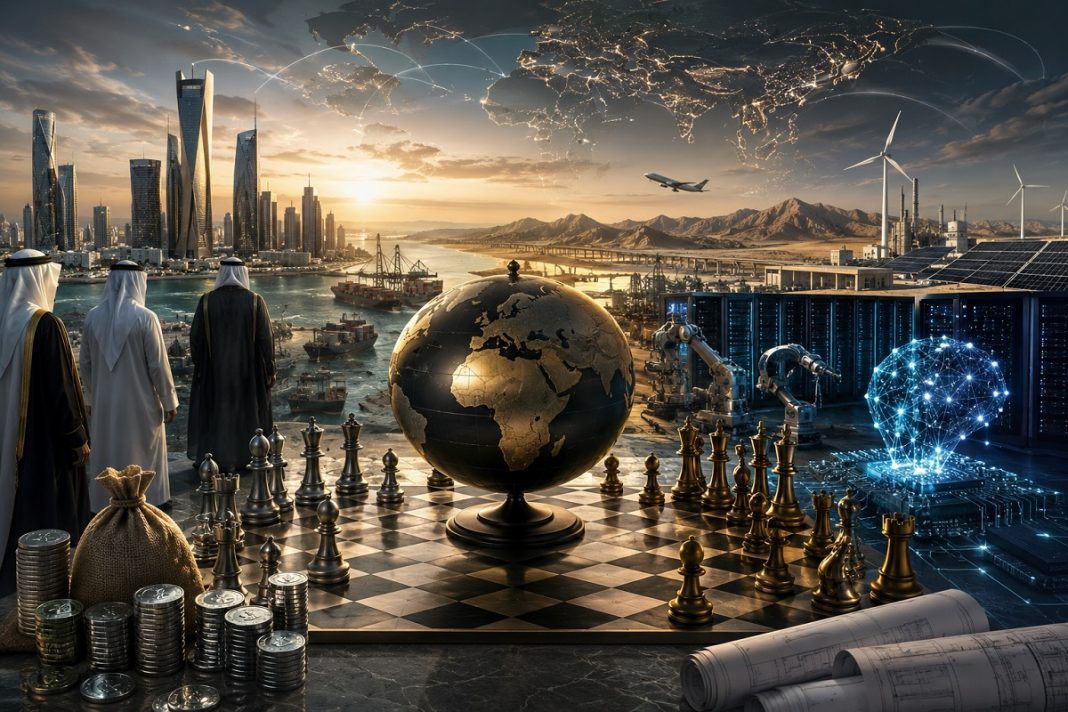
In effect, they are evolving from investment institutions into instruments of economic statecraft.
The distinction matters because the global economy is undergoing a structural shift. For decades, economic efficiency was the organising principle of globalisation. Companies built supply chains where costs were lowest. Capital flowed wherever returns were highest. Governments largely assumed that markets would determine outcomes.
That assumption is rapidly fading.
The United States has committed hundreds of billions of dollars to rebuilding domestic industrial capacity through initiatives such as the CHIPS and Science Act and the Inflation Reduction Act. China continues to deploy industrial policy and state-backed investment to advance strategic sectors ranging from semiconductors to electric vehicles. The European Union increasingly speaks of “strategic autonomy” and economic sovereignty.
Across the world, governments are rediscovering a lesson long associated with the developmental states of East Asia: economic power and national power cannot always be separated.
The Gulf’s response has been distinctive because it relies less on public debt or fiscal stimulus than on sovereign capital.
Rather than merely investing in global markets, Gulf funds are increasingly investing in the foundations of future economic power. Artificial intelligence, advanced computing, clean energy, digital infrastructure, biotechnology and logistics have become strategic priorities. The objective is not simply to earn returns from the industries of the future, but to secure a place within them.
This helps explain why Gulf governments are competing aggressively to attract AI companies, hyperscale data centres and advanced manufacturing projects. It also explains why investments that might once have been evaluated solely on financial grounds are increasingly assessed through a strategic lens.
The race is not simply about diversification. It is about relevance.
For Gulf policymakers, the challenge is clear. Oil wealth created financial capital. The next phase of development requires converting that capital into technological capability, human capital and productive industries capable of sustaining growth long after hydrocarbons cease to dominate the global economy.
Yet this transformation is not without risks.
The very success of Gulf sovereign wealth funds has expanded expectations of what they can achieve. They are expected to finance economic transformation, support national champions, stabilise economies during periods of volatility and strengthen geopolitical partnerships. In times of crisis, they may also be called upon to help absorb fiscal pressures and reassure financial markets.
The danger is that sovereign wealth becomes a tool for managing the present at the expense of building the future.
History offers numerous examples of resource-rich economies that used accumulated wealth to cushion shocks but failed to translate that wealth into lasting productivity gains. The challenge facing Gulf states is therefore not one of financial resources but of strategic allocation.
This is where the comparison with Norway is instructive. Norway’s sovereign fund, the world’s largest, operates primarily as a financial institution designed to maximise long-term returns for future generations. Gulf sovereign wealth funds operate under a more demanding mandate. They are simultaneously investors, development institutions and strategic instruments of national transformation.
Their success will therefore be measured differently.
Over the next decade, the most important indicator may not be the size of their portfolios or even their annual returns. It may be whether they succeed in creating globally competitive industries, fostering innovation ecosystems and reducing dependence on external sources of technology and expertise.
The recent conflicts and geopolitical disruptions affecting the Gulf have reinforced this reality. They have demonstrated that sovereign wealth can absorb shocks, reassure markets and provide governments with strategic flexibility. But they have also revealed the limits of financial power.
Sovereign wealth can buy companies, technologies and influence. It can fund megaprojects, finance industrial strategies and accelerate economic transformation.
What it cannot buy is geography.
That is why the Gulf’s defining challenge is no longer managing oil wealth. It is transforming financial wealth into economic resilience in a world where geopolitics increasingly shapes economic outcomes.
The countries that thrive in the twenty-first century will not necessarily be those with the largest reserves of capital. They will be those that convert capital into capability, wealth into productivity and investment into strategic advantage.
For Gulf sovereign wealth funds, that is the real test ahead.
This article was originally published in Arabic on the Asswak Al-Arab website