Gabriel G. Tabarani
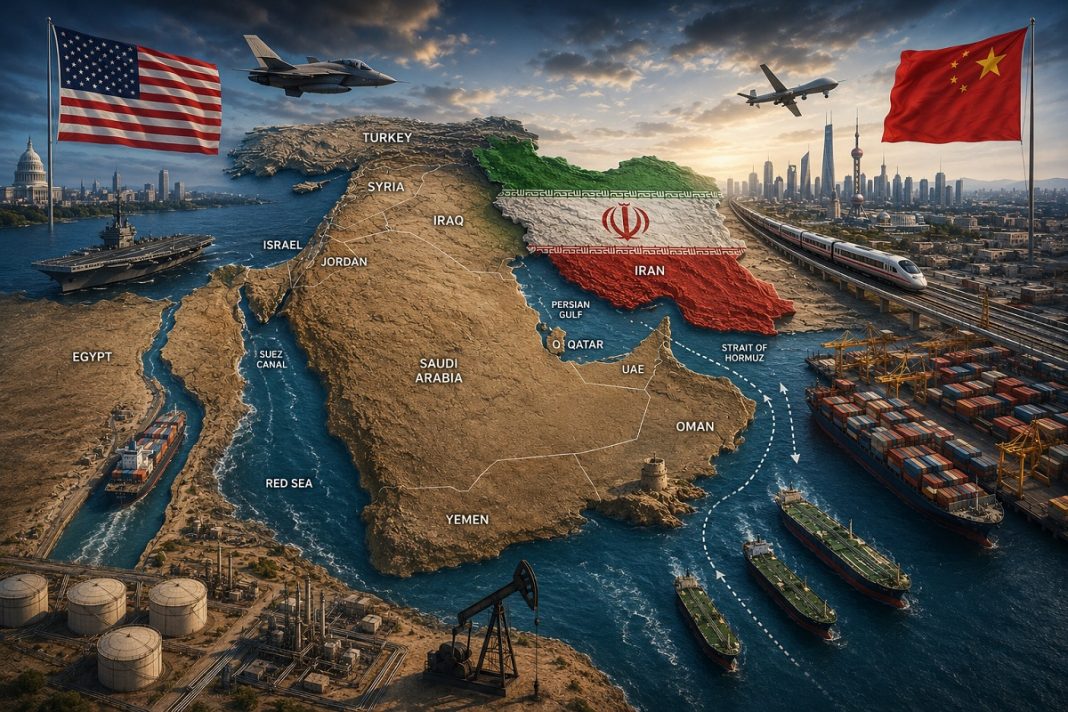
For years, the Middle East has been described as the newest front in the strategic rivalry between the United States and China. The narrative is familiar: Washington provides security, Beijing expands its economic footprint, and regional states hedge between the two.
The description is not entirely wrong. It is simply incomplete.
The Middle East is becoming something far more unusual. It is perhaps the only region where two competing great powers have discovered that they cannot afford the failure of the other. They compete for influence, certainly, but they also share an overriding interest in preventing regional collapse.
That reality has become impossible to ignore.
Ironically, no issue has exposed it more clearly than Iran.
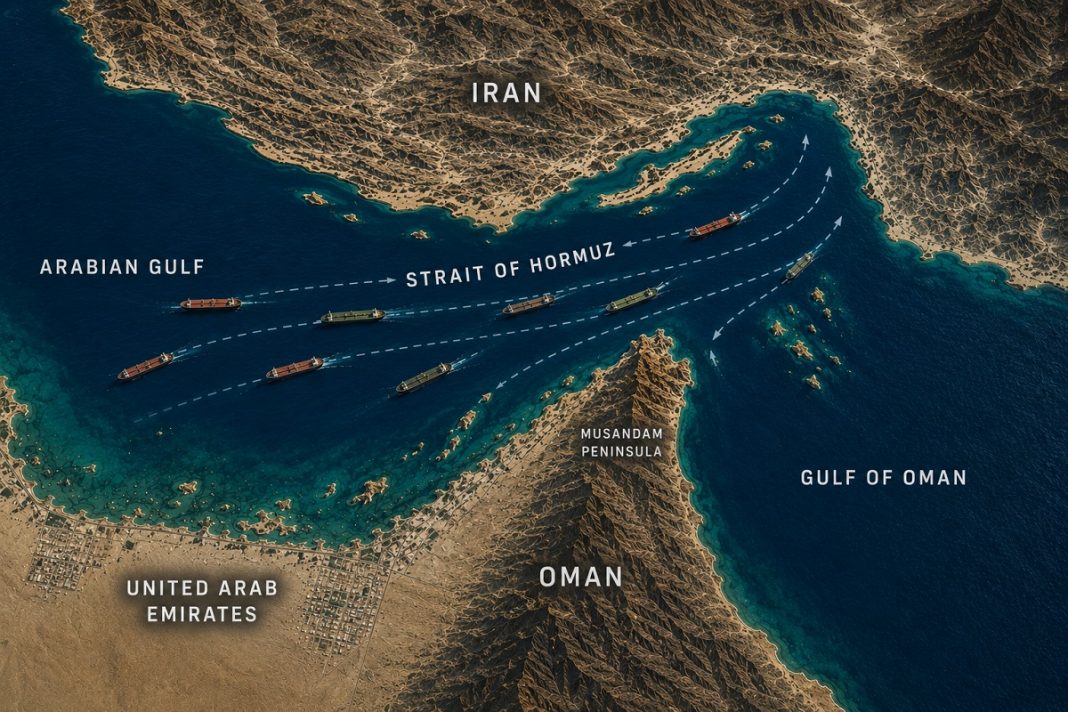
Every escalation over Tehran’s nuclear programme, every exchange of fire between Iran and Israel, every attack on shipping in the Red Sea, and every renewed threat to close the Strait of Hormuz reminds Washington and Beijing of the same uncomfortable truth: a wider regional war would be a strategic disaster for both.
The reasons differ, but the conclusion is identical.
For the United States, a major conflict would endanger allies, destabilise one of the world’s most volatile regions and threaten the credibility of the security architecture it has spent decades constructing.
For China, the consequences would be no less severe. The Gulf remains indispensable to China’s energy security, while the sea lanes linking the Strait of Hormuz, the Red Sea and the Suez Canal underpin a substantial share of its trade with Europe and beyond. A prolonged disruption would reverberate throughout the Chinese economy just as surely as it would across Western markets.
This is why the Middle East is no longer simply a theatre of geopolitical competition. It has become one of the few places where the strategic interests of Washington and Beijing converge, even as their global rivalry intensifies.
Their objectives increasingly overlap.
Their methods could hardly be more different.
The United States remains the region’s indispensable military power. Its network of alliances, forward deployments and security guarantees continues to shape the regional balance of power. Successive crises, including those involving Iran, have reinforced an uncomfortable reality: when deterrence is required, regional governments still look first to Washington.
China has chosen another path.
Rather than building military alliances or replicating America’s security architecture, Beijing has invested in ports, infrastructure, logistics, telecommunications and energy. It has cultivated economic partnerships across political divides, maintaining productive relations not only with Saudi Arabia and the Gulf states but also with Iran.
Yet this relationship with Tehran reveals the limits of China’s regional ambitions.
Beijing values Iran as an energy supplier and an important participant in its Belt and Road Initiative. What it does not want is an Iran whose confrontation with the West destabilises the very trade routes upon which China’s prosperity depends.
That distinction matters.
China’s strategy has never been to replace the United States as the Middle East’s security guarantor. Its objective has been to prosper within an order that someone else continues to secure.
This is not necessarily a sign of weakness. It is a different conception of power.
Military predominance remains Washington’s comparative advantage.Economic connectivity is Beijing’s.
The problem for China is that economic power cannot indefinitely remain detached from strategic responsibility.
If the Strait of Hormuz were seriously disrupted, China would quickly discover the limits of relying upon an American-led security system while declining to assume comparable responsibilities itself. As Chinese investments deepen across the Middle East, so too will expectations that Beijing contribute more than capital.
The burden of leadership rarely remains optional.
The United States faces a different dilemma.
Its military superiority remains unmatched, but military power alone no longer guarantees political influence. The legacy of Iraq and Afghanistan, together with more recent regional conflicts, has complicated Washington’s standing across much of the Middle East. Security remains America’s greatest strength, yet diplomacy and political credibility increasingly determine whether that strength translates into durable influence.
This changing landscape has not gone unnoticed by the region itself.
Saudi Arabia, the United Arab Emirates, Qatar and Egypt have largely rejected the logic of binary alignment. They continue to depend on American security guarantees while simultaneously expanding economic, technological and investment ties with China.
This is not strategic ambiguity. It is strategic autonomy.
The region’s governments have concluded that the emerging international order offers greater room for manoeuvre than the Cold War ever permitted. Their objective is no longer to choose between competing powers, but to maximise the benefits of engaging both.
That is why repeated calls for Middle Eastern states to “pick a side” misunderstand the nature of today’s geopolitical landscape.
The region is no longer merely the object of great-power competition. It is increasingly shaping the rules by which that competition is conducted.
This is precisely why comparisons with a new Cold War are misleading. The Cold War was built upon mutually exclusive blocs.
Today’s Middle East is producing something far more complex: strategic competition combined with functional interdependence.
Neither Washington nor Beijing can preserve regional stability alone. Nor can either afford its collapse.
Iran illustrates this better than any theoretical model could. It reminds both powers that regional stability is no favour one grants the other. It is a shared strategic necessity.
We have grown accustomed to seeing the Middle East as the arena where great powers compete. It may, in fact, become the region that forces them into an uneasy coexistence.
Chaos in the Middle East no longer threatens only the countries of the region. It threatens the arteries of the global economy itself.
That is why the rivalry between Washington and Beijing will undoubtedly intensify in the years ahead. But it is also why it will remain a rivalry that cannot afford chaos.
This article was originally published in Arabic on the Asswak Al-Arab website