Gabriel G. Tabarani
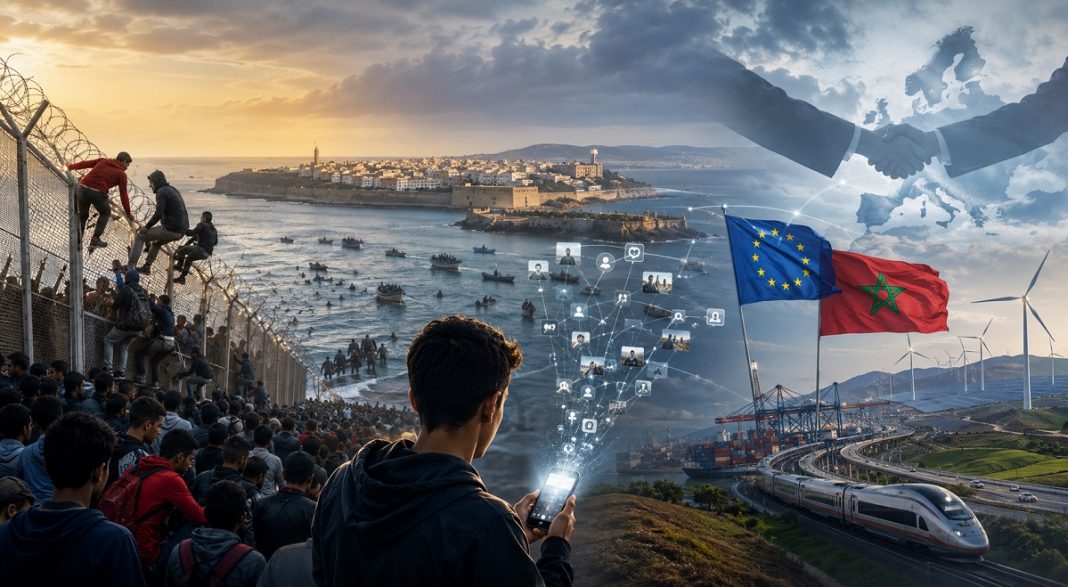
On July 31, within a matter of hours, the Spanish-administered city of Ceuta became the center of an extraordinary migration crisis. Tens of thousands of people attempted to reach the enclave from Morocco, some by sea, as messages and videos spread across social media suggesting that a rare window had opened to enter Europe.
Lives were lost. The border came under enormous pressure. And almost immediately, the political arguments began.
In Madrid and across Europe, the familiar questions returned: Had migration policies become too permissive? Should borders be reinforced? Who was responsible? And what role should Morocco play in policing one of Europe’s most sensitive frontiers?
But focusing only on border security misses the more consequential lesson of Ceuta. The episode showed how migration is being transformed by the speed of digital communication — and why Europe’s relationship with Morocco can no longer be understood primarily through the logic of keeping migrants out.
Ceuta is one of the rare places where Africa and the European Union meet on land. Along with Melilla and the routes to the Canary Islands, it has long been part of the geography of migration toward Europe.
What distinguished this episode was not only its scale but the speed of mobilization.
After a ruling by Spain’s Supreme Court, misleading interpretations circulated online suggesting that people who reached Spanish territory might be able to remain. Images of others heading toward Ceuta amplified the message. Within hours, what began as misinformation helped produce a mass movement of people.
This is a new complication in an old migration crisis.
Europe has spent years treating irregular migration primarily as a problem of physical borders: higher fences, more patrols, tighter maritime surveillance and agreements with transit countries. Ceuta suggests that borders in the digital age are no longer managed only at the fence. A message on a smartphone can put pressure on an international frontier before governments have time to correct it or contain its consequences.
Yet technology explains the speed of the movement, not the motivations behind it.
Morocco, like many countries on the southern Mediterranean, faces a difficult economic and social equation. It has a young population with rising expectations and a labor market that cannot always create opportunities quickly enough. Youth unemployment and regional disparities remain serious challenges.
But Morocco is also a country undergoing a significant economic transformation.
Over the past two decades, it has developed into an increasingly important industrial and logistics hub linking European and African markets. Its automotive and aerospace industries have expanded, renewable energy has attracted major investment, and new ports, railways and other infrastructure have strengthened its position in regional trade.
That apparent contradiction helps explain Ceuta. Economic progress does not automatically eliminate migration. In emerging economies, aspirations can rise faster than opportunities. Greater connectivity also means that young people continuously compare what is available at home with what appears possible elsewhere.
The latest migration wave should therefore not be treated as a verdict on Morocco’s development. It reveals something more complicated: the tension that can arise when economic transformation and social expectations move at different speeds.
Morocco’s role has also changed. It is no longer simply a country migrants leave. It has become a destination and transit country for people from sub-Saharan Africa and an increasingly important European partner on trade, security and migration. Its preparations to host the 2030 World Cup with Spain and Portugal are a striking symbol of how intertwined the two shores of the western Mediterranean have become.
That is why the most useful question after Ceuta is not simply who should be blamed. It is how another tragedy can be prevented.
The answer begins with cooperation between Morocco and Spain.
Rabat and Madrid have had serious disagreements, but geography gives neither country the luxury of ignoring the other. Trade, security, migration and human ties connect them, and stability in the Strait of Gibraltar cannot be managed by one side alone.
The latest crisis demonstrated that cooperation can function even under extraordinary pressure. Authorities on both sides responded, most of those who crossed returned within a short period, and the crisis did not become an open diplomatic confrontation.
There has been speculation that Morocco deliberately permitted the surge for political purposes. So far, there is insufficient evidence to establish those claims. A more important question is whether governments are confronting a new phenomenon: the ability of digital networks to mobilize large numbers of people without centralized organization.
What once required organizers, networks and leaders can now begin with a video and a perceived opportunity.
Europe should take that lesson seriously. But it should also resist the temptation to answer every migration emergency with higher walls.
European governments have a right and responsibility to control their borders. Yet portraying migrants as an invading force may be politically useful; it does little to produce a sustainable migration policy.
Europe faces an additional contradiction. Its population is aging, and many sectors face labor shortages. It wants less irregular migration while continuing to need managed migration.
That makes treating Morocco merely as a buffer protecting Europe’s southern frontier increasingly shortsighted.
A more durable approach would treat Morocco as a partner in building a Mediterranean migration system: one combining effective border enforcement and action against smuggling networks with legal migration channels, investment, skills mobility and economic opportunity.
Ceuta will remain a sensitive frontier as long as large disparities in income and opportunity separate Africa and Europe. Fences cannot change geography, and patrols alone cannot eliminate the forces that drive migration.
Geography has made Morocco and Europe neighbors. Politics will determine whether that proximity remains a source of recurring crises — or becomes the foundation of a more stable partnership.
This article was originally published in Arabic on the Asswak Al-Arab website