Gabriel G. Tabarani
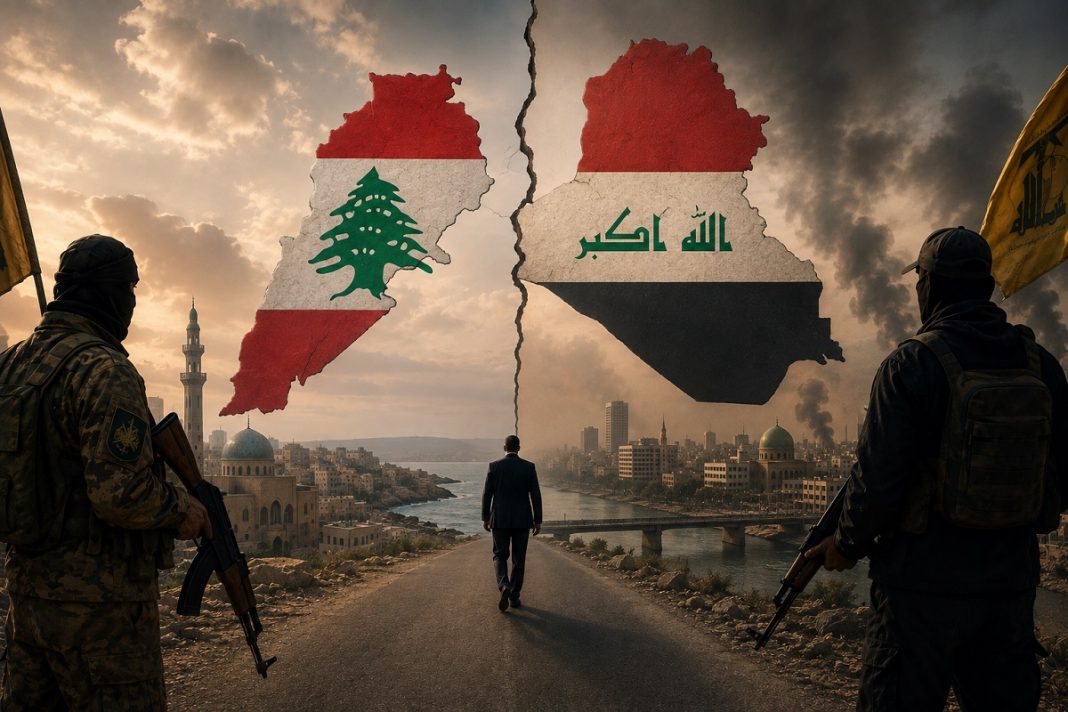
Iraq and Lebanon are confronting what appear to be two different political crises. Baghdad is trying to bring armed factions under the authority of the state. Beirut is struggling with a much older and more politically explosive question: the future of Hezbollah’s weapons.
The histories are different, the institutions are different, and the balance of power between state and nonstate actors is different. But beneath those differences lies the same question, perhaps the most fundamental one a sovereign state can face: Who has the authority to decide when a country goes to war?
In Iraq, that question has recently migrated from closed-door negotiations to television.
In a government-sponsored drama, a father complains that his son, Humaid, a militia fighter, refuses to surrender his weapon. His wife asks the obvious question: “Then who will protect the country?” An Iraqi fighter jet passes overhead. The father points to it. Those are Iraq’s defenders, he says. The country is safe. His son should hand over his weapon.
The scene ends with a slogan: “From weapons to life.”
It is propaganda. But it is also a remarkably concise description of the argument now taking place over the future of the Iraqi state. Baghdad is not simply trying to collect rifles, rockets and drones. It is trying to dismantle an idea that has become deeply embedded in Iraq’s political order since 2003: that the state cannot protect the country by itself and therefore requires armed forces that exist alongside it.
For years, that argument had considerable force.
Shiite armed groups gained legitimacy fighting the American presence after the fall of Saddam Hussein. Their claim became more powerful in 2014, when the Islamic State captured Mosul, the Iraqi military collapsed across large parts of the north, and the country faced an existential threat. The Popular Mobilization Forces played a major role in the campaign that eventually defeated the Islamic State’s territorial caliphate.
But exceptional necessity can become permanent entitlement.
The Islamic State no longer governs Iraqi cities. Iraq’s armed forces are considerably stronger than they were in 2014. And Baghdad and Washington have set Sept. 30 as the date for ending the international coalition’s military mission in Iraq. The Iraqi government has chosen the same deadline for bringing weapons under state authority.
Some factions have indicated a willingness to integrate more fully into official institutions or place their weapons under government control. Others remain resistant. The dispute is complicated by the peculiar architecture of Iraqi power: the Popular Mobilization Forces are themselves legally part of the state security apparatus, even as some factions within or around that structure maintain political loyalties, military capabilities and chains of influence that do not always end with the Iraqi commander in chief.
This is why the Iraqi problem cannot be reduced to the image of a militia fighter handing a rifle to a soldier.
The real issue is not simply where the weapons are stored. It is where the authority to use them resides.
That is where Iraq’s predicament begins to resemble Lebanon’s — without becoming identical to it.
Lebanon’s armed-state problem is more concentrated. Hezbollah is a cohesive political and military organization that has built, over decades, an arsenal and command structure independent of the Lebanese Armed Forces. Its weapons have been justified first by Israeli occupation, then by deterrence against Israel, and increasingly by a broader regional confrontation in which Hezbollah became a central component of Iran’s strategic network.
Iraq presents a more fragmented picture. Rather than one dominant armed organization standing visibly beside the state, Baghdad confronts a web of factions whose relationship with state institutions ranges from formal incorporation to considerable operational autonomy.
Lebanon has long wrestled with what might be called an armed power alongside the state. Iraq increasingly confronts something more ambiguous: armed power that can be inside the state and outside its effective control at the same time.
Yet the justification for retaining those weapons sounds strikingly similar in both countries.
Hard-line Iraqi factions argue that external threats remain, that Iraq’s air defenses are inadequate and that the state cannot yet protect the country without the forces that call themselves the “resistance.” Hezbollah argues that its weapons cannot be surrendered while Israel occupies Lebanese territory and continues to threaten Lebanon. Israel, meanwhile, links its withdrawal from positions in southern Lebanon to Hezbollah’s disarmament.
The result is a circular logic that has trapped both states:
Weapons remain because the state is weak; the state remains weak because it does not control the weapons.
If an armed organization is allowed to decide for itself when the state has become strong enough to deserve a monopoly on force, that moment may never arrive. And if every faction may define the external threat for itself — and retain missiles, drones and fighters until it independently determines that the danger has passed — sovereignty becomes conditional on the consent of those who possess the guns.
The dilemma becomes even more serious when the chain of military decision-making does not necessarily stop at the country’s borders.
Iran spent decades building regional influence through armed allies whose political and ideological relationships with Tehran sometimes give them strategic purposes beyond the immediate interests of the states in which they operate. That does not mean every Iraqi faction is simply commanded from Iran, nor does it erase Hezbollah’s distinctly Lebanese constituency and political history. But it does mean that decisions taken in Tehran — or confrontations involving Iran, Israel and the United States — can profoundly affect whether Iraqis or Lebanese wake up to war.
And this is where the argument stops being primarily about militias.
A state does not possess sovereignty because it has the largest army or the most weapons. It possesses sovereignty because it alone has the legitimate authority to make decisions whose consequences will be borne by the entire society.
Lebanon has learned the cost of that distinction repeatedly. When Hezbollah opens a front with Israel, the consequences are not confined to Hezbollah. Lebanese villages are destroyed, civilians are displaced, infrastructure is damaged and the national economy absorbs the shock. Whatever one thinks of Hezbollah’s motives, the Lebanese population bears the consequences of a decision its government did not make.
Iraq is vulnerable to the same contradiction. An armed faction can attack an American or Israeli target, provoke retaliation on Iraqi territory and leave Baghdad condemning a violation of sovereignty after the decision that helped trigger the retaliation was taken inside Iraq without the government’s authorization.
A state cannot indefinitely demand that outsiders respect a sovereignty that armed actors within its own borders are free to disregard.
None of this means Baghdad should go to war against the militias, or that Beirut can simply order Hezbollah to disarm tomorrow. Forced disarmament could turn divided sovereignty into civil conflict. Nor can governments demand weapons while failing to provide security. A Lebanese state seeking exclusive authority over force must be able to defend its territory and citizens, just as Iraq must demonstrate that its security institutions can protect a country whose recent history gives many citizens reason to distrust the promises of the state.
The harder task, therefore, is transformation: integrating fighters where integration is possible, establishing transparent control over weapons and financing, unifying operational command and ensuring that incorporation into official institutions does not merely replace the name on the barracks while preserving an autonomous military structure underneath.
The Iraqi television mother who asks, “Who will protect the country?” therefore poses an important question.
But it is not the most important one.
From Baghdad to Beirut, the deeper question is: Who gets to decide when the country goes to war?
A sovereign state can have a powerful army, multiple security agencies and an enormous arsenal. What it cannot sustain indefinitely is more than one authority with the power to decide when force will be used.
If that decision does not belong to the state alone, the weapons are certainly a problem.
But the larger problem is the state itself.
This article was originally published in Arabic on the Asswak Al-Arab website