Gabriel G. Tabarani
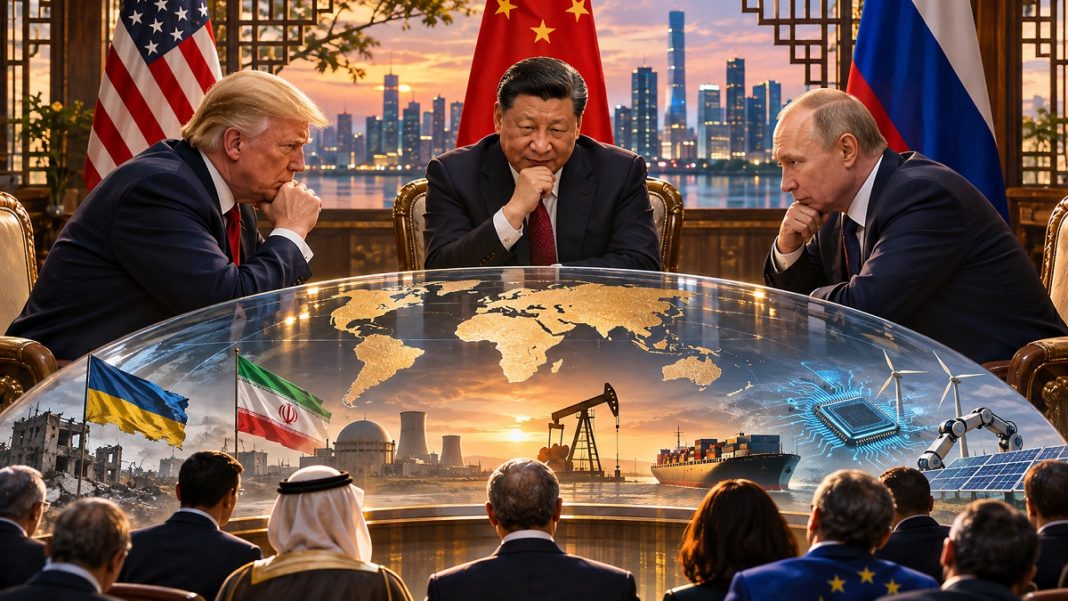
When President Donald Trump sits down with China’s Xi Jinping and Russia’s Vladimir Putin in Shenzhen on November 19, the gathering will invite an uncomfortable historical comparison. In February 1945, Franklin D. Roosevelt, Winston Churchill and Joseph Stalin met at Yalta to discuss the future of a world emerging from a devastating war. The circumstances could hardly be more different today. Yet the central question remains strikingly familiar: Can the world’s most powerful nations reach an understanding about international order without treating the sovereignty and interests of smaller countries as bargaining chips?
In December 1984, Zbigniew Brzezinski, the former U.S. national security adviser, published an essay titled “The Future of Yalta.” He challenged the conventional wisdom that Europe’s postwar division had been decided in a single meeting. By the time the three leaders gathered in Crimea, he argued, military realities and shifting balances of power had already shaped much of the continent’s future. The deeper failure was that Europe itself — the subject of the negotiations — had little say in determining its fate.
More than eight decades later, the prospect of another gathering of great powers raises a similar concern, even in a radically transformed world. The Soviet Union is gone. China has become an economic and technological superpower. Europe is no longer divided by the Iron Curtain. But a meeting among Washington, Beijing and Moscow inevitably raises questions about who gets to shape the emerging international order — and who may be expected to live with decisions made elsewhere.
The three leaders do not share a common vision. The United States seeks to preserve its strategic advantages and reshape its economic and security relationships. China wants recognition of its central role in global commerce, technology and finance. Russia seeks to consolidate its influence and secure acknowledgment of what it considers its strategic interests. Their priorities may converge on preventing a direct confrontation among nuclear powers. They diverge sharply, however, over the boundaries of influence and the rights of countries caught between them.
That tension lies at the heart of Brzezinski’s warning. At Yalta, Roosevelt hoped that cooperation among the victorious powers could provide the foundation for lasting peace. Stalin, meanwhile, was determined to translate Soviet military advances into enduring political control. The agreements reached by the leaders concealed profound differences over what the postwar order should look like.
Shenzhen is not another Yalta. No world war is nearing its conclusion, and no victorious alliance is preparing to distribute the spoils. But the danger is not that history will repeat itself precisely. It is that great-power diplomacy could once again produce arrangements affecting countries that have little influence over the negotiations.
Ukraine offers the clearest test. For Moscow, the war is inseparable from its broader effort to reshape Europe’s security architecture. For Ukraine, any settlement that compromises its sovereignty or territorial integrity risks legitimizing the use of force to change borders. European governments, meanwhile, have reason to fear that decisions affecting their security could be negotiated without their meaningful participation.
Whether Ukraine is formally discussed in Shenzhen or not, the underlying question is unmistakable: Can a durable European security order emerge if Europeans — and Ukrainians in particular — are not central to its design?
Iran presents a different but equally consequential challenge. The repercussions of the U.S.-Israeli war against Iran have extended beyond the battlefield, raising urgent questions about Gulf security, energy supplies, maritime trade and nuclear proliferation. Washington views the Iranian question primarily through the lenses of regional security and nuclear risks. Beijing has substantial interests in stable energy markets and uninterrupted trade. Moscow maintains strategic ties with Tehran.
Any understanding among the three powers over Iran’s future might help reduce tensions. But an arrangement that sidelines Iran or the Gulf states most directly exposed to the consequences would be unlikely to provide a lasting foundation for regional stability.
Today’s world also differs from Yalta’s in one fundamental respect: Economic power is now inseparable from geopolitical influence.
Competition among major powers extends far beyond territory and military bases. It encompasses artificial intelligence, semiconductors, critical minerals, energy supplies, global payment systems and the trade routes that sustain international commerce. A country no longer needs to occupy another’s territory to constrain its choices. Control over technology, markets, investment flows or financial networks can be just as consequential.
That reality gives any understanding among Washington, Beijing and Moscow implications for global trade, capital flows and energy markets. Yet it also makes a neat division of the world into exclusive spheres of influence far more difficult. Economic interdependence remains extensive, while the European Union, India, Japan and the Gulf states possess resources and relationships that complicate any attempt by three capitals to dictate the rules.
For the Arab world, the central question is therefore not simply whether the great powers will reach an agreement. It is whether the region’s countries can help shape the arrangements that affect them.
The Middle East occupies a pivotal position in global energy markets, maritime trade and investment networks. Several Arab states have expanded their room for diplomatic maneuver by maintaining strong security partnerships with Washington while deepening commercial ties with Beijing and preserving channels of communication with Moscow. Such diversification offers opportunities, but it also exposes the region to the consequences of intensifying great-power competition.
Gulf security, freedom of navigation, regional conflicts and the future of the Palestinian question cannot be reduced to bargaining chips in negotiations among outside powers. Nor can economic wealth and strategic geography alone guarantee political influence. What is needed is greater regional coordination, stronger institutions and the ability to translate shared economic interests into diplomatic leverage.
The Shenzhen meeting may produce limited understandings, a framework for managing strategic competition or little more than a commitment to keep talking. It would be premature to declare it the birth of a new world order. International systems are shaped not only by summits but also by wars, economic strength, technological change, alliances and the determination of nations to defend their interests.
Yalta demonstrated that agreements among powerful states do not necessarily produce a just or lasting peace. Subsequent history also showed that spheres of influence are not permanent. Political movements, economic transformations and the choices of nations can overturn arrangements once thought immovable.
The real measure of the Trump-Xi-Putin meeting, then, will not be the historic photograph it produces. It will be whether the three leaders can reduce the risk of conflict without compromising the sovereignty of others.
Dialogue among great powers is necessary, particularly in a nuclear age. But there is a fundamental difference between negotiating with other nations and negotiating over their heads. That was the enduring lesson of Yalta. It is one the world cannot afford to forget in Shenzhen.
This article was originally published in Arabic on the Asswak Al-Arab website