Gabriel G. Tabarani
As Americans vote in the midterm elections on Tuesday, November 3, 2026, the confrontation involving the United States, Israel and Iran is entering a particularly dangerous phase. Washington is showing signs of preparing for another major military campaign, Israeli leaders appear determined to intensify pressure on Tehran, and regional mediators are still trying to prevent a wider war. Yet for the Gulf states, the most pressing question is not whether the United States can strike Iran. Few doubt its ability to do so. The question is what happens afterward: Can Washington prevent Tehran from retaliating against American bases and critical infrastructure across the region? And can a military operation remain confined to a defined set of targets without disrupting oil and gas exports, commercial ports and vital shipping routes?
These questions have acquired greater urgency as previous confrontations have demonstrated that overwhelming military superiority does not necessarily translate into economic security. A strike on a major energy installation or a prolonged disruption in the Strait of Hormuz could inflict damage far beyond the immediate combatants, unsettling global energy markets, trade flows and investment. For Gulf governments pursuing ambitious economic diversification programs, the prospect is especially troubling. They may have little influence over the timing or scale of a confrontation, yet find themselves absorbing much of its cost. That is the central paradox of the current crisis: A decision to go to war may be made in Washington, shaped partly by Israeli strategic calculations, while the consequences spread across economies that have spent years trying to insulate themselves from regional instability.
A Formidable American Force — and the Limits of Readiness
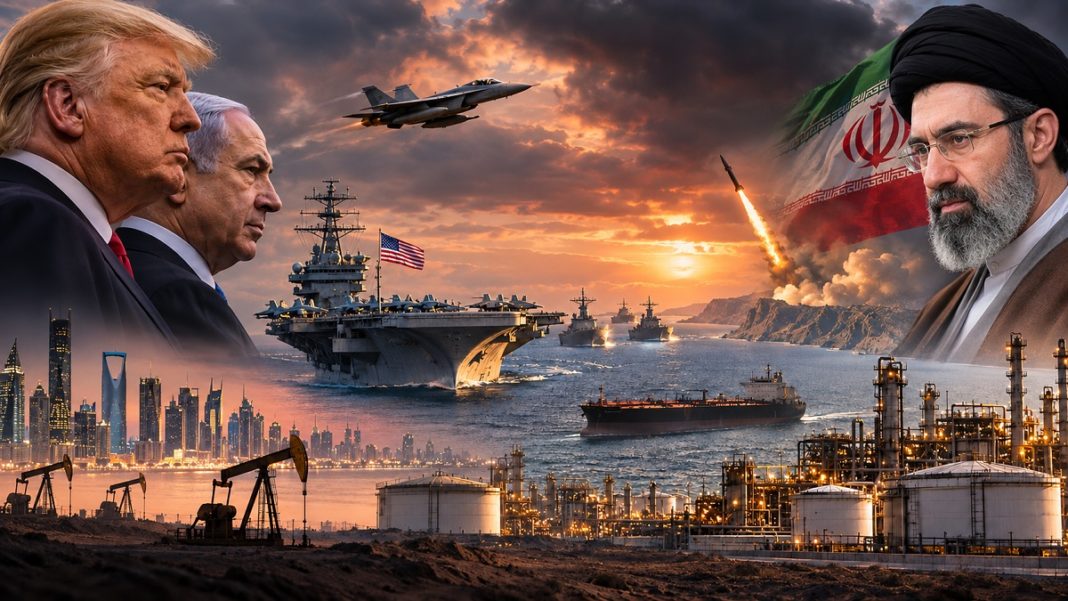
Available military assessments point to a significant repositioning of American forces across the Middle East, designed both to strengthen offensive capabilities and to reduce their vulnerability to Iranian retaliation. Published estimates put the American military presence in the region at roughly 50,000 personnel, supported by approximately 200 fighter aircraft, 30 A-10 attack planes, naval forces and advanced air-defense systems. These are open-source estimates rather than an official Pentagon accounting, but they offer a useful indication of the scale of Washington’s preparations and the options available to American military planners.
According to naval deployment tracking data dated October 26, the aircraft carriers USS George Washington and USS George H.W. Bush were operating in the Arabian Sea, accompanied by their strike groups and support vessels. The broader American naval presence was estimated at about 20 ships, while an amphibious group led by the USS Boxer, carrying U.S. Marines, was also reported to be operating in the region. A third aircraft carrier, the USS Theodore Roosevelt, remained in the western Pacific at that time, following its participation in American-Japanese military exercises that concluded on October 29. Available assessments suggested that the carrier, along with an additional amphibious group led by the USS Makin Island, could reach the region in the second half of November, potentially adding 9,000 to 10,000 American military personnel to the forces operating under U.S. Central Command.
The timing of those reinforcements is important because it offers some insight into the possible scale and duration of a new military campaign. The forces already deployed appear sufficient for a short, high-intensity air and naval operation, but sustaining a longer confrontation could require additional resources, particularly if Iranian retaliation forced Washington to devote more aircraft, ships and defensive systems to protecting its bases, regional partners and maritime routes. The distinction matters politically as well as militarily. A limited campaign might be presented as a demonstration of American resolve, whereas a prolonged conflict would expose the administration to a far more complicated set of strategic, economic and domestic political pressures.
American military airlift activity provides another indication of heightened preparations. Open-source flight-tracking data recorded 193 flights by U.S. Air Force C-17 and C-5M heavy transport aircraft into the region between September 29 and October 29, including nine flights on the final day of that period. Israeli media also reported the arrival of 10 American military transport aircraft at Nevatim and Ovda air bases in southern Israel in late October, alongside similar movements toward Jordan, Saudi Arabia and Qatar. The buildup has reportedly included additional Patriot air-defense batteries in Saudi Arabia and Qatar, while an American THAAD missile-defense system remains deployed in Israel. Taken together, these movements suggest that Washington is preparing not only to project military power but also to strengthen its ability to absorb and counter potential Iranian retaliation.
Not every claim about the scale of these movements, however, has been substantiated. Some Israeli reports suggested that approximately 80 American aerial refueling aircraft had arrived in Israel within 48 hours, but available tracking data does not provide sufficient evidence to confirm that figure, which appears considerably higher than other reported movements. At the same time, Washington has reportedly moved some personnel and equipment away from locations considered particularly vulnerable to Iranian attacks, including sites in Iraq, Syria and Kuwait. Such redeployments do not necessarily indicate a reduction in American military capability. Rather, they suggest an effort to preserve offensive options while limiting the exposure of troops and equipment to retaliatory strikes.
Al Udeid Air Base in Qatar remains central to those calculations because of its role in American air operations and its support for aerial refueling aircraft that allow fighters and bombers to operate over considerable distances. Satellite imagery available through November 1 showed between 19 and 26 large aircraft-sized objects on the base’s parking aprons during separate observations in October, without revealing an evacuation on the scale seen before the previous round of fighting. Although the resolution of the imagery was insufficient to identify every aircraft, the absence of a comparable precautionary withdrawal suggests that Washington had not, at least by that date, adopted all the measures associated with preparations for a major confrontation. There was also no conclusive visual evidence of a substantial forward deployment of American heavy strategic bombers during the final days of October, although such aircraft could still conduct missions against targets in the Middle East from bases in the United States.
Taken together, the military picture suggests that Washington possesses the capability to conduct limited strikes or a relatively short air and naval campaign, while continuing to assemble some of the resources that might be needed for a longer and more complicated confrontation. Military readiness, however, should not be confused with a political decision to go to war. That distinction has become increasingly important following American press reports that U.S. forces carried out limited strikes against Iranian targets on Qeshm Island, near the Strait of Hormuz, on Monday, November 2. Citing officials in Washington, the reports described the strikes as defensive measures, with one American official saying they did not signal a resumption of major combat operations. Iranian media also reported explosions on the island, although the precise targets and extent of the damage were not immediately clear. The reported incident illustrates how military confrontation can continue at a limited level even as diplomatic efforts remain underway, and how quickly a crisis can move from threats to the use of force without a formal announcement of a broader campaign.
Netanyahu’s Pressure, Washington’s Calculations — and the Gulf’s Exposure
Alongside the American military preparations, statements by Israeli leaders and media reports suggest that Prime Minister Benjamin Netanyahu’s government favors renewed military pressure on Iran. The Israeli calculation appears to rest on the belief that current conditions offer an opportunity to weaken Tehran’s military capabilities and regional influence in ways that diplomacy alone may not achieve. Netanyahu has spoken of a historic opportunity to alter the strategic equation with Iran, while reports have pointed to discussions with President Donald Trump about the future of military operations. Yet the interests of Israel, the United States and the Gulf states are not necessarily identical. Israel may see renewed confrontation as an opportunity to secure strategic gains against a longstanding adversary, while Washington must also consider the safety of its forces, the security of its regional bases and the consequences of military escalation for international energy markets. The Gulf states face a different predicament: Their territory, infrastructure and economic interests could become exposed to retaliation even though they did not initiate the conflict.
This does not mean that Washington is simply following Netanyahu’s lead. The United States has its own strategic objectives in confronting Iran, and American decisions will ultimately reflect calculations made in the White House and the Pentagon. But the convergence of Israeli pressure for stronger military action and American operational readiness could narrow the space for diplomacy, particularly if leaders in either country conclude that the opportunity to weaken Iran may not last. The American electoral calendar adds another layer of complexity. Launching a major military campaign before the midterm elections could have imposed significant political costs on the Trump administration, especially given public sensitivity to gasoline prices and the economic consequences of war. Once voting concludes, some of those immediate electoral considerations may recede, potentially giving the White House greater freedom to consider military options. The end of the election, however, does not automatically mean the beginning of a wider war. The decision will still depend on diplomatic developments, military assessments and the administration’s willingness to accept the risks of escalation.
Indirect negotiations between Washington and Tehran have continued through regional intermediaries, particularly Qatar, in an effort to ease tensions and address the disruption of shipping through the Strait of Hormuz. Iranian demands have reportedly included sanctions relief, security guarantees and arrangements concerning the American military presence in the region. Washington thus appears to be pursuing two tracks simultaneously: strengthening its military position to increase pressure on Tehran while keeping open the possibility of a negotiated settlement. The danger is that a military buildup intended to strengthen diplomacy can also make war more likely if either side misreads the other’s intentions. A limited exchange of fire, an attack on an American installation or a miscalculation over the scope of retaliation could quickly transform a controlled confrontation into a regional conflict.
For the Gulf states, the economic consequences could be profound. Under normal conditions, oil shipments through the Strait of Hormuz amount to roughly one-fifth of global petroleum consumption, and although alternative pipelines and export routes can provide some relief, they cannot easily replace the strait’s full capacity. A prolonged disruption would raise shipping and insurance costs, strain energy supplies and ripple through international commodity markets and supply chains. Nor would higher oil prices necessarily benefit Gulf producers. If rising prices coincided with interrupted exports, damaged facilities or heightened security risks, the resulting economic losses could outweigh any gains from more expensive crude. The implications extend well beyond the energy industry. Over the past decade, Gulf economies have invested heavily in ports, airports, logistics networks, tourism, financial services and other sectors intended to reduce their dependence on oil revenues. Those industries depend on stability, investor confidence and the uninterrupted movement of goods, capital and people, all of which could come under pressure in a prolonged regional war.
The Gulf states’ overriding interest, therefore, is not simply which side gains the military advantage. It is preventing the region from becoming an open battlefield and preserving diplomatic channels capable of containing the confrontation. For Washington, the deeper strategic problem is defining what a new military campaign would actually seek to accomplish. Destroying a specific set of Iranian military facilities is one objective; forcing Tehran to accept negotiating terms is another; fundamentally changing the regional balance of power is a far more ambitious undertaking. Each objective carries a different military cost and a different risk of prolonged conflict, and the greater the ambition, the harder it may become to determine when military operations have achieved enough to justify ending them.
Nor is there any guarantee that a powerful American strike would weaken Iran’s willingness to retaliate. During a meeting with senior military commanders on October 31, Iran’s supreme leader, Mojtaba Khamenei, reportedly instructed the armed forces to prepare for an immediate and effective response to any renewed American or Israeli attack, without geographic restrictions. He also called for updating potential target lists to include American and Israeli interests and assets, warning that Iran would determine when and under what conditions a renewed confrontation would end. The message was intended to make clear that another war might not remain confined to Iranian or Israeli territory and that countries hosting American bases or other strategic assets could find themselves exposed to the consequences. Such threats may be intended primarily to strengthen deterrence and discourage an attack, but they also increase the danger of escalation if diplomacy fails. Washington could then find itself fighting a longer war than it anticipated, while Gulf states confront mounting security and economic pressures.
The region now faces three broad possibilities: a diplomatic agreement that leaves military pressure in place as leverage; limited strikes that Washington attempts to contain; or a wider confrontation in which American, Israeli and Iranian calculations interact in ways none of the parties can fully control. The growing American military presence demonstrates that Washington has the means to resume large-scale operations against Iran, but it does not establish whether the United States could end such a campaign on its own terms. The greatest danger may not lie in the first strike, but in the war that follows — a war that exceeds the objectives of Washington and Israel while leaving the Gulf states and global energy markets to bear much of the cost.
This article was originally published in Arabic on the Asswak Al-Arab website