Gabriel G. Tabarani
The Republican defeat in America’s midterm elections was more than a political setback for President Donald Trump. It was a rebuke to a president who has built his political identity around strength, personal authority and the conviction that he can bend events to his will, at home and abroad. Two years into his return to the White House, Trump now faces a Congress controlled by Democrats in both chambers, sharply limiting his ability to advance his domestic agenda and exposing his administration to greater scrutiny. Yet his authority over foreign policy remains considerable. That creates a potentially consequential paradox: A president weakened at home may look abroad for the achievements that could secure his place in history.
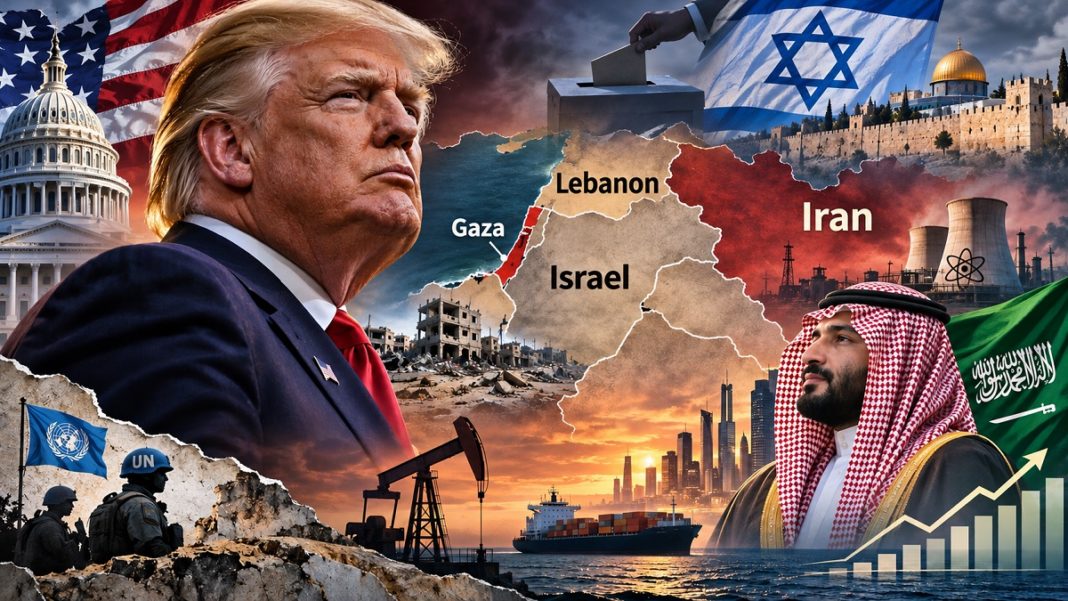
The question is not simply whether Trump will become more aggressive in the final two years of his presidency. It is whether his desire for a defining foreign policy legacy can be reconciled with the political and strategic realities of a world that is increasingly resistant to American dictates. Nowhere is that challenge more apparent than in the Middle East, where Trump has sought to reshape the regional order through military pressure, diplomatic agreements and an ambitious effort to bring Israel and its Arab neighbors closer together.
American presidents have often turned to foreign policy as their time in office draws to a close. But Trump’s preference for personal diplomacy, abrupt decisions and high-pressure bargaining makes his final two years especially difficult to anticipate. Although the new Congress can constrain spending, investigate executive actions and complicate legislative initiatives, its ability to dictate the president’s day-to-day foreign policy decisions is more limited. That does not give Trump unlimited freedom. Congress retains important powers over funding and oversight, while prolonged military commitments carry economic and political costs that no administration can ignore. Still, the imbalance between his diminished domestic authority and his substantial international powers could make foreign affairs an increasingly attractive arena for political achievement.
Iran presents the most immediate test. The war and its economic repercussions, including higher energy prices and mounting pressure on household budgets, contributed to voter dissatisfaction with Republicans. Yet Trump has shown little inclination to reconsider the decision to go to war. His administration could now pursue a negotiated settlement that allows the president to claim that military pressure achieved its objectives. Alternatively, it could intensify that pressure in the hope of extracting concessions that could be presented as a decisive victory.
Neither course offers a straightforward solution. Iran is not merely a military problem that can be resolved through superior American firepower. It is a central actor in a complicated regional balance, and any renewed escalation could threaten Gulf security, international shipping and global energy supplies. Even a successful cease-fire would be only the beginning of a durable settlement. Without arrangements that reduce the risk of another confrontation, an end to the fighting could amount to little more than an interval before the next crisis.
The consequences extend well beyond Iran. The future of Gaza, the fragile diplomatic framework between Lebanon and Israel, and the prospects for expanding the Abraham Accords are all influenced, to varying degrees, by the wider regional security environment. A negotiated understanding with Tehran could create more favorable conditions for diplomatic progress elsewhere. Renewed confrontation, by contrast, could deepen insecurity, complicate existing agreements and increase the political costs of normalization with Israel.
But it would be a mistake to assume that these initiatives form a coherent American blueprint accepted by the region’s principal actors. Israel approaches Iran primarily through the lens of national security. Gulf governments increasingly define security in terms that include economic development, investment and the avoidance of another regional war. For Palestinians, the central questions remain self-determination, sovereignty and the future of their national aspirations. These priorities overlap in some areas but diverge sharply in others. Washington’s challenge is not simply to bring the parties together. It is to reconcile competing interests that cannot be resolved by diplomatic ceremony or presidential pressure alone.
Gaza illustrates the difficulty. With the establishment of Trump’s Board of Peace and the introduction of transitional arrangements for governing and rebuilding the territory, the administration has sought to turn the end of the fighting into the foundation of a broader regional settlement. But managing a postwar transition is not the same as resolving a decades-old conflict.
Reconstruction requires financing, security and functioning institutions. Peace requires something more: a credible political framework that addresses Palestinian rights, governance, sovereignty and relations with Israel. The success of the Board of Peace cannot be measured solely by the funds it mobilizes or the projects it launches. It will ultimately depend on whether authority can pass to legitimate and capable Palestinian institutions, and whether reconstruction is accompanied by a political horizon that prevents temporary arrangements from becoming a permanent substitute for self-determination.
There is a fundamental danger in treating economic recovery as a replacement for political resolution. New housing, infrastructure and investment are indispensable to Gaza’s future. But without a settlement that addresses the underlying conflict, reconstruction could produce only a fragile stability vulnerable to the next outbreak of violence.
Lebanon offers another test of the administration’s ability to translate diplomatic initiatives into lasting security arrangements. The framework agreement signed by the United States, Lebanon and Israel in June established a road map for ending the conflict, linking a gradual Israeli withdrawal from southern Lebanon to the extension of Lebanese state authority and measures addressing Hezbollah’s weapons.
The agreement’s central difficulty has always been the sequence of implementation. Israel seeks security guarantees and progress on Hezbollah’s disarmament before completing its withdrawal. Lebanon insists on sovereignty and an end to the Israeli military presence on its territory. Neither position can simply be dismissed, but neither can be fulfilled without credible mechanisms for reciprocal compliance.
This is not merely a dispute over timetables. It raises a more consequential question: Can a sustainable security arrangement emerge when mutual trust is absent, Lebanese state institutions remain under strain and neither side is confident that the other will honor its commitments?
Pressure on Beirut alone will not resolve the problem. Nor will demands for an Israeli withdrawal, however legitimate, establish a durable peace without enforceable security arrangements. Any lasting agreement will require international guarantees, meaningful support for Lebanese institutions and a framework that strengthens state sovereignty while providing security on both sides of the border. Otherwise, a diplomatic breakthrough celebrated in Washington could remain little more than an agreement on paper.
Israel’s October 27 election has introduced another layer of uncertainty. Benjamin Netanyahu’s political camp lost its parliamentary majority, but the opposition led by Gadi Eisenkot has yet to establish a viable alternative government. Although Eisenkot received more recommendations from lawmakers, divisions among potential coalition partners have left the formation of a new government unresolved.
The implications extend far beyond Israeli domestic politics. The composition and priorities of the next government could influence negotiations over Lebanon, the administration of Gaza, relations with the Palestinians and the prospects for expanding the Abraham Accords. A change in leadership might alter negotiating tactics or diplomatic priorities, but it would not automatically eliminate longstanding Israeli security concerns or produce agreement on Palestinian statehood.
The American election adds a second complication. With Democrats controlling Congress, an incoming Israeli government may have stronger incentives to cultivate relationships across the American political spectrum rather than depend primarily on Trump. The president, in other words, faces not only a less accommodating political environment in Washington but also an evolving political landscape in Israel that could limit his ability to deliver the agreements he seeks.
Saudi Arabia occupies a pivotal position in this changing equation. Bringing the kingdom into the Abraham Accords would represent a major diplomatic achievement for Trump, potentially transforming the strategic landscape of the Middle East. But normalization cannot be separated from Riyadh’s position on Palestinian statehood.
That position gives Saudi Arabia considerable influence over the terms of any broader regional settlement. The kingdom is not simply a prospective participant in an American-sponsored diplomatic initiative. Its political, economic and religious weight gives it the ability to shape the conditions under which a new regional framework might emerge.
Saudi priorities also reflect a wider transformation in Gulf strategic thinking. While the United States remains an essential security partner, Gulf governments have increasingly emphasized regional stability, economic diversification and the avoidance of military confrontations that could undermine their long-term development plans. Their interests do not always coincide with those of Washington or Israel, particularly when military escalation threatens economic gains.
For Saudi Arabia and its Gulf neighbors, security is no longer defined solely by military deterrence or the balance of power. It is also measured by the ability to attract investment, develop new industries, expand tourism, build infrastructure and integrate more deeply into the global economy. These ambitions require a predictable regional environment.
The economic consequences of instability are therefore central to the strategic equation. War does more than drive up oil and gas prices. It raises shipping and insurance costs, disrupts supply chains, undermines investor confidence and complicates the movement of capital. For Gulf economies investing heavily in technology, logistics, tourism and industrial diversification, a prolonged regional confrontation could threaten the foundations of their economic transformation.
Conversely, durable settlements in Gaza and Lebanon could open opportunities for reconstruction, investment and regional economic cooperation. But capital cannot substitute for political agreement. Investors require functioning institutions, reliable legal frameworks and security arrangements capable of surviving changes in government. Economic integration may reinforce peace, but it cannot manufacture peace where the underlying political disputes remain unresolved.
These constraints are not unique to the Middle East. Europe is watching the future of American security commitments. Ukraine faces uncertainty over the terms of any possible settlement with Russia. China is closely monitoring changes in Washington’s strategic calculations. Trump may seek major diplomatic achievements across several regions before leaving office, but pursuing multiple agreements simultaneously does not necessarily increase his capacity to deliver durable results.
Indeed, the temptation to prioritize speed and spectacle could undermine the very legacy he hopes to establish. A cease-fire is not necessarily peace. A framework agreement is not necessarily a settlement. And a normalization ceremony, however significant, cannot by itself resolve the political conflicts that have shaped the Middle East for generations.
The midterm elections exposed the limits of Trump’s political strength at home. Israel’s election has added new uncertainty to his diplomatic calculations abroad. Yet the president still possesses considerable power to influence the region’s future. He may hope to leave office having ended the confrontation with Iran, helped rebuild Gaza, expanded the Abraham Accords and secured a lasting agreement between Lebanon and Israel.
Whether those ambitions succeed will depend on much more than American pressure or presidential determination. Iran, Israel, the Palestinians, Lebanon and the Gulf states all have interests, constraints and political choices of their own. Any regional order that fails to accommodate those realities is unlikely to endure.
For Gulf governments, the central lesson is not to wait for Washington to determine the region’s future. Their economic resources, diplomatic relationships and growing strategic influence give them an opportunity to help shape the terms of regional stability rather than merely adapt to decisions made elsewhere.
Trump may still have the power to redraw parts of the Middle East’s political landscape. What he cannot do alone is determine whether the resulting order will last.
The question, ultimately, is not simply whether Trump will leave behind a more peaceful Middle East. It is who will have the power to define that peace, on what terms, and in whose interests.
This article was originally published in Arabic on the Asswak Al-Arab website