Gabriel G. Tabarani
Russia’s veto of a US-backed resolution on Western Sahara has complicated Morocco’s diplomatic ambitions, but it has not reversed the broader shift in international thinking about the territory. If anything, the Security Council’s failure to agree on the future of the United Nations mission has exposed the limitations of a framework that has managed the dispute for decades without bringing it closer to a lasting settlement.
For Rabat, the significance of the October 30, 2026, confrontation lies less in the immediate outcome than in the changing terms of the debate. Morocco has steadily moved its autonomy proposal from the margins of international diplomacy toward the center of discussions about a political solution. The challenge now is to turn that diplomatic momentum into a settlement capable of delivering stability, effective local governance, and broader regional benefits.
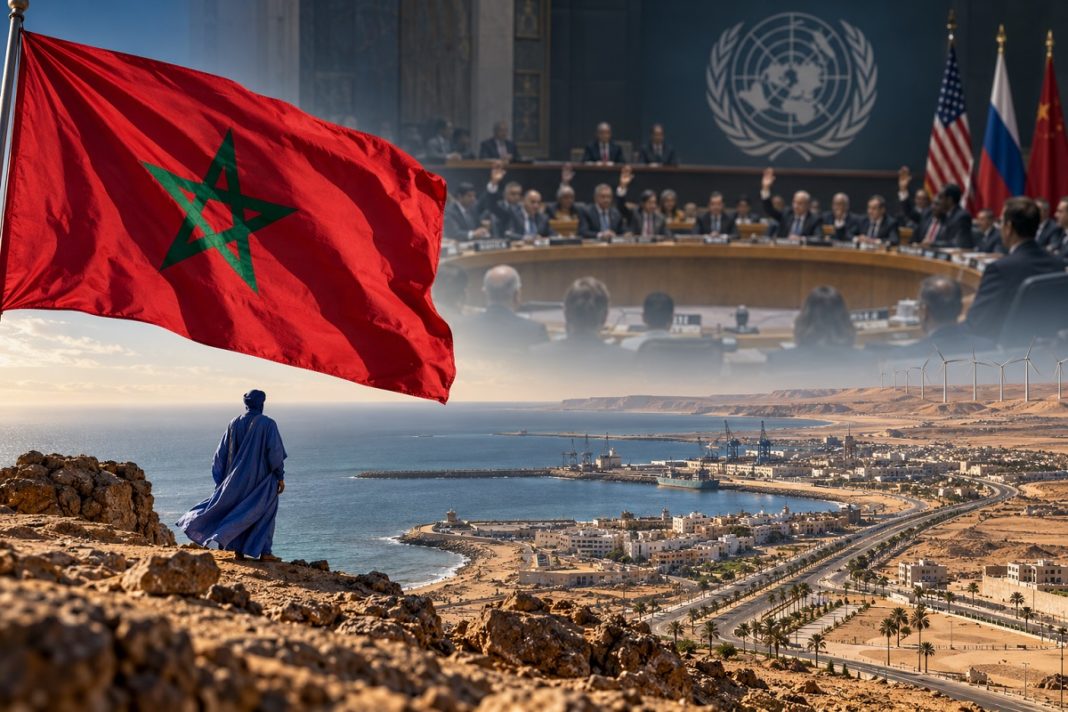
The American draft, supported by eleven Security Council members before being blocked by Moscow, sought to reinforce Morocco’s autonomy initiative as the principal basis for negotiations while reconsidering the structure and mandate of the UN Mission for the Referendum in Western Sahara, known as MINURSO. A competing Russian proposal to preserve the mission’s traditional framework failed to secure the votes required for adoption.
Neither initiative prevailed. Yet the outcome revealed something important: the international consensus that sustained the existing UN arrangements has weakened considerably.
The Russian veto should not be interpreted simply as an endorsement of Algeria’s position or a rejection of Morocco’s territorial claims. Moscow maintains substantial strategic ties with Algiers, but it also values its relationship with Rabat. Its objections reflect a wider contest over diplomatic influence and Washington’s ability to shape the terms of international conflict resolution.
Western Sahara has therefore become another arena in which regional disputes intersect with great-power competition. For Morocco, this presents both an opportunity and a warning. Western support has strengthened its diplomatic position, but the durability of any settlement should not depend exclusively on the shifting calculations of Washington, Moscow, or European capitals.
Morocco’s progress, moreover, did not begin with the latest Security Council confrontation. It reflects a sustained diplomatic strategy, supported by expanding economic partnerships, a growing role in African trade and security, and an increasingly persuasive argument that the referendum envisaged when MINURSO was established in 1991 has become politically unworkable.
Security Council Resolution 2797, adopted in October 2025, marked an important stage in that evolution by strengthening the place of Morocco’s autonomy proposal in the negotiating process. It did not settle the territory’s final legal status, but it reinforced the international search for a practical political arrangement rather than an indefinite continuation of an unresolved process.
That distinction matters. Morocco’s strongest argument is not that diplomatic recognition alone can end the dispute. It is that meaningful autonomy under Moroccan sovereignty could offer a workable balance between territorial integrity and the aspirations of the territory’s inhabitants.
For such an arrangement to succeed, however, autonomy must be more than a constitutional formula. It would require credible representative institutions, clearly defined local powers, legal safeguards, and genuine participation in decisions affecting the territory’s economic and social development.
These are not concessions that weaken Morocco’s position. They are the elements that could make its proposal more credible internationally and more sustainable locally.
The uncertainty surrounding MINURSO also creates responsibilities that should not be underestimated. Although the mission never fulfilled its original referendum mandate, its monitoring role helped provide a measure of international oversight in a fragile security environment. With the ceasefire effectively broken since November 2020, the absence of an agreed UN framework could increase the risks of miscalculation and escalation.
The expiration of a peacekeeping mandate does not, by itself, remove Western Sahara from the United Nations’ agenda or resolve its status under international law. Morocco would therefore gain little from treating the institutional impasse as the definitive end of the dispute. Its interests are better served by combining diplomatic confidence with restraint, political engagement, and a commitment to preventing renewed confrontation.
The regional dimension is equally important. Algeria regards Western Sahara as a question of self-determination and regional balance, while Morocco considers sovereignty over the territory a fundamental national issue. The Polisario Front remains a central participant in the dispute. These conflicting positions cannot simply be wished away by changes in international diplomatic alignments.
Yet acknowledging those realities does not diminish Morocco’s achievements. Rather, it underscores the importance of using its stronger position to encourage a political process that addresses legitimate concerns without reopening an endless cycle of confrontation.
The economic costs of the dispute provide a compelling reason to seek such an outcome. Closed borders, limited trade, and decades of political estrangement have deprived the Maghreb of opportunities for integration at a time when regional cooperation is becoming increasingly important to economic resilience.
Morocco has invested heavily in infrastructure, ports, renewable energy, and transport links in its southern provinces, seeking to position the territory as a gateway between North Africa and the continent’s Atlantic economies. These projects offer a potentially powerful foundation for long-term prosperity.
But development will carry greater political weight if local communities participate meaningfully in shaping its priorities and sharing its benefits. Economic investment can reinforce a settlement; it cannot substitute for the institutions and guarantees that make one legitimate and durable.
The broader lesson of the Security Council deadlock is that international diplomacy can alter the balance of a dispute without necessarily resolving its underlying causes. Morocco has made substantial progress in establishing autonomy as a central reference point for negotiations. The next stage will test whether that diplomatic achievement can be translated into a credible political settlement.
For Rabat, this is an opportunity to demonstrate that sovereignty, local self-government, and regional stability need not be competing objectives. Properly designed and implemented, they could become mutually reinforcing foundations for a different future.
Morocco has gone a long way toward winning the argument over the political framework for Western Sahara. Its more consequential task is to demonstrate that autonomy under Moroccan sovereignty can deliver the lasting peace that decades of international mediation have failed to achieve.
This article was originally published in Arabic on the Asswak Al-Arab website