Gabriel G. Tabarani
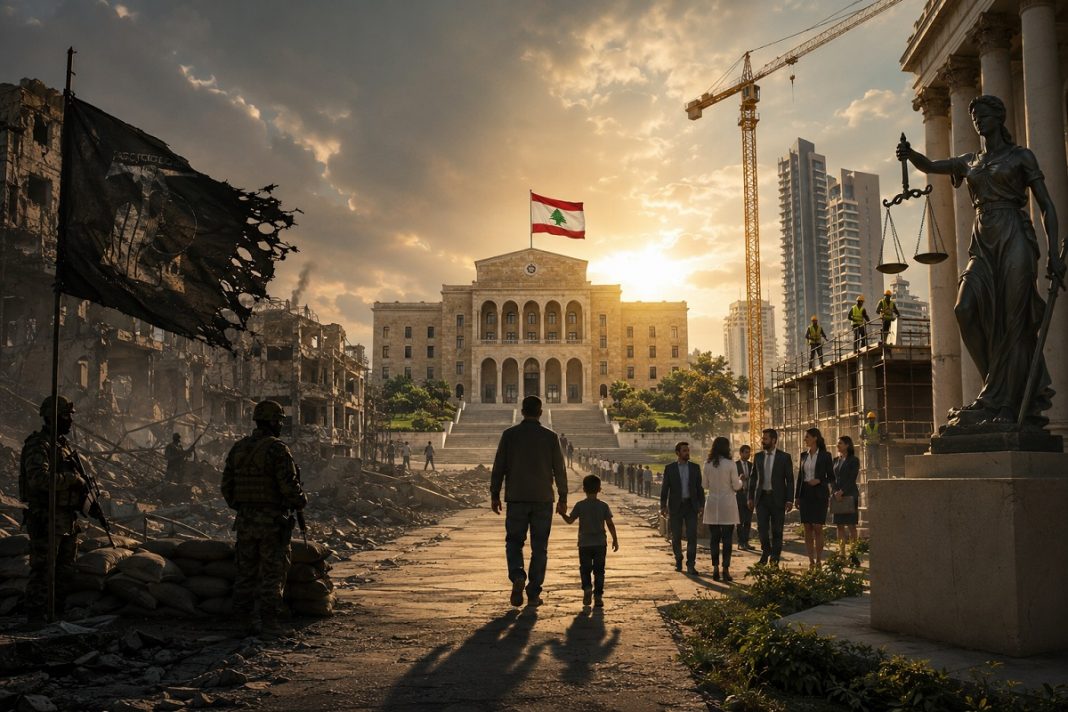
Military victories can change the balance of power, but they rarely determine a country’s future. What matters is what comes after the battlefield falls silent. Lebanon now stands at precisely such a moment. Hezbollah may be weaker than it has been in years, yet that alone will not decide whether Lebanon moves toward stability or slides into another cycle of crisis. The country’s future depends not on the decline of one armed movement, but on the return of one functioning state.
There should be no ambiguity about Hezbollah’s role in Lebanon’s troubles. Over the past two decades, the group has become one of the greatest obstacles to state sovereignty, maintaining an independent military force, exercising decisive political influence, and repeatedly placing national decisions outside the authority of elected institutions. But reducing Lebanon’s crisis to Hezbollah alone mistakes a symptom for the disease. Armed movements do not become powerful because states are strong; they flourish because states are weak.
For years, the United States and its partners largely approached Lebanon through a security lens. The priority was to contain Hezbollah through sanctions, financial pressure, intelligence cooperation, and regional deterrence. Those policies may have constrained some of the group’s capabilities, but they never addressed the deeper structural conditions that allowed Hezbollah to become far more than an armed organization. It evolved into a parallel system because the Lebanese state steadily lost its ability to govern effectively, deliver public services, enforce the rule of law, and earn the confidence of its own citizens.
That distinction matters because weakening Hezbollah and rebuilding Lebanon are not the same objective. One can happen without the other. History offers countless examples of armed groups losing ground while the states around them remained fragile, divided, and incapable of filling the vacuum. Unless state institutions recover their legitimacy and effectiveness, today’s victory can easily become tomorrow’s instability.
This is where many international strategies toward Lebanon have fallen short. They focused overwhelmingly on limiting the power of one actor while paying insufficient attention to strengthening the institutions that should ultimately replace its influence. Yet the true measure of success is not whether a militia becomes weaker; it is whether the state becomes stronger.
The central question, therefore, is no longer how to diminish Hezbollah’s influence. It is how to build a Lebanese state that prevents any political or military organization from operating above the law in the future. That requires functioning courts, accountable public administration, professional security institutions, a productive economy, and political reforms capable of restoring public trust.
Military pressure can create an opening, but only institutions can secure a lasting peace. Hezbollah’s expansion also took place during years of Syrian dominance over Lebanon, when the country’s sovereignty and institutions were themselves severely constrained. Militias rarely destroy states by themselves. More often, they grow within states that have already begun to fail. Corruption, sectarian patronage, economic collapse, and institutional paralysis create spaces where alternative centers of authority emerge. Citizens who lose confidence in public institutions inevitably seek protection, services, and representation elsewhere.
The opportunity now facing Lebanon is therefore larger than the future of Hezbollah itself. It is an opportunity to redefine the relationship between citizens and the state. If Lebanon succeeds in rebuilding institutions that function impartially and effectively, the political space available to armed non-state actors will naturally shrink. If it fails, today’s shifts in the balance of power will simply prepare the ground for future crises under different names.
The responsibility for seizing this opportunity begins in Beirut, but it does not end there. Lebanon’s political leaders must recognise that rebuilding the state cannot be another slogan postponed by sectarian bargaining or short-term political calculations. Constitutional government, judicial independence, public-sector reform, and accountability are not technical issues; they are the foundation of national sovereignty. A state that cannot govern effectively cannot prevent others from governing in its place.
Regional partners also have a critical role to play. Arab states have repeatedly supported Lebanon during times of crisis, but financial assistance alone has never been enough. Injecting money into a broken political system without meaningful reform merely prolongs its dysfunction. Future support should focus less on sustaining the existing order and more on rebuilding the institutions that allow Lebanon to function as a normal state. Investment in education, infrastructure, economic recovery, public administration, and institutional reform will ultimately prove far more valuable than another round of emergency assistance.
The same lesson applies to the United States and its Western allies. For years, Washington devoted enormous attention to containing Hezbollah and limiting Iranian influence. That objective remains legitimate. No sovereign country can fully function while an armed organisation operates outside state authority. Yet containment alone cannot produce a stable Lebanon. If the ultimate objective is to reduce Iran’s long-term influence, then strengthening Lebanese institutions is not separate from that strategy—it is the strategy.
This requires a shift in perspective. Lebanon should no longer be viewed primarily as a security problem to be managed, but as a state-building project worth supporting. Security assistance remains important, but it must be matched by sustained political and economic engagement aimed at restoring institutional capacity. Effective courts, transparent governance, professional civil services, and economic opportunity do more to weaken extremist and militia movements over time than military pressure alone ever can.
The stakes extend beyond Lebanon itself. Across the Middle East, Iran’s regional strategy has often relied on exploiting weak states rather than confronting strong ones directly. Parallel armed structures emerge where governments lose legitimacy, institutions fail, and citizens no longer trust the state to protect their interests. Lebanon offers an opportunity to reverse that model. A successful Lebanese state would demonstrate that durable sovereignty is achieved not simply by confronting militias, but by eliminating the conditions that make them indispensable to segments of society.
This is why the coming years will matter far more than the recent battlefield gains. Military setbacks can weaken armed organisations, but they do not automatically strengthen public institutions. If Lebanon’s current moment is treated simply as the defeat of one political actor, the country risks repeating a familiar cycle in which new crises emerge from the same structural weaknesses. If, however, this moment becomes the beginning of genuine institutional reconstruction, Lebanon could finally break a pattern that has defined much of its modern history.
Ultimately, Lebanon’s future will not be decided by how much territory Hezbollah loses, how many sanctions are imposed, or how regional alliances evolve. It will be decided by whether the Lebanese state can once again become the country’s sole legitimate political authority and the primary source of security, justice, and public trust.
Lebanon’s defining challenge has never been defeating one organisation. It has been building a state that no organisation can replace. That remains the country’s defining challenge—and its greatest opportunity.
This article was originally published in Arabic on the Asswak Al-Arab website