Gabriel G. Tabarani
In the hours following the attack on Saudi Arabia’s Abqaiq oil processing facility in September 2019, intelligence agencies were not the only actors assessing the scale of the damage. Within hours, commercial satellite imagery circulated across newsrooms, research institutions, and open-source intelligence platforms worldwide. Analysts thousands of miles away were able to evaluate the extent of the destruction and estimate its impact on global oil production without access to classified information or government intelligence networks.
At that moment, a profound shift became impossible to ignore: the state’s monopoly over strategic information was beginning to erode.
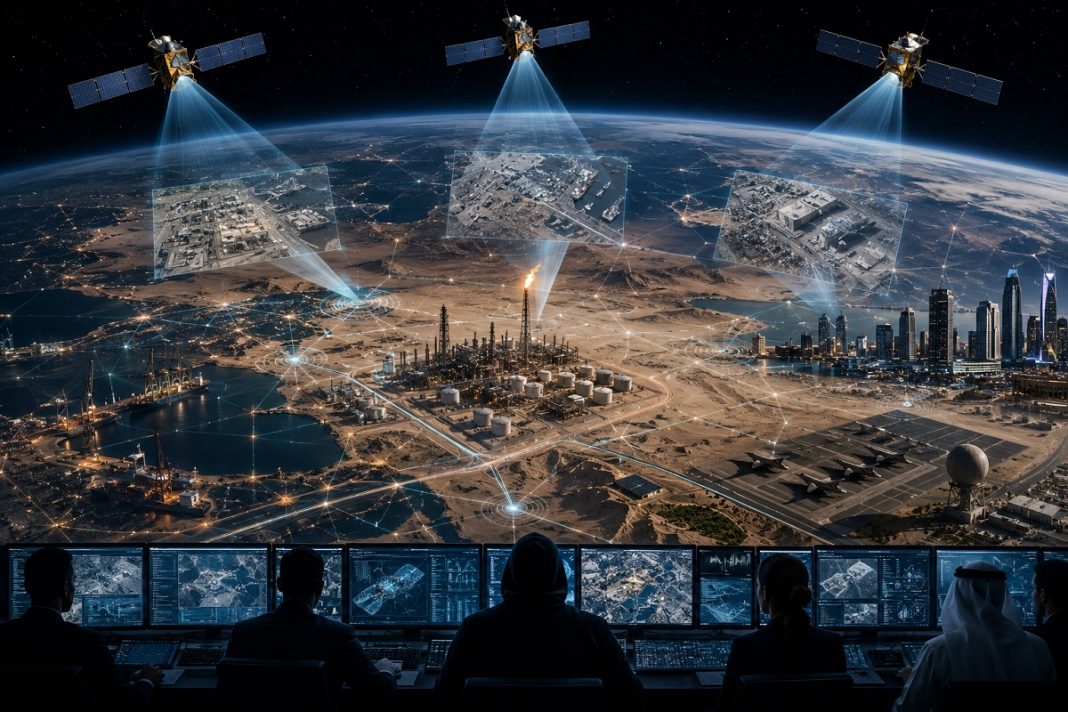
What was once the exclusive domain of military organizations and intelligence services is now increasingly accessible to journalists, researchers, private companies, international organizations, and even non-state actors. Commercial satellite imagery and open-source intelligence (OSINT) tools have transformed the information landscape, reshaping not only journalism and academic research but also the nature of security, deterrence, and conflict itself.
The Middle East stands at the center of this transformation.
Home to some of the world’s largest energy reserves, most strategically important maritime corridors, and most ambitious infrastructure projects, the region has simultaneously become one of the most visible from space. From Gulf oil fields and Red Sea ports to military installations and emerging smart cities, critical assets across the region can now be observed, analyzed, and monitored by a growing range of actors with unprecedented ease.
Yet the real story is not about satellites alone.
The revolution lies in the convergence of satellite imagery, big data, and artificial intelligence. In the past, analyzing large volumes of geospatial information required teams of trained specialists. Today, AI-powered tools can identify changes, detect patterns, track infrastructure development, and generate actionable insights in minutes. The combination of widespread imagery availability and increasingly sophisticated analytical capabilities has dramatically lowered the barriers to strategic observation.
In effect, intelligence is becoming democratized.
For decades, governments relied on information superiority as a cornerstone of national security. The ability to conceal sensitive facilities, restrict access to critical information, and maintain uncertainty for potential adversaries formed an essential part of military planning and deterrence. That environment is rapidly disappearing.
Commercial imagery providers are continuously improving image resolution and update frequency. At the same time, advances in artificial intelligence are making it easier than ever to transform publicly available information into meaningful intelligence. Visibility, once a privilege of states, is increasingly becoming a shared capability.
The implications are already visible across the Middle East.
In recent conflicts in Syria, Gaza, Lebanon, and Iraq, satellite imagery has been used to document destruction, monitor military activity, assess infrastructure damage, and verify competing claims. These developments have strengthened transparency and accountability by enabling independent observers to establish facts in environments often dominated by information warfare and political narratives.
But the same tools that empower journalists and humanitarian organizations can also serve less benign purposes.
Armed groups, criminal networks, hostile intelligence services, and other non-state actors can use commercially available imagery to monitor critical infrastructure, analyze economic and military activity, and reduce uncertainty about potential targets. Open-source imagery may not provide every operational detail, but it can significantly narrow the information gap that once favoured states and large military organizations.
This challenge is particularly acute in the Gulf.
Over the past two decades, Gulf countries have invested hundreds of billions of dollars in energy infrastructure, ports, airports, logistics hubs, industrial zones, and futuristic urban developments. These investments are central to national diversification strategies and long-term economic transformation. Yet they are also highly visible from space.
Nor is the issue limited to oil and gas facilities.
Emerging trade corridors, regional connectivity projects, digital infrastructure, renewable energy networks, and large-scale development initiatives have become part of an increasingly transparent geospatial landscape. In an era of intensifying geopolitical competition, accumulated knowledge about these assets can shape calculations related to security, investment, resilience, and deterrence.
Despite these realities, many security institutions continue to approach the issue through frameworks designed for a different era.
Traditional security models focus on protecting classified information, preventing leaks, and defending against espionage. The emerging challenge, however, stems not from secret information becoming public but from the unprecedented abundance of information that is already public. The problem is no longer simply protecting secrets; it is managing strategic exposure.
This distinction is crucial.
Calls to broadly restrict access to satellite imagery are unlikely to succeed. Commercial imagery is now a global industry operating across multiple jurisdictions. New providers continue to enter the market, while artificial intelligence is accelerating analytical capabilities at a pace that regulators struggle to match. The trend toward greater visibility is not temporary. It is structural.
The more relevant question, therefore, is not how to prevent others from seeing.
It is how states can remain secure in a world where visibility is increasingly unavoidable.
That requires a fundamental shift in strategic thinking. Critical infrastructure must be designed with the assumption that it can be observed. Security planning must account for continuous monitoring from open sources. Exposure assessments should become a routine component of infrastructure design, risk management, and national resilience planning, just as cybersecurity and physical threats are today.
The Middle East, like the rest of the world, has entered the age of open intelligence. Strategic advantage is no longer defined solely by who possesses information, but by who can operate effectively when information is widely available.
Commercial satellites have broken the historic monopoly over strategic observation and ushered in a new era in which access to visibility is no longer confined to governments and intelligence agencies. In a world where nearly everyone can see, national power will be measured less by what states can hide and more by what they can protect when it is exposed to view.
This article was originally published in Arabic on the Asswak Al-Arab website