Gabriel G. Tabarani
Whenever the United States launches a military operation thousands of miles from its shores, attention naturally turns to the visible instruments of power: aircraft carriers, stealth fighters, long-range bombers, and precision-guided missiles. Yet these familiar symbols of American might obscure a more fundamental reality. U.S. power does not begin with aircraft carriers or bombers. It begins with something far less visible: the willingness of other countries to open their territory, airspace, ports, and infrastructure to American forces.
That is the real story of American hegemony since World War II.
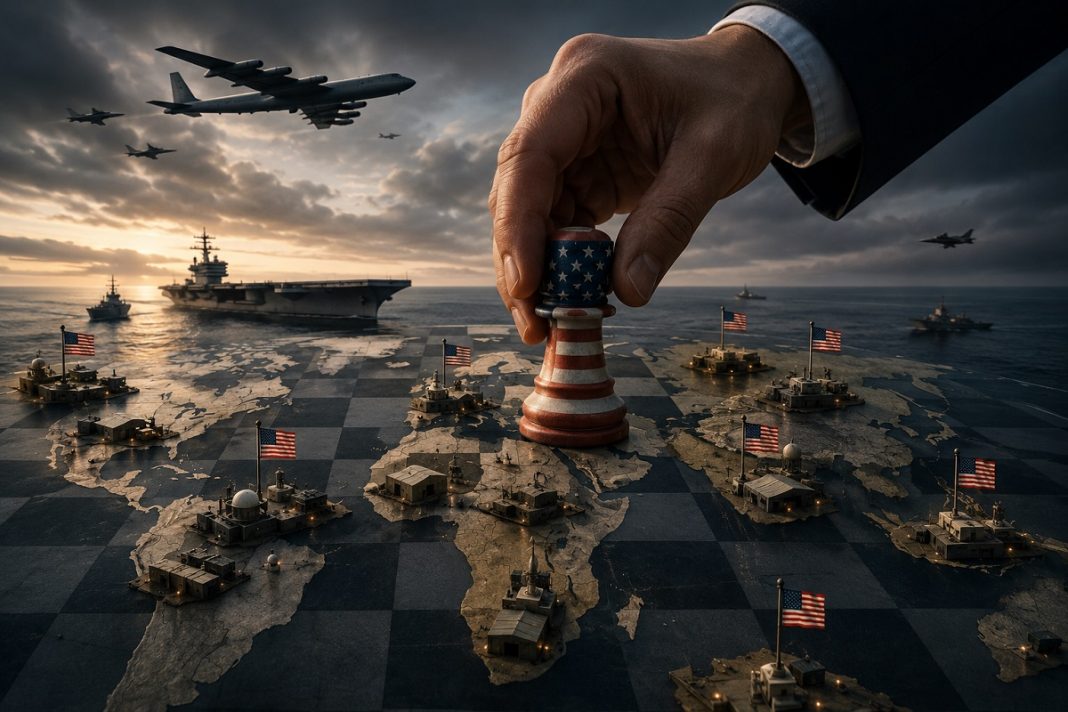
For nearly eight decades, the United States has enjoyed a strategic privilege unmatched in modern history. More than any other great power, it has been able to transform foreign geography into an extension of its own strategic reach. From Germany, United Kingdom and Japan to the Gulf and the Pacific, Washington has built an extraordinary network of alliances, military facilities, logistics hubs, and access agreements that has allowed it to project power virtually anywhere on earth.
This is not merely a story about military bases. According to estimates by researchers who study overseas military deployments, the United States maintains between 750 and 800 military bases, facilities, and sites across more than 80 countries and territories. No other great power in modern history has come close to building a global military footprint on this scale.
At first glance, these numbers appear to measure military strength. In reality, they reveal something more important. The foundation of American power is not simply the number of ships, aircraft, or missiles at Washington’s disposal. It is the fact that dozens of sovereign states permit the United States to operate from their territory. American military power is not merely a military arsenal; it is a global network of access.
The question now is whether that privilege remains as secure as it once seemed.
On the surface, the United States remains the world’s dominant military power. Its defense budget exceeds that of most major powers combined. Its naval forces patrol the world’s oceans, and its military infrastructure spans continents. Yet power is not only about what a state possesses. It is also about what others allow it to use.
And it is here that an important shift may be underway.
For decades, Washington operated under a relatively simple assumption: if a crisis erupted anywhere in the world, the United States would almost certainly find airfields, ports, logistics centers, and partner governments willing to support military operations. Distance, the great constraint that has limited military power throughout history, appeared largely conquered.
But modern warfare is beginning to challenge that assumption.
Recent conflicts in the Middle East have demonstrated that countries hosting American forces are no longer insulated from the consequences of U.S. military action. Military facilities across the region have become potential targets. Precision missiles and low-cost drones have altered the strategic equation, often making it far cheaper to attack military infrastructure than to defend it.
For the Gulf states, this shift carries particular significance.
Qatar hosts one of the most important American military facilities outside the United States. Bahrain is home to the U.S. Fifth Fleet. The United Arab Emirates, Kuwait and Saudi Arabia have become central pillars of the regional security architecture. For decades, these arrangements helped secure energy flows, safeguard maritime trade routes, and underpin broader regional stability.
Yet governments across the region are increasingly confronted with a difficult question. If hosting American forces also means becoming a frontline target during periods of regional escalation, how should the costs and benefits of those arrangements be reassessed?
The same dilemma extends far beyond the Middle East.
In Asia, America’s strategy toward China depends heavily on access to facilities in Japan, Australia, the Philippines, and potentially other regional partners. In any future crisis over Taiwan, those countries would face the same question confronting America’s Gulf partners today: Is hosting U.S. military power still a purely defensive asset, or has it become a source of strategic vulnerability?
Herein lies the paradox.
The extraordinary success of the United States in building a global network of military access may also be the source of one of its greatest future challenges. That network ultimately rests on sovereign decisions made by host governments. Should those governments begin to reassess the risks associated with hosting American forces, Washington’s ability to project power globally could become more expensive, more politically difficult, and less predictable.
The implications extend well beyond military strategy.
Since 1945, American security guarantees have served as one of the largely invisible foundations of the global economy. The dollar’s role as the world’s dominant reserve currency, the stability of international trade routes, and the openness of global markets have all benefited, directly or indirectly, from the security architecture underwritten by the United States.
Yet maintaining that architecture has come at a growing cost.
The wars and military interventions undertaken by the United States since the beginning of this century have cost trillions of dollars. At the same time, strategic competition with China is intensifying, public debt is rising, and questions are mounting about the sustainability of America’s global commitments. Increasingly, the debate in Washington is not merely whether the United States can afford its global military presence, but whether the returns continue to justify the investment.
Ultimately, the future of American power may depend less on military capability than on political consent.
The United States is not on the verge of strategic collapse, nor is it likely to lose its status as the world’s most powerful military actor anytime soon. But history suggests that great powers rarely decline because they suddenly become weak. More often, they struggle to sustain the political, economic, and diplomatic foundations upon which their power rests.
That is why the debate over America’s overseas military presence matters far more than discussions about troop numbers or defense budgets. At stake is the informal bargain that has allowed the United States to transform the territory of dozens of sovereign nations into an extension of its strategic reach.
For decades, conventional wisdom held that America’s dominance rested on aircraft carriers, advanced weaponry, and technological superiority. The deeper truth is that Washington built the most extensive system of influence in modern history because it secured something no other power has ever enjoyed on a comparable scale: the consent of other nations to make part of their geography available to American power.
The question that may shape the international order in the decades ahead is not whether the United States will remain the world’s preeminent power. It is whether other nations will remain willing to grant the privilege upon which that power has rested since 1945: access to the world.
This article was originally published in Arabic on the Asswak Al-Arab website