Gabriel G Tabarani
The most consequential question raised by the emerging U.S.-Iran negotiations may have little to do with uranium enrichment levels, sanctions relief or maritime security in the Gulf.
Instead, it concerns the future of an entire network of allies and armed movements that has shaped Middle Eastern politics for more than two decades.
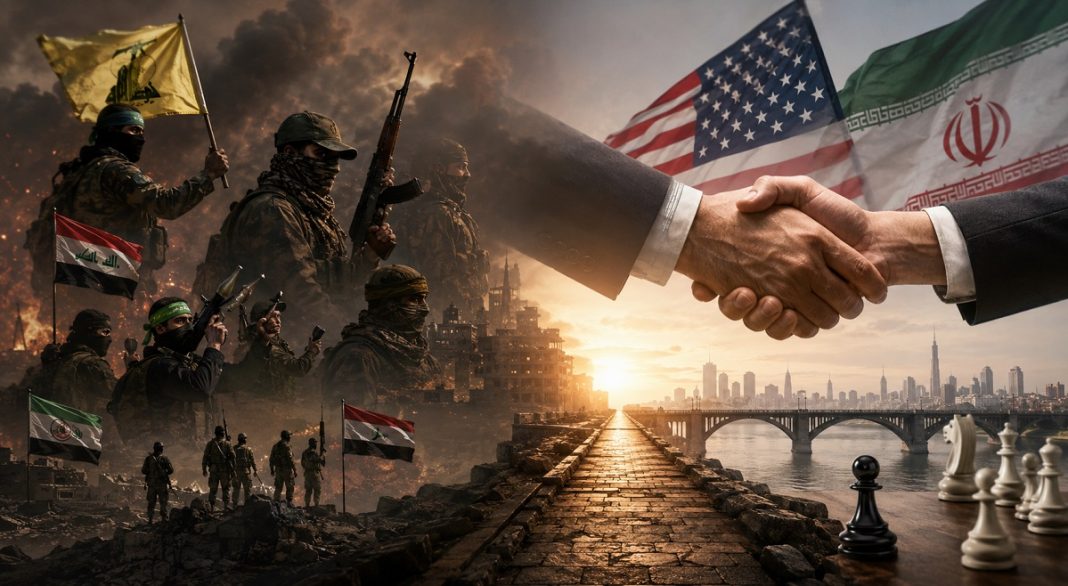
If Washington and Tehran succeed in transforming their current memorandum of understanding into a broader framework for managing tensions, what becomes of the so-called “Axis of Resistance”—the constellation of actors through which Iran has projected influence across the region since the U.S. invasion of Iraq in 2003?
The details of the discussions currently taking place in Geneva remain unclear. Neither side has publicly outlined the full scope of the proposed arrangements, and it would be premature to predict their outcome. Yet the very fact that such talks are taking place raises a question that has long lingered beneath the surface of regional diplomacy: can a sustainable U.S.-Iran understanding emerge without redefining the role of Iran’s partners in Lebanon, Iraq, Yemen and Syria?
For much of the past twenty years, Iran’s regional influence has rested not on conventional military power alone but on a network of allied movements and armed groups that provided Tehran with strategic depth far beyond its borders.
This network served multiple purposes. It expanded Iran’s reach across the Middle East, increased the cost of military confrontation for its adversaries and allowed Tehran to exert pressure through several arenas simultaneously without necessarily engaging in direct conflict.
In Lebanon, Hezbollah became the most sophisticated component of this architecture. In Iraq, Iran cultivated relationships with an array of political and military actors. In Yemen, the Houthis evolved from a local insurgency into a regional force capable of influencing maritime security and international trade routes. In Syria, Iran embedded itself deeply within the political and security landscape that emerged during the civil war.
Together, these actors became more than allies. They formed the backbone of Iran’s deterrence strategy.
But what once represented a strategic asset may increasingly become a diplomatic challenge.
Any meaningful U.S.-Iran agreement would almost certainly require a reduction in regional tensions. Such a goal cannot be achieved solely through nuclear provisions or economic arrangements. It inevitably raises questions about the behavior of armed groups operating across multiple conflict zones.
This does not mean Iran will abandon its allies. Such expectations are unrealistic. The networks Tehran has spent decades cultivating cannot simply be dismantled through a diplomatic agreement. Nor would Iran willingly surrender one of the principal sources of its regional influence.
The more likely outcome is not the disappearance of the Axis of Resistance but its transformation.
The key distinction may be between an axis of confrontation and an axis of influence.
For years, many of these organizations derived their legitimacy and strategic importance from their role in military resistance and regional confrontation. A more stable regional environment, however, could gradually shift the emphasis toward political influence, institutional presence and domestic power.
Hezbollah illustrates this possibility. Despite the military and political pressures it has faced in recent years, the organization remains a major actor within Lebanon and beyond. Yet if regional tensions ease, its future relevance may depend less on its role as a front-line military force and more on its ability to preserve influence within Lebanon’s evolving political landscape.
A similar dynamic could emerge in Iraq. Many Iraqi armed factions have already developed substantial political influence and institutional presence. Their long-term survival may depend increasingly on their integration into state structures rather than their utility as instruments of regional confrontation.
The situation in Yemen is more complex. The Houthis have become an important regional actor whose influence extends well beyond Yemen itself. Yet a broader U.S.-Iran accommodation would inevitably increase pressure for a recalibration of their regional role, particularly regarding maritime security and international shipping routes.
None of this implies the end of Iranian influence. In fact, Tehran may calculate that influence exercised through political leverage, social networks and institutional power can sometimes prove more durable than influence sustained through continuous military escalation.
The challenge for Iran will be managing this transition without appearing to retreat.
For decades, the Islamic Republic has presented itself as a force of resistance against American and Israeli influence in the region. Any significant moderation in the activities of its allies risks being interpreted by opponents as a concession and by supporters as a betrayal. Tehran will therefore seek to frame any adjustment not as a retreat from its regional project but as an evolution of that project.
Whether such a balancing act is possible remains uncertain.
Middle Eastern history offers few examples of major geopolitical rivalries ending simply because governments reach an agreement. Regional orders are rarely transformed in negotiating rooms alone. They are tested in border regions, conflict zones and political crises long after diplomats have signed their documents.
That is why the future of any U.S.-Iran understanding will ultimately be determined not only in Geneva but also in Beirut, Baghdad and Sana’a.
The real question is not whether the Axis of Resistance will survive a U.S.-Iran agreement. It almost certainly will.
The more important question is whether it can evolve from a network built for confrontation into one designed primarily for influence.
If it can, the Middle East may be entering a new phase—one in which competition continues, but through different instruments and under different rules. If it cannot, then any agreement reached today may prove little more than a temporary pause in a conflict whose underlying dynamics remain unresolved.
This article was originally published in Arabic on the Asswak Al-Arab website