Gabriel G. Tabarani
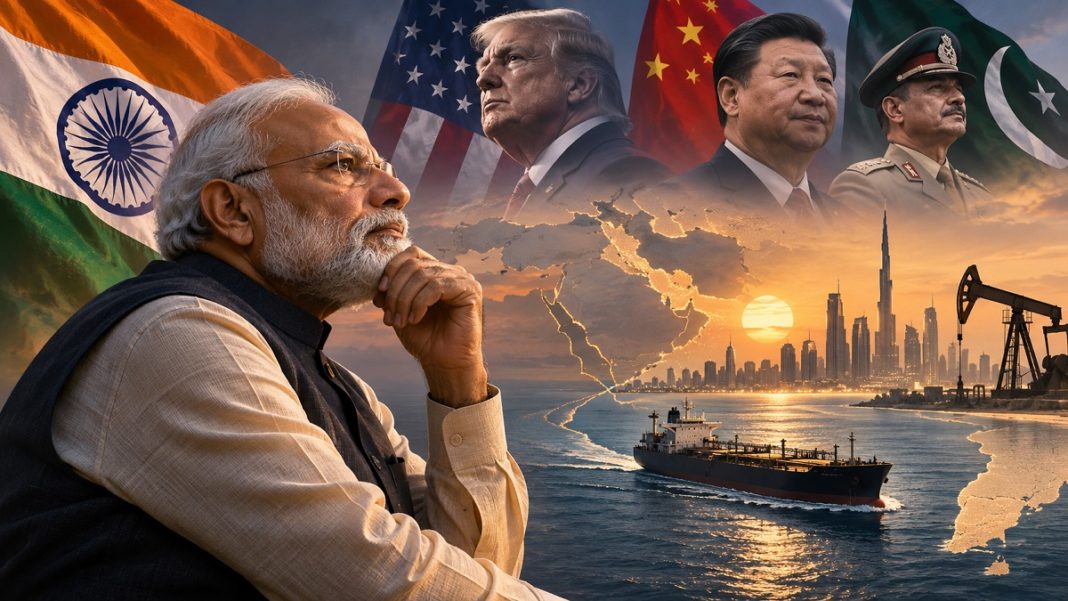
Much of the debate over the Middle East’s changing balance of power revolves around the future of American influence, China’s expanding economic presence and Pakistan’s growing involvement in regional security arrangements. Yet a crucial question receives remarkably little attention: Where is India? The world’s most populous nation, and one of its largest economies, has enormous interests in the Arabian Gulf but exercises political and strategic influence that remains modest in comparison. As New Delhi pursues its ambition of becoming the world’s third-largest economy, this imbalance is becoming increasingly difficult to sustain.
The war involving Iran has exposed the depth of India’s dependence on Gulf stability. Disruptions to shipping through the Strait of Hormuz, alongside mounting threats around the Bab el-Mandeb, have demonstrated that the region is far more than a source of energy for the Indian economy. Over several decades, India has developed an intricate network of commercial, financial and human relationships with Gulf countries. Merchandise trade with the region, including Iraq and Iran, reached approximately $208 billion in the 2025-26 fiscal year, accounting for nearly 17 percent of India’s total trade. About 10 million Indians live and work in the Gulf, while sovereign wealth funds from the region have become important investors in Indian infrastructure, energy and technology. These connections have helped drive India’s economic expansion, but they have also created vulnerabilities that cannot be resolved simply by finding alternative suppliers of oil.
The consequences of instability in the Gulf extend well beyond energy markets. Disruptions to maritime traffic increase transportation and insurance costs, place pressure on the rupee and raise the prices of electricity, food and fertilizers. India has demonstrated considerable resilience by diversifying its oil purchases toward Russia, Africa and the United States, absorbing the initial shock more effectively than many anticipated. Yet these alternatives involve longer shipping routes, higher costs and, in some cases, dependence on American sanctions exemptions that New Delhi cannot guarantee will remain in place. Natural gas presents an even more difficult challenge, particularly when supplies from Qatar are disrupted, because it is essential to industrial production, fertilizer manufacturing and household consumption. India’s ability to withstand the immediate economic consequences of war should therefore not be mistaken for protection against a prolonged regional crisis.
The deeper problem is political and strategic. For years, India pursued a flexible Middle East policy that allowed it to maintain productive relationships with Gulf Arab governments, Iran, Israel and the United States despite their competing interests. This approach helped New Delhi expand its economic presence without becoming deeply entangled in regional rivalries. The outbreak of war, however, has exposed the limits of such diplomatic flexibility. Protecting millions of Indian citizens living in the Gulf, ensuring the safe passage of energy shipments and preserving partnerships with governments on opposing sides of regional disputes are no longer easily compatible objectives. Economic interdependence has become a strategic predicament, requiring India to reconsider whether its traditional emphasis on bilateral relationships is sufficient for an increasingly unstable regional environment.
The central paradox is that India, despite its substantial economic stake in the Gulf, remains a comparatively limited participant in the security arrangements upon which that stake depends. Its navy can escort commercial vessels and strengthen cooperation with Oman, but New Delhi lacks the sustained regional presence and institutional partnerships necessary to play a larger role in protecting critical maritime routes. Its strategic resources are also stretched by the challenge posed by China and its longstanding confrontation with Pakistan. India cannot realistically replace the United States as a security provider, nor should it seek to do so. Nevertheless, a country aspiring to a leading position in the global economy cannot indefinitely remain dependent on regional stability without assuming a greater share of responsibility for sustaining it.
Recent developments have made this imbalance more conspicuous. Pakistan has strengthened its defense relationship with Saudi Arabia and expanded its involvement in regional security and diplomatic initiatives. This does not mean that Islamabad is displacing New Delhi as an important Gulf partner, particularly given the breadth of India’s economic relationships and the reluctance of Gulf governments to embrace exclusive alignments. It does, however, reveal a striking contrast: India possesses greater commercial weight, while Pakistan has found opportunities to increase its security relevance at a time when confidence in the American security umbrella has weakened. For New Delhi, the concern is not simply Pakistan’s growing presence but the possibility that regional security arrangements may evolve without adequate consideration of Indian interests.
China adds another dimension to this challenge. Beijing is a major trading partner of Gulf economies and a leading purchaser of their oil, while its financial resources and substantial energy reserves provide greater protection against supply disruptions. Its military base in Djibouti, near the southern entrance to the Red Sea, gives its regional presence a strategic dimension that extends beyond commerce. India consequently faces a complicated environment in which its principal Asian economic rival is expanding its influence and its Pakistani adversary is strengthening security relationships with important Gulf partners. Yet treating the Middle East as another arena for Asian rivalries would serve neither India’s interests nor those of the Gulf states, which need diversified partnerships, reliable trade routes and regional stability rather than additional geopolitical confrontation.
India has considerable advantages on which to build a more coherent regional strategy. Its vast domestic market, expanding industrial and technological capabilities and deep human connections with Gulf societies make it an indispensable economic partner. The Gulf states, for their part, have compelling reasons to strengthen ties with New Delhi as they seek to diversify their international relationships. Cooperation could extend beyond energy trade to strategic storage facilities, port infrastructure, alternative transport corridors, maritime intelligence and mechanisms for protecting expatriate communities during emergencies. A more active Indian diplomatic role in regional de-escalation would also help align its political influence with its economic interests, without requiring military alliances or involvement in conflicts that could undermine its traditional strategic autonomy.
The war has demonstrated that Gulf security is inseparable from the stability of the broader Asian economy. India has shown that it can manage economic shocks, but managing a crisis is not the same as addressing the vulnerabilities that make such crises dangerous. New Delhi must move beyond a policy centered primarily on benefiting from Gulf stability toward one that contributes more systematically to preserving it. The question is no longer whether India has a stake in the Middle East’s future; its economic, energy and human connections make that undeniable. The question is whether the world’s most populous nation can translate its growing economic weight into political and strategic influence commensurate with its ambitions. A rising power that depends on stability maintained by others, without helping sustain it, remains vulnerable, however large its economy becomes.
This article was originally published in Arabic on the Asswak Al-Arab website