Gabriel G. Tabarani
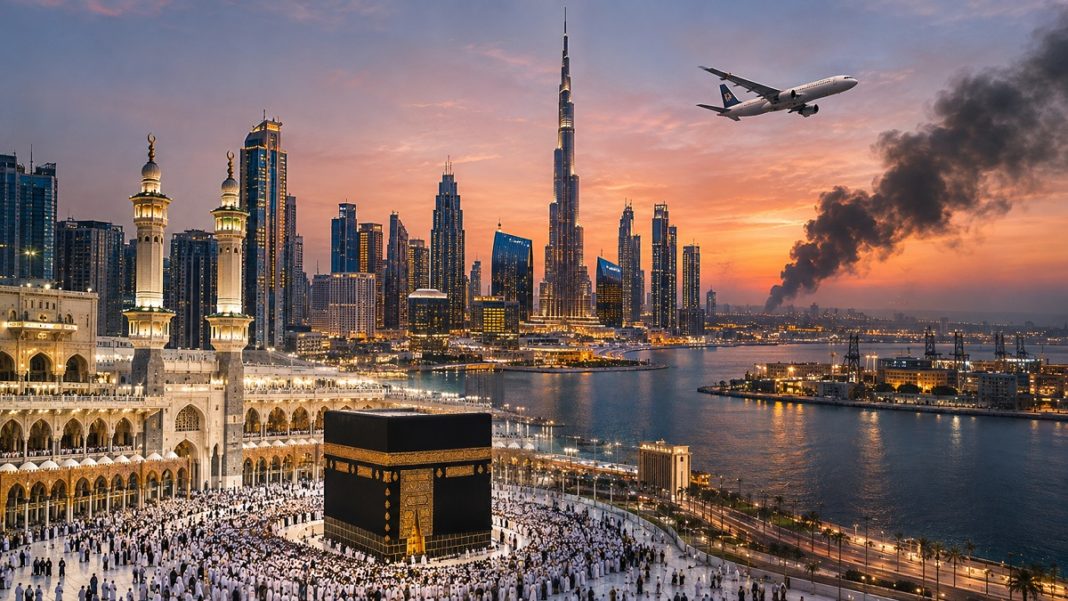
Religious tourism in Saudi Arabia has long been regarded as one of the kingdom’s most resilient industries. Demand for the Hajj and Umrah is rooted in religious convictions that transcend conventional economic and political considerations. Yet Houthi attacks on Saudi airports have raised concerns about an industry worth tens of billions of dollars annually. Press reports indicate that several hotel operators in Mecca suffered declining revenues in the third quarter as regional instability weighed on occupancy rates. If security concerns can disrupt an industry for which there is no geographical substitute, what might they mean for sectors in which the Gulf faces global competition?
This question captures a paradox confronting the Gulf economies. Over recent decades, the members of the Gulf Cooperation Council have deployed their oil wealth to establish an economic significance extending well beyond energy markets. Their cities have become international hubs for aviation, commerce, finance, tourism and property investment. Yet while diversification has strengthened their ability to absorb certain shocks, it has also made their share of global economic activity increasingly dependent on regional stability.
Dubai illustrates the scale of the challenge. Its international airport handled 50.4 million passengers in the first nine months of 2026, down 28.1 per cent year on year, according to Dubai Airports. The implications extend far beyond aviation: an entire economic ecosystem depends on the uninterrupted movement of people and goods.
The property market offers further evidence. According to consultancy Cavendish Maxwell, the value of residential property sales in Dubai fell by 47 per cent year on year in the third quarter. S&P, citing industry reports, pointed to price declines of between 5 and 15 per cent between the end of 2025 and September 2026. In Saudi Arabia, the value of residential property transactions fell by 24.6 per cent year on year in the second quarter, according to Knight Frank. These developments cannot be attributed entirely to geopolitical instability — supply and affordability also matter — but they underscore the sector’s sensitivity to shifts in confidence.
More tellingly, Hong Kong overtook Dubai in the aggregate value of residential property sales exceeding $10mn in the third quarter, for the first time since the second quarter of 2022, according to Knight Frank, although Dubai remained ahead in transaction volumes. This does not necessarily imply a direct migration of investors between the two markets. It does, however, illustrate how competitive positions can shift.
Oil reserves cannot be relocated to safer jurisdictions. Corporate headquarters can. Investors can redeploy capital, tourists can change destinations and skilled professionals can choose to work elsewhere. Even property, though physically immovable, derives its value from capital and demand that are not. The Gulf is moving from an economic model underpinned by inherited natural advantages towards one built on acquired competitive strengths. Yesterday’s success offers no guarantee of tomorrow’s.
The result is what might be called a geopolitical tax on prosperity. Levied not by governments but by uncertainty, it manifests itself in higher insurance, financing and transport costs, and in additional incentives governments may need to offer investors. Its most damaging consequences, however, rarely appear in official statistics: investments that never materialise, projects established elsewhere and opportunities forgone.
Competition between global business centres does not stand still while wars are being fought. As rival centres attract companies and financial institutions, they develop networks of clients, suppliers and expertise that reinforce their appeal and raise the cost of leaving. Temporary disruption can thus produce lasting shifts in the geography of global economic activity.
There is a crucial distinction between recovering growth and recovering economic standing. An economy may regain its previous growth rate even as its share of international investment, trade or travel diminishes. An investor contemplating a project with a 20-year horizon is concerned not merely with the end of the current war, but with the likelihood of the next one.
None of this establishes that the Gulf is already losing its economic standing. Substantial financial reserves, sophisticated infrastructure, strategic geography and considerable institutional capacity provide significant room for adaptation. But economic security must encompass more than the protection of existing assets. It must also safeguard the region’s place in future investment decisions.
Gulf diplomacy therefore has an increasingly important economic function: reducing the regional risk premium through conflict prevention and resolution. External security partnerships must likewise be judged not solely by their military capabilities but by their contribution to long-term development. Lasting stability will require addressing the underlying causes of regional conflict, not least the unresolved Palestinian question, and establishing relations based on respect for sovereignty and mutual interests.
The Gulf has spent decades converting oil wealth into global economic influence. Its challenge now is to translate that influence into a greater capacity to shape the geopolitical environment on which its prosperity depends.
The problem is not the Gulf’s economic success, but the failure of the regional security architecture to evolve alongside it. If oil conferred strategic importance on the Gulf in the past, confidence will be among its most valuable economic assets in the future. Its loss cannot be offset by oil revenues alone.
This article was originally published in Arabic on the Asswak Al-Arab website