Gabriel G. Tabarani
Over the past few decades, some of the Arabian Gulf’s cities have become among the most culturally and demographically diverse in the world. Followers of different religions live alongside one another, multiple languages and cultures coexist, and institutions host international conferences on interfaith dialogue as governments seek to cultivate an image of openness, tolerance and coexistence. This transformation has been more than a response to the demographic changes brought about by the arrival of millions of foreign workers. It has become an integral part of the region’s economic and diplomatic strategy, as Gulf states compete to attract capital, skilled professionals, international companies and tourists, while seeking to establish a global identity that extends beyond their traditional association with oil and wealth.
For all its significance, this achievement raises a question less about the Gulf’s relationship with the wider world than about the relationship between the state and its citizens: to what extent can societies that have successfully accommodated diversity from abroad develop an institutional framework that embraces their own internal diversity on the basis of equal citizenship? The issue is not one of comparing the rights of citizens and expatriate residents, each of whom has a distinct legal status. Rather, it concerns two different approaches to managing diversity: tolerance, which recognises and respects differences, and citizenship, which requires that those differences should not determine citizens’ rights, obligations or opportunities.
The question assumes particular importance at a time when regional tensions repeatedly bring sectarian affiliations to the forefront of political and security calculations, and when Gulf economies increasingly need to mobilise their human resources to achieve their development objectives. At the intersection of security imperatives and economic transformation, citizenship emerges as an area in which the political and economic interests of the state converge with the legitimate rights of its people.
The Limits of Tolerance and the Promise of Citizenship
Sectarian diversity in the Gulf predates both the establishment of modern states and the political borders that separate them. The region’s societies evolved over centuries through trade, migration, intermarriage and cultural and professional exchanges across a geographical space encompassing both shores of the Gulf, the Indian Ocean and the Indian subcontinent. Although religious differences left their mark on aspects of social and political life, they were never the sole determinant of relations between communities. Nor did cross-border religious ties necessarily imply political allegiance.
The Iranian Revolution of 1979, the Iran–Iraq War, the US-led invasion of Iraq in 2003 and subsequent conflicts in Syria, Yemen and Lebanon increasingly invested these affiliations with geopolitical significance. Iran’s regional policies and its relationships with certain political and armed groups reinforced concerns about the instrumentalisation of sectarian ties in pursuit of strategic objectives. Meanwhile, the rise of extremist organisations and the spread of sectarian mobilisation deepened divisions and encouraged religious differences to be interpreted through the prism of political conflict.
Recognising the risks arising from these developments, however, does not justify reducing individuals’ political attitudes to their religious affiliations. Being a Shia Muslim is not, in itself, evidence of political allegiance to Iran, any more than being a Sunni Muslim indicates attachment to a transnational political or religious project. This distinction is particularly important in Gulf societies, where many citizens maintain family, cultural and commercial ties with neighbouring communities without those relationships necessarily diminishing their national identity or their commitment to their countries’ laws and interests. A comparison of the six Gulf states demonstrates that sectarian diversity does not produce predetermined outcomes. Political history, institutional structures and the nature of social relations are at least as important as religious composition itself.
In Oman, the historical coexistence of Ibadi, Sunni and Shia Muslims, together with the maritime and commercial traditions that connected the country to diverse societies, helped shape a national experience characterised by relatively limited sectarian political polarisation. This approach has acquired an institutional and legal dimension: the Basic Law of the State prohibits discrimination between citizens on religious grounds, while official religious discourse emphasises common ground among Islamic traditions and the importance of national unity. The significance of the Omani experience lies not in assuming the absence of social inequalities or challenges, but in its relative success in preventing religious differences from becoming a permanent axis of political conflict. It illustrates how the political consequences of diversity depend more on the institutions and policies governing relations between communities than on diversity itself.
Kuwait offers a different experience. Shia citizens have contributed to the country’s commercial, social and political life since the early stages of its modern history and have participated in its representative institutions. The national dimension of this relationship was particularly evident following the terrorist attack on the Imam al-Sadiq Mosque in 2015, when the official and public response sent a clear message against attempts to inflame sectarian tensions. Perhaps the most striking expression of that response was the decision of Kuwait’s then emir, Sheikh Sabah Al-Ahmad Al-Jaber Al-Sabah, to visit the mosque personally following the attack. The gesture went beyond humanitarian solidarity, affirming that an attack on citizens because of their religious affiliation was an attack on Kuwaiti society as a whole, and that protecting national unity begins with refusing to treat the victims as a community apart. Although Kuwait’s experience does not suggest that all challenges relating to equal opportunity have been overcome, it demonstrates the important role that an inclusive national political discourse can play in countering sectarian polarisation.
In Bahrain, the relationship between sectarian affiliation, political participation and the distribution of economic opportunities has acquired more complex dimensions, particularly since the events of 2011. While the authorities emphasise the need to preserve stability and counter foreign interference, debates continue over political representation, equal opportunity and access to certain public-sector positions. Significantly, the Bahrain Independent Commission of Inquiry, established by royal order in 2011, concluded that the evidence submitted by the government had not established a discernible link between Iran and the events that took place in the kingdom during February and March of that year. Although this finding was confined to the events and period covered by the commission’s investigation, it underscores the importance of distinguishing legitimate security concerns from the evidence pertaining to individual cases. Bahrain’s particular circumstances reflect the intersection of sectarian considerations with political, social and economic demands. Reducing these complexities to a confrontation between national loyalty and foreign influence offers an inadequate explanation, just as disregarding regional security concerns would provide an incomplete understanding of the environment in which Bahraini policies are formulated.
In Saudi Arabia, where religious diversity is intertwined with a long history of relations between political and religious institutions, recent social transformations and reforms to religious discourse and educational curricula have created opportunities to reconsider aspects of the relationship between national identity and sectarian affiliation. The US government’s 2023 Report on International Religious Freedom noted progress in revising educational content and permitting certain Shia religious observances, while also identifying continuing challenges relating to equality and restrictions on some religious practices. The issue is particularly significant in the Eastern Province, which is home to historically established Shia communities and occupies a central position in the Saudi economy. As the kingdom’s development programme expands, broadening citizens’ participation regardless of their social or religious backgrounds becomes an important condition for the success of its economic and social transformation, enlarging the pool of both contributors to and beneficiaries of that process.
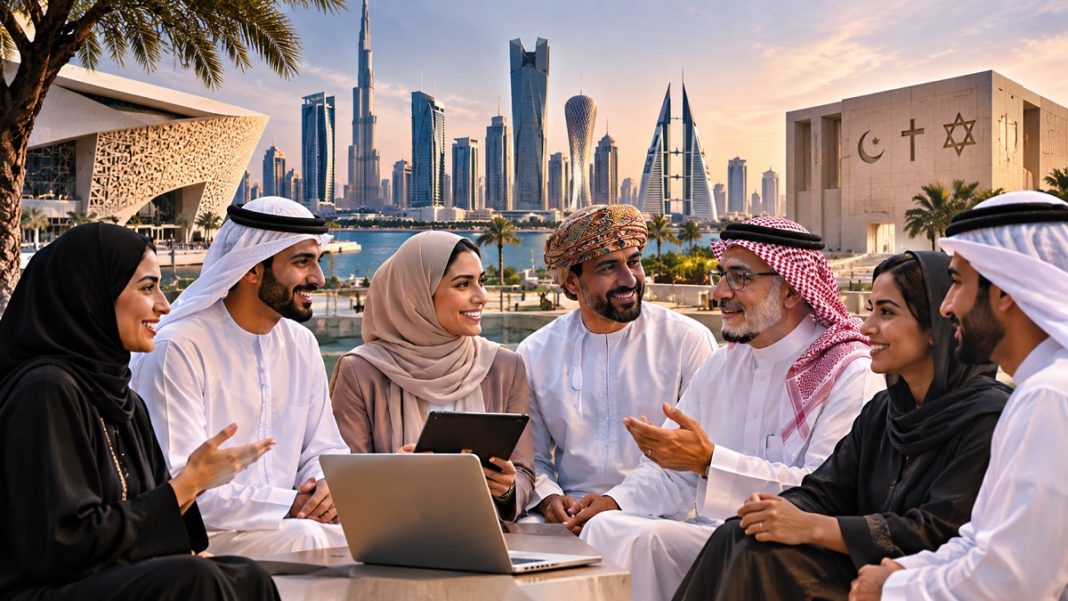
In the United Arab Emirates and Qatar, interfaith dialogue and cultural coexistence have become prominent features of national development strategies and international image-building. The opening of the Abrahamic Family House in Abu Dhabi in February 2023, comprising a mosque, a church and a synagogue, represented one of the most visible institutional expressions of this approach. Qatar’s efforts to promote dialogue across cultures and beliefs have included the establishment of the Doha International Center for Interfaith Dialogue in 2007 and the granting of formal approval for its establishment by emiri decision in 2010. Yet the nature of these initiatives, which are largely concerned with relations between followers of different religions, means that they cannot in themselves serve as a measure of citizenship or equality of opportunity within national communities. Interfaith dialogue and equality among citizens are complementary endeavours, but success in one does not automatically demonstrate the achievement of the other.
Despite these shared themes, the Gulf Co-operation Council states should not be regarded as a homogeneous political or social entity. Differences in the size of their citizen populations, institutional histories, religious composition and economic structures shape each country’s priorities and challenges. Nevertheless, these differences do not diminish their common interest in developing institutions that assess individuals on the basis of citizenship, competence and lawful conduct, rather than allowing social or sectarian affiliations to determine their standing. The most sustainable extension of tolerance, therefore, lies in moving beyond recognition of the right to be different towards ensuring that difference does not entail a diminution of rights.
The Economic Cost of Discrimination
Sectarian and social discrimination are frequently discussed from political or human rights perspectives, while their economic costs receive considerably less attention, despite their growing relevance to the Gulf states. The substantial resources governments devote to education, training and technology cannot generate their full potential returns if some citizens encounter barriers to employment, career advancement or access to economic resources that are unrelated to their qualifications and abilities. Nor are such barriers confined to religious affiliation. They may also arise from tribal loyalties, social origins, personal networks and the practice of wasta, or the use of connections to secure preferential treatment. The influence of these factors varies across countries and economic sectors.
When an individual secures a professional opportunity through personal connections or group affiliation at the expense of a more qualified candidate, the loss extends well beyond the person who has been overlooked. The institution forfeits the opportunity to benefit from the best available talent, while the economy loses potential added value that might have been generated under more equitable conditions. Perhaps the greatest losses are those that never materialise in the first place: the business that is never established, the initiative that never secures funding, the talent that never finds an opportunity, and the investment in skills that an individual abandons after losing confidence in its prospective returns. These are opportunity costs that are particularly difficult to capture in national accounts because they concern economic value that could have been created but never was.
Academic research helps illuminate the multiple dimensions of this problem. In a 2016 study published by the Carnegie Endowment for International Peace, The Political Economy of Sectarianism in the Gulf, political scientist Justin Gengler examined the relationship between social divisions, the distribution of economic benefits and the maintenance of political support, showing how the management of collective identities can contribute to the preservation of governing arrangements. His analysis invites consideration of the trade-off between the short-term political advantages that selective allocation of opportunities may yield and the economic and social costs that can accumulate over the longer term.
From a complementary perspective, Steffen Hertog, in a study published online in February 2025, examined the growing divide between citizens who enjoy the benefits of public-sector employment and those, particularly among younger generations, whose prospects of securing such employment have become increasingly limited. The study highlights this phenomenon in Saudi Arabia, Oman and Bahrain, in comparison with Gulf states enjoying higher levels of rentier income relative to their citizen populations. The significance of Hertog’s analysis lies in demonstrating that economic exclusion can also arise from structural changes in labour markets and intergenerational inequalities, rather than solely from sectarian or tribal affiliations, although the interaction of these factors can compound disparities.
There is insufficient publicly available data across the Gulf to calculate the economic cost attributable specifically to sectarian discrimination. Isolating its effects from the wider institutional and social factors influencing economic performance is equally difficult. Yet this lack of data is itself an argument for developing better measurement tools, particularly as Gulf economies move increasingly towards sectors driven by knowledge, specialised skills and innovation. In such industries, the ability to identify, develop and retain talent is a decisive factor in competitiveness. The economic cost of excluding an individual with a scarce skill may far exceed the immediate value of the opportunity denied to that person.
From this perspective, the Gulf states face a striking economic paradox. While competing to attract the world’s best talent and developing programmes to retain foreign professionals and encourage their investments, they must also ensure that social or institutional barriers do not prevent them from making full use of their own citizens’ abilities. It would be contradictory for an economy to devote substantial resources to attracting human capital from abroad while allowing some of its domestic human capital to go to waste.
The implications extend beyond employment and career progression to entrepreneurship, domestic investment and commercial activity. An individual’s decision to establish a business depends not only on skills, financing and market opportunities, but also on confidence in the fairness of the rules governing competition, the transparency of administrative procedures and the effectiveness of the judiciary in protecting rights. When entrepreneurs believe that the success of their ventures depends as much on personal connections or social standing as on the quality of their business proposals, economic incentives become distorted. Resources and energies may be diverted towards cultivating networks of influence and securing privileges rather than improving productivity or developing better products and services.
Transparent recruitment and promotion practices, equitable access to finance and public contracts, and effective grievance mechanisms should therefore be regarded as instruments of economic efficiency as well as means of strengthening equality before the law. The more effectively institutions can limit the influence of considerations unrelated to merit in allocating opportunities, the better placed economies will be to translate investments in education and skills into productive output. Equal opportunity is not a concern solely for those who may experience discrimination, because society as a whole bears the cost of its absence.
National Loyalty Is Not a Sectarian Identity
The relationship between citizenship and religious affiliation becomes particularly sensitive when regional confrontations intensify, as citizens’ attitudes may increasingly be interpreted through geopolitical divisions rather than their own national circumstances. In such an environment, external powers can present themselves as protectors of religious communities beyond their borders or exploit real and perceived grievances to construct political narratives that advance their interests. The effectiveness of such narratives, however, depends not merely on religious ties but on their ability to acquire credibility among their intended audiences. That credibility is shaped, among other factors, by the nature of citizens’ relationships with their own state institutions.
One of the political paradoxes is that treating a group of citizens primarily according to its religious affiliation may reproduce the very categories that external powers seek to exploit. When individuals are regarded as members of a sectarian community before they are treated as citizens, the space for developing political and social relationships that transcend religious divisions narrows. Issues concerning employment, education or public services may consequently come to be interpreted through the lens of collective identity. Conversely, addressing these issues through fair and effective institutions diminishes the ability of external actors to monopolise the discourse surrounding national communities or claim to represent their interests.
It is equally important, however, to avoid an opposite and no less dangerous assumption: that citizens who experience discrimination are necessarily more inclined to align themselves with a foreign power. Individuals may feel aggrieved, demand reform and criticise government policies without their national allegiance being in question. Conflating loyalty to one’s country with agreement with every government policy, like equating religious affiliation with foreign allegiance, restricts the space within which societies can resolve their differences through national institutions. It also invests political disagreement with security implications that may have little basis in reality.
Security agencies have a legitimate and essential role in countering espionage, sabotage and foreign interference, particularly in a region that has experienced repeated external interventions and conflicts. Yet the effectiveness of security operations also depends on the ability to distinguish genuine threats from suspicions based on collective identity. Individual accountability grounded in evidence and the rule of law helps direct security resources towards actual dangers. Broadening the scope of suspicion on grounds that lack objective justification, by contrast, risks dispersing those resources and weakening trust between citizens and the institutions responsible for protecting them.
This distinction has become increasingly important with the proliferation of social media, which allows inflammatory rhetoric and disinformation campaigns to transcend geographical boundaries and reach communities directly. Governments may be able to restrict the circulation of certain forms of content that incite hatred and violence, but regulation alone cannot eliminate the conditions that give such narratives their influence. The greater the scope for addressing grievances through the judiciary, public administration and participation in public life, the greater a society’s capacity to resolve its differences within its own institutions, and the more difficult it becomes for external actors to exploit those grievances in pursuit of their own agendas.
The Gulf states could, in this regard, develop regular assessments of equality of opportunity, public confidence in institutions, the effectiveness of grievance mechanisms and equitable access to public services. Provided such assessments are independent, credible and respectful of individual privacy, they could help policymakers distinguish inequalities arising from economic, geographical and educational circumstances from those associated with discriminatory practices requiring intervention. Their purpose should be to evaluate institutional performance and the effectiveness with which equality is upheld, rather than to classify citizens according to their religious affiliations or attempt to measure their political loyalty.
The Gulf states have achieved a significant transformation in building cities and economies capable of accommodating considerable human and cultural diversity. Openness to the world has become one of the foundations of their international appeal and economic success. That achievement offers an opportunity to develop policies that make equality among citizens an integral part of the development agenda, bringing the gains of religious tolerance together with institutional efficiency, equitable opportunity and individual enterprise. Equal citizenship is neither a reward for loyalty nor a privilege granted in exchange for proof of belonging. It is the foundation of the relationship between the state and its citizens, irrespective of the economic or security benefits it may yield.
Ultimately, the more profound test of the Gulf’s openness in the decades ahead will lie not simply in its ability to welcome the world in all its diversity, but in its ability to ensure that differences among its own citizens do not determine their rights, opportunities or futures. When diversity becomes as much a source of strength within national societies as it has become a source of appeal in their engagement with the wider world, the Gulf will have moved beyond managing differences towards harnessing the full potential they offer.
This article was originally published in Arabic on the Asswak Al-Arab website