Gabriel G Tabarani
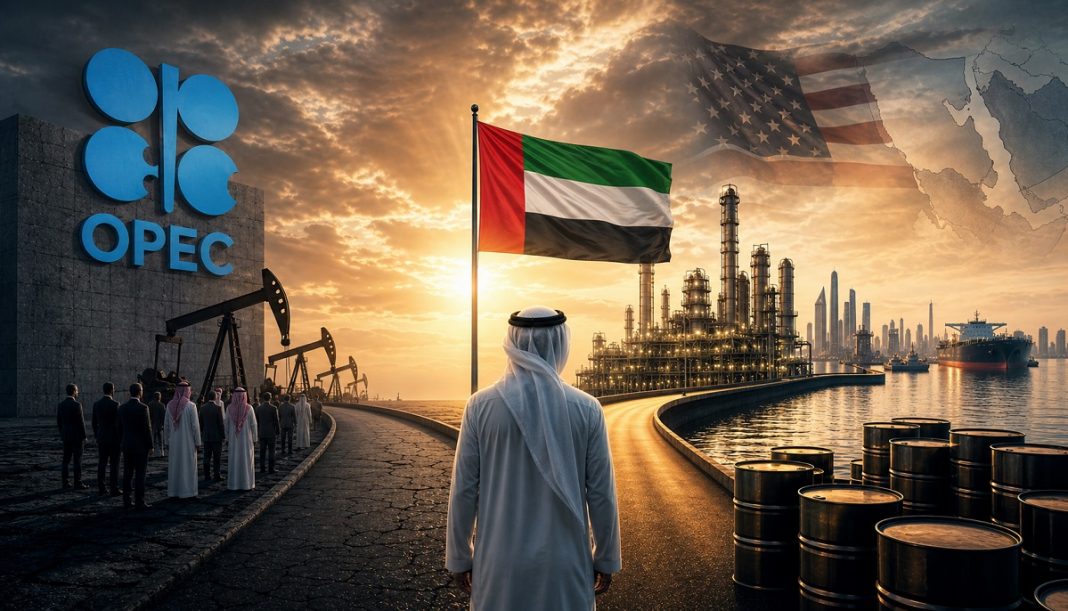
The United Arab Emirates’ decision to leave OPEC did not come out of nowhere. Like many geopolitical shifts, it unfolded quietly over years before crystallizing into a single, decisive act. What appears sudden is often the culmination of accumulated grievances, structural tensions and shifting ambitions. In this case, Abu Dhabi’s departure reflects not only an economic calculation but also a deeper reordering of power and priorities in the Gulf.
For decades, the UAE had been a loyal, if occasionally restless, member of OPEC. Since joining in 1967, it accepted the cartel’s central premise: that coordinated production limits could stabilize markets and maximize collective revenue. But the logic of restraint began to fray after 2016, when Saudi Arabia, OPEC’s dominant force, expanded the group into OPEC+ by bringing in Russia. This broadened coalition strengthened Riyadh’s hand while complicating the internal balance of interests.
For the UAE, the consequences were tangible. Years of heavy investment by its national oil company, ADNOC, had significantly expanded production capacity. Yet OPEC+ quotas effectively prevented the country from fully utilizing that capacity. According to analysis from the Baker Institute for Public Policy at Rice University, the UAE carried a disproportionate share of unused production potential within the cartel—a burden that only grew over time. The economic case for leaving was therefore straightforward: independence could unlock tens of billions of dollars in additional annual revenue.
But to treat this as a purely technocratic decision would be to miss the broader story. Oil policy in the Gulf has never been just about barrels and prices; it is inseparable from politics, security and prestige. Over the past decade, relations between Abu Dhabi and Riyadh have become increasingly strained. Once aligned partners, the two have drifted apart over regional conflicts and strategic priorities, from Yemen to Sudan and Libya. These divergences have eroded the sense of unity that once underpinned Gulf cooperation.
The friction is not merely tactical—it reflects competing visions of leadership in the Arab world. Saudi Arabia has long positioned itself as the region’s political and economic center of gravity. The UAE, smaller but increasingly assertive, has pursued a more nimble and diversified strategy, leveraging finance, logistics and diplomacy to punch above its weight. In this context, OPEC membership began to look less like a source of influence and more like a constraint.
Abu Dhabi insists that geopolitics played no role in its exit. Officially, the move is about flexibility—about reaching a production target of 5 million barrels per day by 2027 without being bound by collective quotas. Yet this explanation strains credibility. The UAE has been openly critical of what it views as a tepid regional response to threats from Iran, particularly as it has absorbed the impact of drone and missile attacks. At the same time, it has drawn closer to Washington, aligning with the preferences of Donald Trump, who has long criticized OPEC for manipulating oil markets.
Seen in this light, the withdrawal is also a signal—a recalibration of alliances and priorities. By stepping outside OPEC, the UAE is asserting that its national interests will no longer be subordinated to a collective framework increasingly dominated by others.
The timing is equally telling. Global oil markets are currently tight, with supply concerns heightened by instability around the Strait of Hormuz, a chokepoint through which a significant share of the world’s oil flows. In such an environment, additional Emirati production is unlikely to trigger an immediate price collapse. On the contrary, it may help stabilize markets in the short term.
The longer-term implications, however, are more uncertain. OPEC’s ability to manage supply has always depended on discipline and cohesion among its members. Each departure weakens that cohesion. While previous exits—from Indonesia, Qatar, Ecuador and Angola—had limited impact, the UAE is different. It is a major producer with significant spare capacity and a track record of strategic ambition.
As the energy analyst in Bloomberg Javier Blas has noted, Abu Dhabi’s move could encourage others to follow suit. If more producers prioritize national output over collective restraint, the result could be a more volatile market—one prone to sharp swings between shortage and glut. Once current supply disruptions ease, the world could quickly move from tightness to oversupply, with all the attendant economic consequences.
Beyond oil there is a deeper institutional question. The UAE’s dissatisfaction is not limited to OPEC. It has also expressed frustration with broader regional bodies such as the Gulf Cooperation Council, the Arab League and the Organization of Islamic Cooperation. These organizations, once envisioned as platforms for collective action, have struggled to respond effectively to shared challenges.
If Abu Dhabi continues down a path of selective disengagement, the implications for Arab multilateralism could be profound. A region already fragmented by conflict and competition may find it even harder to coordinate policy or present a unified front on the global stage.
In the end, the UAE’s exit from OPEC is both a symptom and a catalyst. It reflects the erosion of old structures and the rise of a more fragmented, competitive order in the Gulf. For Abu Dhabi, the benefits are clear: greater autonomy, higher potential revenues and a foreign policy less constrained by consensus. But for the region—and for global energy markets—the costs may only become apparent over time.
The era of disciplined oil diplomacy, anchored by OPEC’s collective authority, may be giving way to something looser and less predictable. And as the UAE has shown, once the logic of cooperation begins to unravel, the shift from gradual change to sudden rupture can happen faster than anyone expects.
This article was originally published in Arabic on the Asswak Al-Arab website