Gabriel G Tabarani
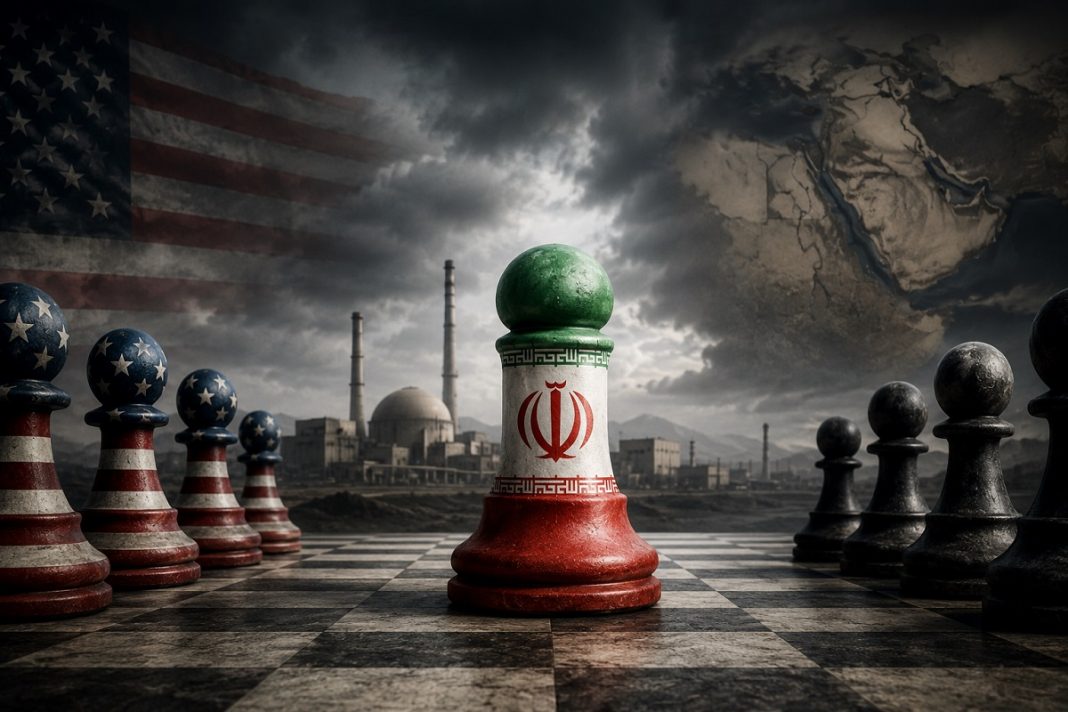
After years of sanctions, sabotage operations and military strikes, Iran is closer to the nuclear threshold today than it was when Donald Trump withdrew from the nuclear deal in 2018. That is the paradox now confronting Washington — and it reveals something larger than the resilience of the Islamic Republic. It reveals the limits of American power in a changing world.
On paper, Iran looks weaker than it has in decades. Its economy is exhausted, its currency battered, its infrastructure degraded and its society deeply strained. Yet beneath that visible weakness, Tehran has built something more durable: an ability to survive pressure, absorb isolation and convert vulnerability into leverage.
This is what the Trump administration never fully understood.
Trump did not simply want a new nuclear agreement. He wanted vindication. The withdrawal from Barack Obama’s 2015 nuclear deal was supposed to prove that “maximum pressure” could achieve what diplomacy could not: force Tehran into accepting a broader, harsher and more humiliating settlement. In Trump’s worldview, pressure creates submission. Economic pain eventually translates into political surrender.
But states do not behave like distressed corporations. And the Middle East does not operate according to the logic of real-estate negotiations.
Instead of capitulating, Iran adapted. It accelerated uranium enrichment, developed more advanced centrifuges and reduced the time needed to reach nuclear breakout capability. More importantly, it learned something that may outlast the current crisis entirely: strategic ambiguity can itself function as deterrence.
Nuclear facilities can be bombed. Technical knowledge cannot.
That distinction matters because the Iranian nuclear challenge is no longer primarily about whether Tehran builds an actual bomb. It is about whether Iran has reached a stage where it no longer needs one.
Threshold status — the ability to produce a weapon quickly without formally crossing the line — may be strategically more useful than overt nuclearization. It maximizes deterrence while minimizing the political costs of openly becoming a nuclear state. Iran appears increasingly comfortable operating inside that ambiguity.
And this is where much of the Western debate remains outdated.
Washington still approaches Iran through the framework of non-proliferation diplomacy inherited from the post-Cold War era: sanctions, inspections, negotiations and the assumption that economic coercion can ultimately compel behavioral change. But Iran’s real achievement was not defeating sanctions. It was learning how to govern through them.
Over time, sanctions ceased to function as temporary pressure and became part of the architecture of the Iranian state itself. Entire economic sectors adapted around isolation. Informal financial networks expanded. Smuggling evolved into institutional infrastructure. The Islamic Revolutionary Guard Corps deepened its role not despite sanctions, but because of them.
Maximum pressure did not merely fail to transform Iran. It transformed the Iranian system itself.
This may be the most uncomfortable reality for Washington: American pressure arguably strengthened the very factions it sought to weaken. As foreign investment disappeared and the formal economy contracted, the security apparatus gained greater control over trade, logistics and strategic industries. The Iranian middle class absorbed the economic pain; the state’s coercive institutions absorbed the strategic benefits.
In other words, Washington may have helped produce the Iran it fears today.
But the deeper issue extends beyond Iran altogether.
For decades, American foreign policy rested on a core assumption: overwhelming economic and military superiority would eventually force adversaries into compliance. That assumption shaped everything from sanctions policy to regime-isolation strategies after the Cold War. Iran, however, exposed the limits of that model.
Like Russia, North Korea and, in different ways, China, Iran belongs to a generation of states that have learned how to survive inside prolonged confrontation with the United States. The lesson of the past decade is not that these countries are stronger than Washington. It is that American power no longer automatically produces political submission.
This is the real geopolitical shift underway.
The world emerging today is not defined by the disappearance of American power, but by the growing inability of that power to impose decisive outcomes. Military superiority remains overwhelming. Financial leverage remains immense. But coercion increasingly struggles to generate stable political results.
Iran is therefore not simply a Middle Eastern problem. It is a case study in the erosion of post-Cold War assumptions about how global power works.
This also explains the strategic confusion surrounding Trump’s Iran policy. At times, he appeared to seek a grand bargain that would deliver a historic diplomatic victory. At others, his administration seemed to flirt with regime collapse or internal destabilization. These are fundamentally different objectives masquerading as a single strategy.
Tehran noticed the contradiction.
Inside Iran, few policymakers now believe any agreement with Washington can survive changes in American domestic politics. The collapse of the 2015 deal permanently altered Iranian calculations about U.S. credibility. From Tehran’s perspective, negotiations no longer represent stable settlements; they represent temporary pauses between cycles of pressure.
Meanwhile, everyday Iranian frustrations have shifted far beyond nuclear policy itself. Inflation, electricity shortages, currency collapse and economic exhaustion dominate public life. Yet even this internal pressure has produced paradoxical effects. Economic suffocation did not weaken the state uniformly. It redistributed power within it.
The Guards expanded. Civilian technocrats receded. Isolation militarized governance.
The result is that the Iranian system today is simultaneously more brittle socially and more hardened strategically.
This creates a growing danger not only for the region, but for the global non-proliferation system itself. Because the real risk may no longer be an Iranian bomb. It may be the normalization of nuclear threshold status as the new model of deterrence in the Middle East.
If regional powers conclude that latent nuclear capability offers the best insurance against external coercion, the region could drift into a form of permanent gray-zone proliferation: no declared nuclear powers beyond Israel, but multiple states capable of approaching the threshold rapidly when necessary.
That environment would be far less stable than the Cold War’s rigid deterrence structure. Ambiguity may prevent direct war for a time, but it also shortens decision-making windows, increases the risk of miscalculation and creates constant uncertainty about red lines.
The Middle East would not enter a balance of terror. It would enter a fog of deterrence. And Washington still appears intellectually unprepared for that transition.
The United States continues to oscillate between two assumptions: either Iran can eventually be forced backward through pressure, or internal exhaustion will someday produce systemic collapse. But recent history suggests otherwise. Sanctions have inflicted enormous damage without toppling the regime. Military strikes have delayed nuclear progress without eliminating it. And internal unrest, though serious, has not produced political transformation.
None of this means Iran has succeeded. The regime faces deep legitimacy problems, severe economic deterioration and persistent public anger. But the broader lesson remains: external pressure alone rarely produces the kind of political outcomes Washington imagines.
At some point, the United States may have to accept that the objective is no longer transforming Iran, but managing a long-term strategic rivalry with it.
Containment is an unfashionable word in contemporary American politics because it sounds passive. Yet historically, it was often America’s most successful grand strategy. The United States contained the Soviet Union for decades not because it trusted Moscow, but because it recognized the dangers of pursuing total victory.
The challenge for Washington today is that containment requires patience, discipline and strategic realism — qualities that sit uneasily beside Trump’s instinct for dramatic confrontation and highly marketable wins.
But Iran is not a problem likely to produce cinematic endings.
It is a slow geopolitical struggle over deterrence, endurance and the future distribution of power in the Middle East. And the danger is no longer simply that conflict between Washington and Tehran continues. It is that both sides may continue managing that conflict through escalation without fully understanding how much the strategic environment beneath them has already changed.
The real story is not that Iran survived maximum pressure. It is that the age of maximum pressure may itself be ending.
This article was originally published in Arabic on the Asswak Al-Arab website