Gabriel G Tabarani
If desalination plants across the Gulf stopped operating for only a few days, some of the richest cities on Earth could become unlivable.
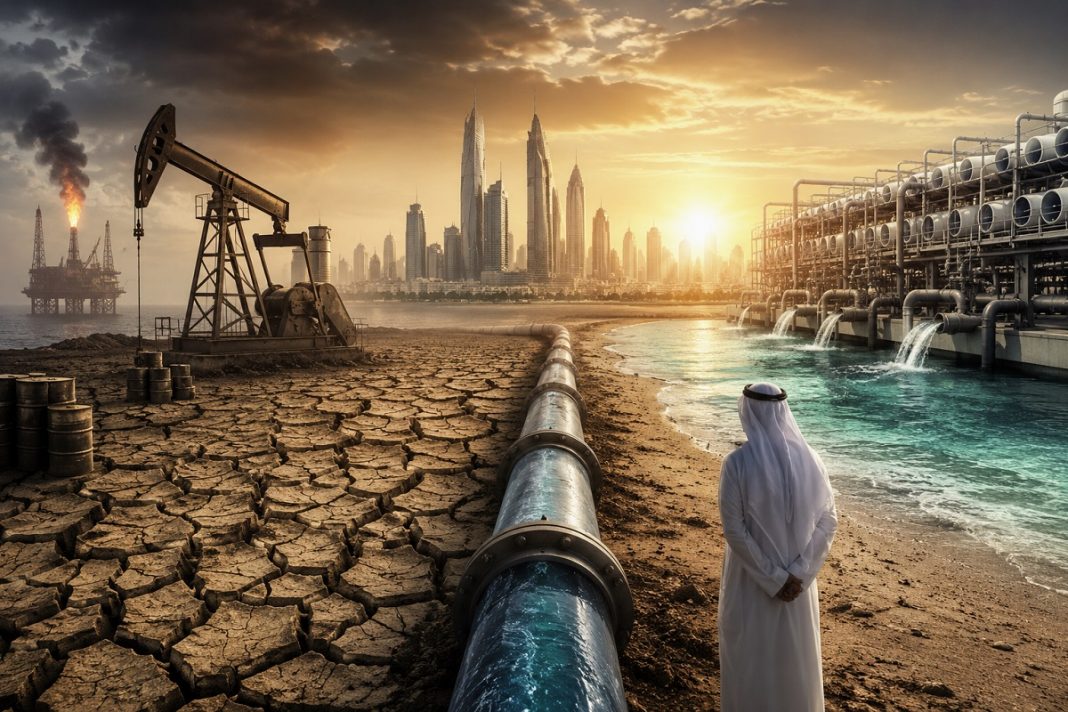
That is the uncomfortable reality emerging across the Middle East. For decades, the Gulf’s strategic anxieties revolved around oil — pipelines, tankers, shipping lanes and energy markets. Wars were fought over hydrocarbons, and alliances were built to protect them. But the next great crisis in the Gulf may not begin with oil at all. It may begin with water.
Climate stress is colliding with geopolitical instability to produce a new kind of vulnerability, one that military power alone cannot contain. Rising temperatures, collapsing groundwater reserves, intensifying dust storms and chronic water scarcity are no longer environmental side issues. They are becoming central questions of political stability and economic survival.
For years, Gulf states believed wealth could compensate for geography.
Lacking rivers and renewable freshwater resources, they used oil revenues to build one of the world’s largest desalination networks. Modern urban life across much of the Gulf now depends on turning seawater into freshwater on an enormous industrial scale. Kuwait, Qatar and the United Arab Emirates rely almost entirely on desalinated water for drinking, industry and daily life.
What once looked like a technological triumph is increasingly becoming a strategic weakness.
Desalination plants are no longer simply civilian infrastructure. They are part of the Gulf’s security architecture. Recent regional conflicts have already exposed how vulnerable critical infrastructure can be to disruption. Energy facilities, ports and shipping lanes have all come under attack. Water systems may be next.
The danger is especially acute because many Gulf states depend on only a handful of large desalination facilities. Taking even one major plant offline — whether through missile strikes, drone attacks or cyberwarfare — could disrupt water access for entire cities within days.
And unlike oil shocks, water shocks are much harder to absorb.
Oil disruptions raise prices. Water disruptions threaten the functioning of society itself. A prolonged interruption in desalinated supply would not simply slow economic growth or unsettle markets. It could quickly evolve into a humanitarian and political crisis across some of the world’s most densely urbanized desert environments.
The risks are not only military. Cyberattacks on water and energy systems are becoming an increasingly serious concern across the region as critical infrastructure grows more digitally interconnected. The Gulf’s next water crisis may begin with malicious code as easily as with missiles.
At the same time, the cost of producing water is itself rising. Desalination is extraordinarily energy intensive, and Gulf states have few realistic alternatives. As energy markets become more volatile and temperatures continue climbing, the economic burden of maintaining water security will grow heavier.
Yet the vulnerability of desalination infrastructure is only part of the story. Even in times of relative stability, the Middle East faces one of the world’s worst water crises. Climate change is driving temperatures higher, making rainfall more erratic and accelerating groundwater depletion. Meanwhile, decades of unsustainable water management have pushed much of the region closer to ecological stress.
The World Bank estimates that water scarcity intensified by climate change could cost Middle Eastern economies between 6 and 14 percent of GDP by 2050. Much of the damage may already be difficult to reverse. Aquifers depleted over decades can take centuries to recover, if they recover at all.
Iran increasingly offers a glimpse of what the region’s future could look like.
Years of drought, groundwater depletion and poor water management have pushed several Iranian cities toward severe shortages. Reservoirs have fallen to dangerously low levels. Iranian officials have even floated the possibility of relocating the capital away from Tehran because of worsening water insecurity. Alongside climate pressures, decades of overbuilding dams and over-extracting groundwater — partly driven by efforts to maintain agricultural self-sufficiency under sanctions — have deepened the crisis.
The consequences extend far beyond environmental degradation. Water scarcity is intensifying economic hardship, straining rural communities and contributing to broader social discontent.
Nor do these pressures remain confined within national borders. Dust storms, desertification, agricultural collapse and climate-driven migration increasingly spill across the region. Environmental stress is becoming geopolitical stress.
This is quietly changing the meaning of security in the Gulf.
For decades, regional security was largely understood through military terms: deterrence, naval power, missile defense and foreign protection guarantees. But fighter jets cannot replenish aquifers. Missile shields cannot lower temperatures. Wealth can delay vulnerability, but it cannot eliminate geography.
The deeper danger is that Gulf governments may continue treating climate vulnerability as secondary to geopolitical competition, when in reality the two are becoming inseparable. The region’s future instability may emerge less from ideology or conventional warfare than from ecological breakdown interacting with political fragility.
That possibility is already beginning to reshape regional calculations. Water management, climate adaptation and ecological resilience are slowly moving from the margins of policy debates toward the center of long-term strategic planning. Cooperation on water, desalination technology and environmental management may eventually become one of the few areas where regional coordination remains possible despite political rivalries.
That may sound ambitious in a region shaped by mistrust and recurring conflict. Yet ecological systems do not recognize political borders. Heat waves, groundwater depletion and dust storms move across the region regardless of diplomacy or ideology. No Gulf state can fully insulate itself from environmental collapse elsewhere.
The irony is difficult to miss. The same region that powered the industrial world through oil now finds itself on the front line of climate vulnerability.
For generations, oil defined Gulf power. In the decades ahead, water may determine whether that power can endure.
This article was originally published in Arabic on the Asswak Al-Arab website