Gabriel G Tabarani
The escalation unfolding in the Middle East is no longer defined by the number of strikes or their geographic reach, but by the nature of the targets themselves. When conflict shifts from military installations to energy infrastructure—from Iran’s South Pars gas processing facilities to critical Gulf energy hubs and vital maritime routes—it signals not just another round of confrontation, but a transformation in the rules of the game.
Energy is no longer a backdrop to regional conflict. It has become one of its primary arenas.
This shift is already reshaping not only the trajectory of the war but also the relationship between security and economics in the Middle East—and, by extension, in the global system.
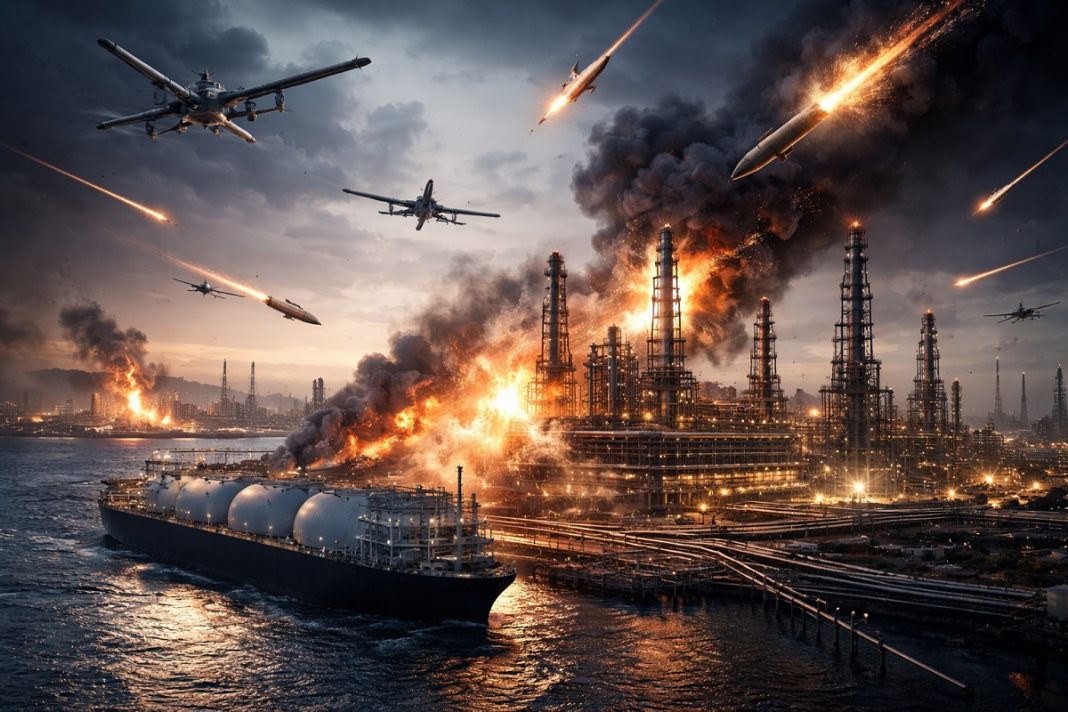
What is most striking is not the targeting of Iran alone, but the rapid expansion of attacks into the core of the Gulf’s energy architecture. In the first wave of Iranian strikes, high-value energy assets were the clear focus. Drones targeted Ras Laffan Industrial City in Qatar, home to the world’s largest liquefied natural gas export complex, with an annual capacity of roughly 77 million tons—nearly one-fifth of global LNG supply.
The consequences were not merely technical, but systemic. Following the attack and subsequent security concerns, QatarEnergy halted LNG production and declared force majeure, disrupting shipments to both Europe and Asia. A single strike cascaded into a global supply shock.
Saudi Arabia, too, felt the fragility of even the most fortified infrastructure. Debris from intercepted drones sparked a fire at the Ras Tanura refinery, one of the kingdom’s most critical export facilities. Although the damage was contained, precautionary shutdowns of processing units underscored a key lesson: even partially intercepted attacks can halt operations due to safety protocols, amplifying their impact.
In the United Arab Emirates, the disruption followed a different pattern. Rather than directly targeting oil production, attacks struck broader economic infrastructure—ports, airports, and data centers in Dubai. While most projectiles were intercepted, falling debris caused damage, disrupted air traffic, and raised civilian casualties. The message was unmistakable: modern warfare increasingly targets entire economic systems, not just energy production sites.
Even countries less directly targeted were not spared. Oman reported damage to facilities near the ports of Duqm and Salalah, including incidents affecting oil tanker crews. Bahrain and Kuwait recorded damage to civilian infrastructure from intercepted missiles. The geographic spread of these incidents made clear that no part of the Gulf lies outside the conflict’s expanding footprint.
Overlaying all of this is the persistent strategic weight of the Strait of Hormuz. Roughly one-fifth of the world’s oil supply passes through this narrow waterway. It has long been understood as a potential chokepoint, but in the current context, it has evolved into something more: a standing instrument of pressure. Even the threat of disruption, combined with simultaneous attacks on production and infrastructure, creates an unprecedented risk to both supply and transit.
What is emerging is not a conventional escalation, but a systemic one.
This is no longer a conflict confined to military domains. It is one that targets the connective tissue of the global economy. Strikes on South Pars affect gas production. Disruptions in Ras Laffan ripple through global LNG markets. Instability around Ras Tanura touches crude oil exports. And the shadow over Hormuz threatens the movement of energy itself.
Taken together, these actions reveal a shift toward what might be called “total economic exposure”—a strategy aimed not simply at weakening an adversary’s military capacity, but at raising the cost of conflict across entire economic networks.
In this sense, the Middle East is entering what analysts Jason Bordoff and Meghan O’Sullivan have described as a new era of energy weaponization—one in which energy resources, infrastructure and supply chains become instruments of geopolitical leverage . Yet what we are seeing today goes even further. Energy is not just being used as a tool of pressure; it is becoming a battlefield in its own right.
For the Gulf states, this marks a critical inflection point.
Over the past decade, they have pursued ambitious strategies of economic diversification, investing heavily in tourism, finance, logistics and technology. These strategies rested on a central assumption: that the region was gradually moving toward a more stable, predictable order.
That assumption is now under strain.
The immediate challenge is no longer simply how to diversify economies, but how to protect them. The priority is shifting from opportunity to resilience—from expansion to risk management. And as security concerns intensify, so too does the likelihood of increased defense spending and deeper reliance on external security guarantees, particularly from the United States.
Here lies a profound paradox.
The more Gulf economies seek to reduce their dependence on energy, the more geopolitical tensions pull them back into its orbit. Energy remains both their greatest asset and their most significant vulnerability.
At a broader level, the current moment signals the erosion of a model that has defined the region for years: one of managed rivalry, calibrated escalation and implicit limits. That model is giving way to a more volatile environment in which military and economic tools are deployed simultaneously and without clear boundaries.
The question now is whether any red lines remain.
Thus far, those lines appear increasingly blurred. The targeting of processing facilities, the disruption of export hubs, attacks on economic infrastructure and the looming threat to critical maritime routes all suggest that actors are probing the limits of escalation in an environment with few effective constraints.
In such a context, escalation is no longer an exception. It is a trajectory.
What is at stake is not just the outcome of a particular conflict, but the structure of the regional order itself. If energy continues to be drawn into the center of confrontation, the consequences will extend far beyond the Middle East, reshaping global markets, supply chains and strategic alignments.
The era of strategic patience is over.
What is taking shape in its place is a new reality—one in which power is measured not only by military strength, but by the ability to disrupt, control and influence the world’s economic lifelines.
This article was originally published in Arabic on the Asswak Al-Arab website