Gabriel G Tabarani
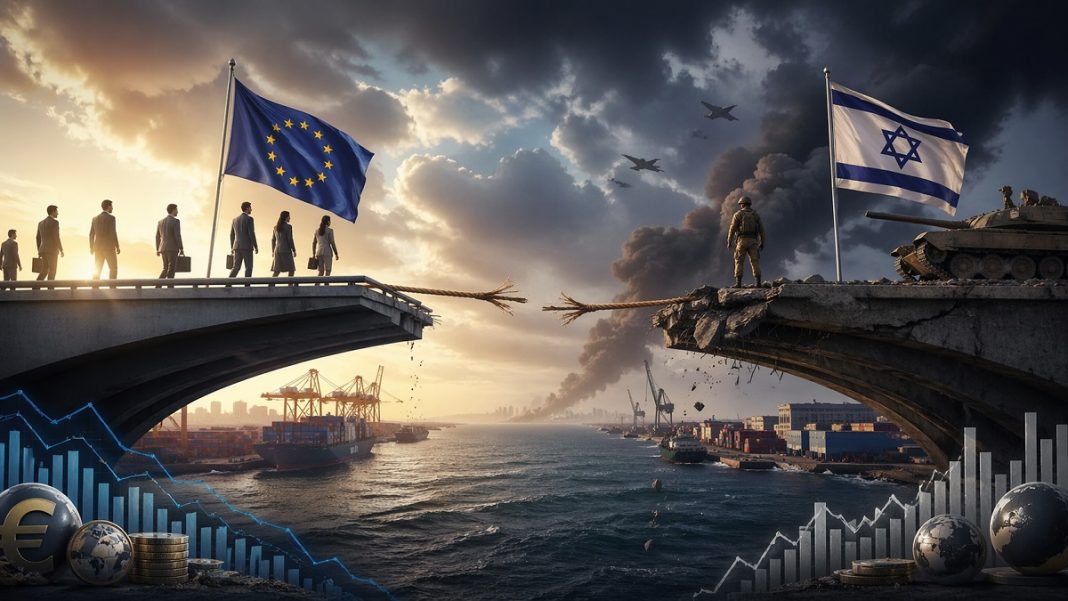
Europe’s relationship with Israel is no longer defined by quiet divergences or routine diplomatic friction. It is increasingly shaped by a deeper, more consequential shift—one where political tensions, legal scrutiny and regional instability are converging with economic interests. For decades, the European Union has been Israel’s largest trading partner, absorbing roughly a third of its exports—worth more than $40 billion annually—while providing privileged access under the EU-Israel Association Agreement signed in 2000. Today, that framework is under mounting strain.
The recent effort (last Tuesday) by Spain, Ireland and Slovenia to suspend the agreement, though unsuccessful, was not merely symbolic. It reflected a growing readiness within parts of Europe to consider economic leverage in response to what international bodies and some European officials have described as serious violations of international law, including potential war crimes and crimes against humanity in Gaza. Even raising the prospect of suspending such a foundational agreement marks a notable shift in tone.
At the heart of this tension lies a familiar European dilemma: how to reconcile economic interdependence with a foreign policy built on the defense of human rights. The Association Agreement itself is explicitly conditioned on respect for democratic principles and human rights—provisions that have long remained largely theoretical but are now increasingly invoked in political debate. As scrutiny intensifies, maintaining the status quo is becoming more difficult to justify, both politically and legally.
The economic stakes are significant. Israel is deeply integrated into European markets, not only through trade but also via collaboration in high-tech industries, cybersecurity, and scientific research programs. European companies benefit from access to Israel’s innovation ecosystem, while Israeli firms rely heavily on European markets for exports and investment. Any disruption—whether partial or gradual—could reverberate across supply chains, investment flows and joint ventures, making escalation costly for both sides.
Yet consensus within the European Union remains elusive. Germany and Italy, among others, continue to favor what they describe as “critical engagement” over punitive measures. In Berlin’s case, historical responsibility remains a central factor shaping its approach. Rome, meanwhile, balances European commitments with domestic political considerations. But this cautious stance is increasingly at odds with shifting public opinion. Across Europe, large-scale protests and evolving polling data suggest a growing discomfort with Israel’s conduct in Gaza and beyond.
These dynamics cannot be separated from the broader geopolitical environment. The war in Gaza has not remained contained; it intersects with rising tensions along the Lebanese border and the persistent risk of escalation with Iran. For European policymakers, this widening arc of conflict raises concerns that extend beyond security into economic stability—particularly regarding energy markets, Mediterranean trade routes and regional supply chains. As the prospect of a wider confrontation looms, Israel is increasingly seen not only as a strategic partner but also as a source of mounting geopolitical uncertainty.
Internal shifts within the European Union may further accelerate this recalibration. The political weakening of leaders who have historically shielded Israel from collective European action could open the door to measures previously blocked, such as targeted sanctions on extremist settlers in the West Bank. While such steps may appear limited in scope, they could signal the beginning of a broader trajectory toward economic and political pressure.
From a regional perspective, this evolving European stance carries implications beyond the continent. Arab states that have pursued normalization or economic partnerships with Israel are watching closely. A cooling of EU-Israel relations could reshape investment patterns, influence energy cooperation in the Eastern Mediterranean, and introduce new uncertainties into regional economic planning.
Meanwhile, Israel’s current leadership shows little indication of adjusting course. The continued rise of hardline political forces has reinforced policies that draw sustained international criticism. As long as this trajectory persists, tensions with Europe are likely to deepen, gradually shifting from political disagreement to tangible economic consequences.
There is also a notable gap between perception and reality within Israel itself. Public opinion surveys suggest that many Israelis increasingly view the European Union as an adversary, despite its central role in sustaining Israel’s economic integration and prosperity. This disconnect may complicate the country’s ability to anticipate and respond to changes in European policy.
For now, Europe is not on the verge of a dramatic rupture with Israel. The relationship remains intact, underpinned by mutual interests and institutional ties. But it is no longer static. It is evolving—slowly, unevenly, yet decisively—under the weight of war, legal accountability and geopolitical risk.
The question is no longer whether Europe will reassess its relationship with Israel, but when and how far it is prepared to go. In an era where economics, politics and security are increasingly intertwined, the cost of this gradual drift may ultimately prove difficult for both sides to contain.
This article was originally published in Arabic on the Asswak Al-Arab website