Gabriel G Tabarani
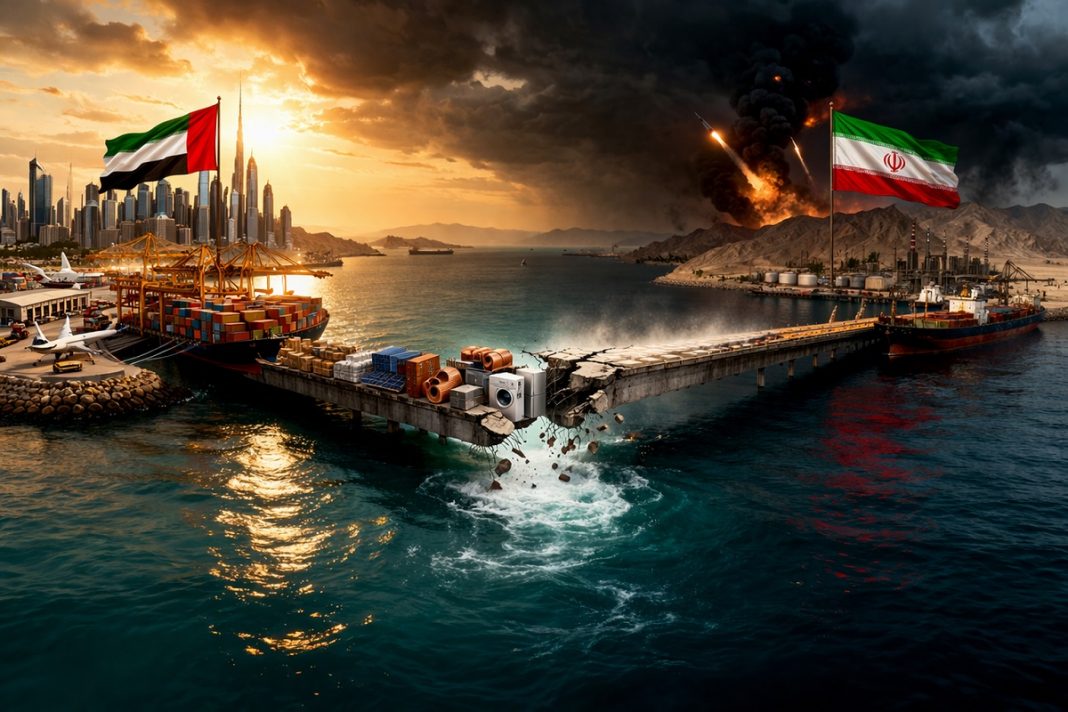
While the world fixates on Iran’s oil exports and the strategic importance of the Strait of Hormuz, a quieter but potentially more consequential vulnerability is coming into view: Iran’s dependence on the United Arab Emirates as its last functional gateway to the global economy.
For years, Dubai has served as Iran’s economic back door. In 2024 alone, roughly $21 billion worth of goods—nearly a third of Iran’s total imports—passed through the Emirates. But this relationship has never been a simple matter of bilateral trade. It is a sophisticated workaround, a system that allows Iran to access global markets indirectly despite sanctions that have cut it off from much of the world.
Through Emirati ports, Iran imports everything from electronics and machinery to gold and consumer goods. Supply chains are rerouted, goods are reclassified and intermediaries play a crucial role. This is not just trade—it is adaptation. And it has kept Iran’s economy functioning when direct access to international markets has been largely closed.
That system is now under strain in ways it has never been before.
Since the outbreak of hostilities on Feb. 28, the United Arab Emirates has found itself increasingly entangled in the conflict surrounding Iran—intercepting missiles, confronting drone attacks and facing growing threats to its own security. In such an environment, the long-standing separation between commerce and geopolitics is breaking down.
The early signs are already visible. Shipping traffic between Emirati ports and Iran has slowed sharply. What once operated as a reliable corridor is beginning to narrow. If the Emirates moves to tighten oversight—or worse, restrict trade altogether—the consequences for Iran would not be marginal. They would strike at one of the central pillars keeping its economy afloat.
Iran has few alternatives.
China and Turkey can absorb some trade, and Oman offers a limited logistical and diplomatic channel. But none can replicate the unique role the Emirates plays. Geography, infrastructure and decades of commercial integration have made Dubai indispensable. It is not just a trading partner; it is a system.
That system has become even more critical since 2018, when the United States reimposed sweeping sanctions under its “maximum pressure” campaign. As direct trade routes closed, Iran leaned more heavily on indirect channels. A vast shadow economy emerged, with an estimated $20 to $25 billion in goods entering the country annually through semi-formal mechanisms—often mislabeled, rerouted or quietly approved.
This ecosystem is remarkably resilient—but also inherently fragile. It depends on a delicate balance of trust, tolerance and shared economic interest. War disrupts all three.
The irony is stark. Iran’s regional strategy—built on deterrence, proxies and asymmetric pressure—has long been designed to offset its economic isolation. But in escalating confrontation, Tehran risks undermining the very networks that have allowed its economy to survive.
The United Arab Emirates, for its part, would feel the loss. Iran is a meaningful partner in Dubai’s re-export economy. But the imbalance is clear. The Emirates has global alternatives. Iran does not.
If this trade artery is severed, Iran will not simply lose access to consumer goods or industrial inputs. It will lose a critical mechanism of economic adaptation. Inflationary pressures would intensify, supply chains would strain and the country’s already fragile economic equilibrium could tip further toward instability.
This is why the stakes are higher than they appear.
The real risk is not just the loss of a trading partner, but the collapse of a model—one that has allowed Iran to function in a constrained international system by relying on ambiguity, intermediaries and quiet cooperation.
For years, Iran managed a precarious balance: confrontation in politics, flexibility in economics. That balance is now eroding.
Iran may not lose the Strait of Hormuz. But it could lose something more consequential: its last reliable connection to the global economy.
And if that connection breaks, the question will no longer be how Iran adapts to isolation—but whether it still can.
This article was originally published in Arabic on the Asswak Al-Arab website