Gabriel G Tabarani
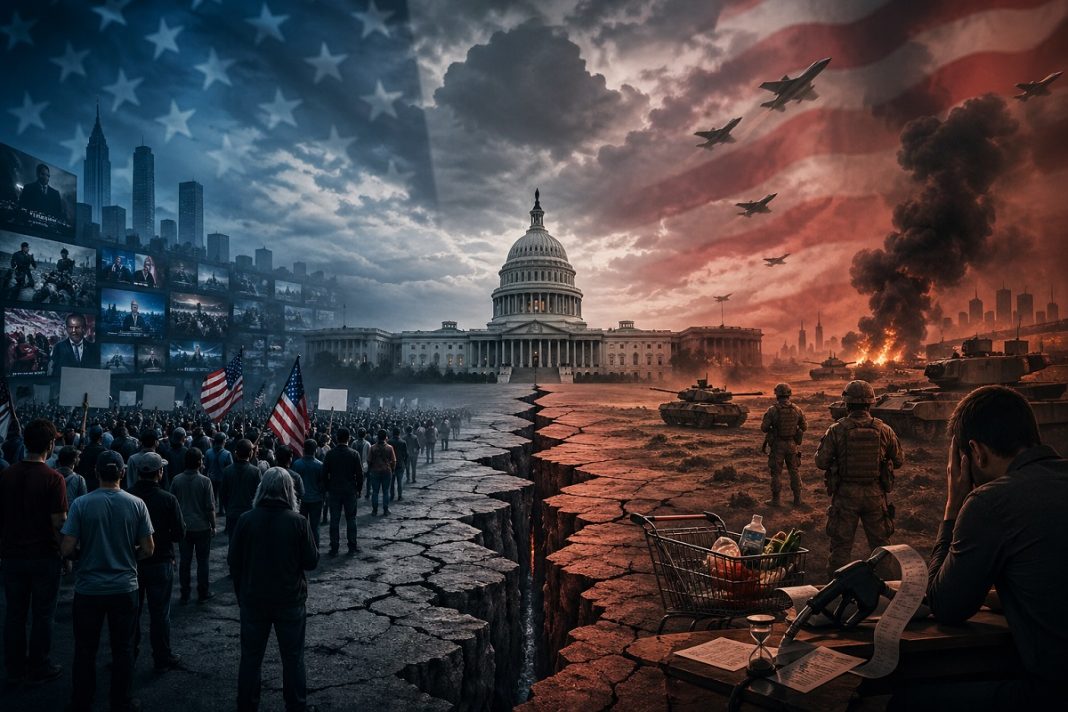
America’s wars are no longer decided on distant battlefields. Increasingly, they are shaped—and constrained—at home. The confrontation with Iran has exposed a reality that extends well beyond the Middle East: the United States’ capacity to wage war now depends not only on military superiority, but on the strength of its political cohesion and social fabric.
For decades, American military power was regarded as the decisive factor in any conflict. The Iran war has unsettled that assumption. Despite its technological edge and unmatched combat capabilities, Washington appears constrained by deep internal divisions that define the limits of its actions as much as strategic calculations do.
At the heart of this shift lies a stark political divide. The conflict has produced more than routine partisan disagreement; it has revealed two competing visions of America’s role in the world. One camp argues that deterrence and hard power remain the only reliable guarantors of U.S. influence. The other sees the expansion of overseas wars as a costly burden—one that drains national resources and undermines the country’s ability to rebuild at home.
This divide has been on full display in Washington, particularly as debates in Congress intensify over funding the war. Supporters frame increased military spending as a strategic necessity, while opponents—from both parties—warn of an open-ended commitment with no clear horizon. In a notable turn, questions about the limits of presidential war powers have resurfaced, echoing earlier divisions during the wars in Iraq and Afghanistan. At the same time, opinion polls suggest that a majority of Americans oppose deploying ground troops to Iran, highlighting a widening gap between elite calculations and public sentiment.
The fragmentation extends beyond politics into the media landscape. There is no longer a single narrative of the war, but rather two parallel accounts that rarely intersect. In one, the confrontation with Iran is framed as a strategic imperative tied to national security. In the other, it appears as a high-risk venture that could draw the United States into another protracted and uncertain conflict.
This divergence does more than reflect a difference of opinion; it creates a fragmented political reality. Citizens are presented with competing versions of the same war, making it harder to build national consensus around its objectives or limits. In such an environment, sustaining a long-term conflict becomes markedly more difficult for any administration.
Yet the most sensitive pressure point remains the economy. However distant the battlefield, the effects of war quickly reach American households. Rising energy prices, disrupted supply chains and growing defence expenditures all revive a familiar question: what is the true cost of this war—and who will bear it?
Amid mounting fiscal deficits, defence spending is no longer solely a matter of national security; it has become a domestic political issue in its own right. Every dollar allocated to war is a dollar not invested in infrastructure, education or healthcare. As this tension between external commitments and internal priorities grows, the legitimacy of prolonged conflicts begins to erode.
A deeper shift in the American mood is also under way. The idea of retrenchment—or “reordering priorities”—is no longer confined to a single political current. It has become a cross-partisan inclination. From the progressive left to the populist right, voices increasingly converge around the need to scale back foreign engagements and refocus on domestic renewal.
This does not necessarily signal a decline in American power. Rather, it points to a redefinition of what power means. In the 21st century, strength is no longer measured solely by aircraft carriers or overseas bases, but by a nation’s ability to sustain internal cohesion and maintain a resilient economic and social model.
The war with Iran thus raises a question that transcends the conflict itself: can the United States still function as the world’s pre-eminent power amid deepening internal divisions?
The answer is not straightforward. Washington retains a level of military and technological dominance that remains unmatched. But it faces a different kind of challenge—how to manage that dominance in a fractured domestic environment, where every external decision carries immediate internal political costs.
Ultimately, the conflict reveals that the balance of power is no longer drawn solely on battlefields or in energy markets, but within societies themselves. In democracies, wars are not fought by weapons alone, but by political consensus and public trust—two resources that appear to be steadily eroding in the United States.
The war in Iran may end with a new regional arrangement or a fragile equilibrium. Its deeper impact, however, will be felt at home. There, far from the noise of the front lines, the real battle is unfolding: a struggle to define America’s role, the limits of its power, and its capacity to endure as a global force in a world that no longer resembles that of two decades ago.
This article was originally published in Arabic on the Asswak Al-Arab website