Gabriel G Tabarani
There is a familiar script for post-conflict recovery: stabilise institutions, rebuild infrastructure, attract capital. Syria, emerging from more than a decade of devastating war, appears to be stepping cautiously onto that path. But the country’s revival—if it is to endure—will depend less on reconstruction spending than on whether it can fundamentally rewire the political economy that failed it in the first place.
Recent discussions around Syria’s “growth perspectives” reflect a cautious return of economic dialogue. Forums are re-emerging, policymakers are re-engaging and early conversations with investors are resuming. These signals matter. Recovery begins with confidence, and confidence rests on expectations of continuity and stability.
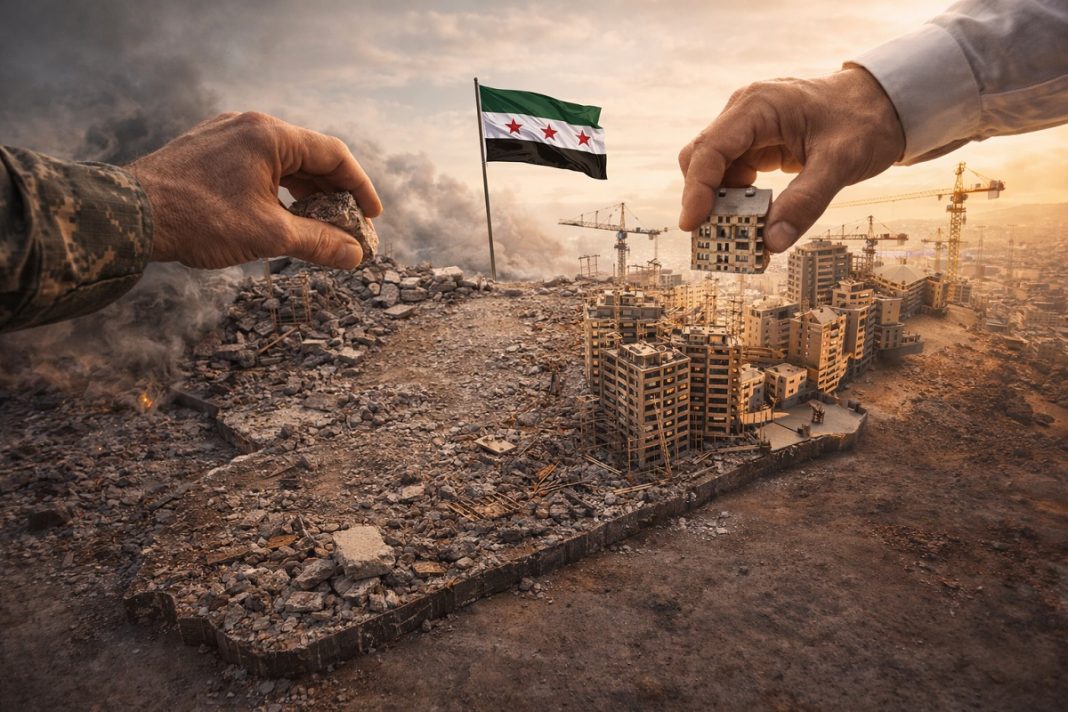
Yet optimism must be measured against the scale of collapse. Syria’s economy has contracted dramatically, infrastructure has been destroyed, supply chains fragmented and human capital dispersed through displacement and migration. Most Syrians now live in conditions of acute economic hardship. In this context, reconstruction is not simply about rebuilding what was lost—it is about deciding what kind of economy Syria is meant to become.
This is the central dilemma: should Syria reconstruct its pre-war economic model, or attempt a deeper transformation? The answer is not technical, but political.
Before the war, Syria operated a hybrid economic system—state-dominated yet partially liberalised, with blurred boundaries between political authority and economic activity. While this model ensured a degree of control, it proved structurally weak in generating sustainable growth. The risk today is that reconstruction capital, if it materialises, may entrench rather than reform this system.
This trajectory cannot be separated from the wider regional shock triggered by the recent Iran-linked conflict, which has reshaped risk perception across the Middle East. The war exposed the vulnerability of energy infrastructure and raised the geopolitical risk premium, prompting capital—particularly from the Gulf—to reassess its allocation strategies. In this context, Syria represents a paradox: a potential post-conflict investment frontier, yet a high-risk environment shaped by unresolved tensions linked to Iran and its regional networks. Any meaningful reconstruction effort will therefore be conditioned not only by domestic reforms, but by the evolution of regional power balances. In that sense, Syria’s recovery is not merely an economic process, but part of a broader strategic equilibrium that remains unsettled.
Reintegration into regional and global economic systems is often presented as a solution. Syria’s gradual re-entry into economic diplomacy and the tentative easing of constraints may improve sentiment. But reintegration alone does not resolve the core issue: weak institutions and the absence of a predictable business environment.
The real test lies in institutional reform. Rebuilding the economy requires rebuilding the state’s core functions—credible fiscal management, a functioning banking system, transparent investment rules and enforceable legal frameworks. These are not technical details; they are the preconditions for any serious flow of capital.
There are early signs of openness. The leadership has signalled a willingness to engage the private sector and attract foreign investment, including from the Syrian diaspora. But without credible guarantees and regulatory clarity, capital will remain cautious—short-term, opportunistic and risk-averse.
Another challenge concerns sequencing. Post-conflict economies often prioritise visible infrastructure—roads, housing, energy—to signal progress. But without parallel governance reforms, such investments risk becoming inefficient or reinforcing existing distortions.
The energy sector illustrates this dilemma. Reviving oil and gas production could deliver immediate fiscal relief, but it may also reinforce a narrow, resource-dependent model. Diversification into agriculture, light industry and services will be slower and more complex, but ultimately more resilient.
Regional dynamics will also shape the recovery trajectory. Gulf states, Turkey and European actors are all positioning themselves for a role in reconstruction, driven by economic interests and geopolitical calculations. Investment flows are unlikely to be neutral; they will reflect competing agendas. Syria’s challenge will be to leverage this engagement without becoming structurally dependent on any single axis.
The social dimension is equally critical. The return of displaced populations presents both an opportunity and a strain. Reintegrating labour into the economy will be essential for growth, but will require sustained investment in housing, services and job creation. Without this, social fragility could undermine economic recovery.
Ultimately, Syria stands at a crossroads between two paths: a conventional reconstruction that reproduces pre-war vulnerabilities, and a more difficult but necessary transformation towards a diversified and sustainable economy.
The signals so far are mixed. Diplomatic and economic re-engagement is underway, investor interest is emerging and international actors are preparing to provide technical support. Yet the underlying political economy remains largely intact.
In a region where recent conflict has redefined risk, Syria’s recovery will not be a purely domestic matter. It will test whether the Middle East can move from cycles of confrontation to a framework of economic stabilisation.
The question is no longer whether Syria will be rebuilt, but how. History suggests that the volume of investment is not decisive; the rules governing that investment are.
Rebuilding roads and factories may take years. Rebuilding trust—the most valuable currency in any economy—may take a generation.
This article was originally published in Arabic on the Asswak Al-Arab website