Gabriel G Tabarani
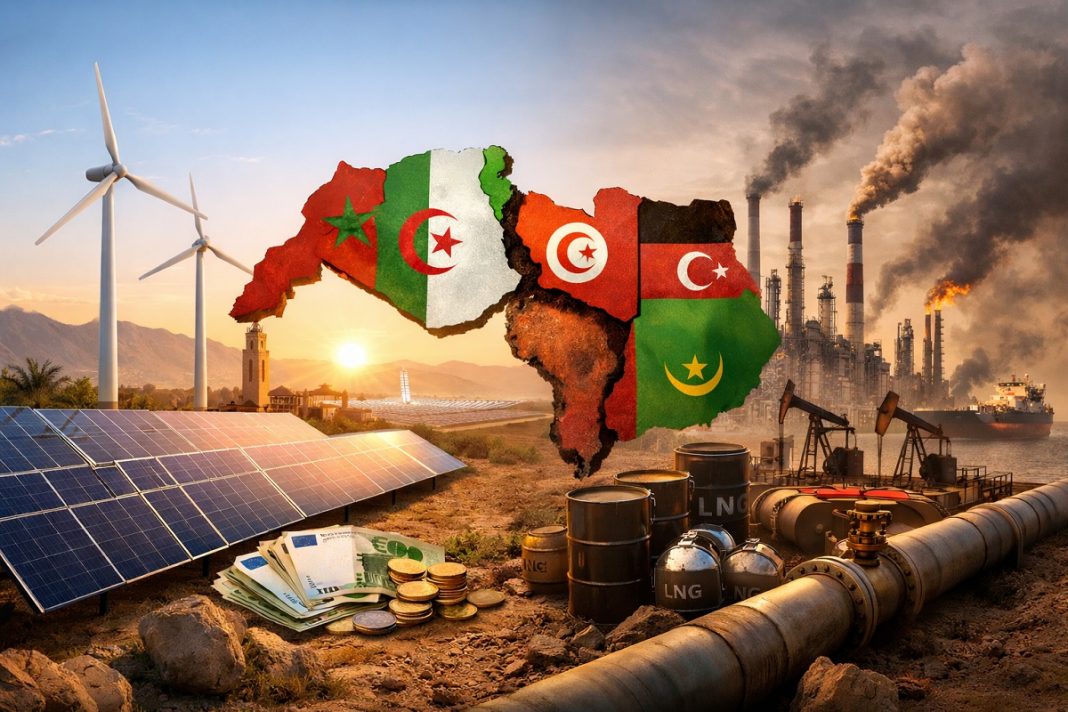
As the world accelerates its shift toward clean energy, the Maghreb finds itself at a pivotal crossroads. What appears to be a historic opportunity to reposition the region as a strategic energy hub may also conceal a more familiar risk: the reconfiguration of dependency—this time under a green banner.
Since Russia’s invasion of Ukraine in 2022, the European Union has moved swiftly to reduce its reliance on Russian energy. In doing so, it has deepened its engagement with North African countries, particularly Algeria, Morocco and Tunisia, which are increasingly seen not as distant partners but as extensions of Europe’s energy security architecture.
Yet this transformation is not merely a technical transition toward renewables. It represents a broader reordering of relations between North and South, where geopolitics and market imperatives intersect, and where the meaning of sovereignty and development is being quietly renegotiated.
Over the past decade, Maghreb countries have pursued ambitious strategies to transition to low-carbon economies, leveraging abundant solar and wind resources. But this domestic agenda has converged with a European strategic shift that risks reducing the region to a functional component within Europe’s energy system, rather than a fully autonomous partner.
The nature of engagement has evolved accordingly. What was once primarily a commercial relationship is now a strategic one, reshaping the energy map of the Mediterranean. Cross-border electricity interconnections, hydrogen corridors and large-scale infrastructure projects are not just investments—they are instruments of influence.
The planned ELMED electricity interconnection between Tunisia and Italy illustrates this shift. With a projected capacity of around 600 megawatts, it is designed to integrate North Africa more tightly into the European energy market. While such projects promise connectivity and investment, they also underscore the direction of integration: south-to-north, supply-to-demand.
At the same time, the European Union is no longer the only player. China has expanded its footprint through infrastructure and energy projects linked to its Belt and Road Initiative. Gulf states, particularly Saudi Arabia and the United Arab Emirates, are investing heavily in hydrogen and renewable energy ventures across the region. The Maghreb is thus becoming less a partner in energy production than a theatre of competition over the energy systems of the future.
This growing diversity of partners offers governments in the region a degree of leverage. But it also introduces new complexities. Managing competing interests requires more than attracting capital—it demands the capacity to shape it in line with national priorities.
Here lies the central paradox. While governments speak increasingly of “energy sovereignty,” many of the flagship projects underpinning this transition are structured according to external financial and regulatory frameworks. Sovereignty, in this sense, risks becoming more rhetorical than real—repackaging dependence rather than overcoming it.
The economic dimension reinforces this concern. Renewable energy projects in the Maghreb are not driven by technology alone, but by complex financing models that rely heavily on loans and partnerships with international institutions. While these arrangements unlock capital, they also shift risks onto states and, ultimately, onto citizens.
In Tunisia, for example, energy investment coincides with acute economic strain, marked by rising public debt and persistent shortages of foreign currency. In Morocco, despite significant progress in solar development, questions remain about the financial sustainability of projects such as the Noor Ouarzazate complex, whose costs have exceeded $2 billion.
Meanwhile, the European Union is extending its influence through regulatory tools such as the Carbon Border Adjustment Mechanism. Designed to level the playing field for European industries, it effectively imposes new standards on external partners. For Maghreb economies, this presents a stark choice: adapt to rules they did not shape, or risk losing access to critical export markets.
The green transition, then, is not only about energy production. It is about the restructuring of entire economic systems under externally defined conditions—raising difficult questions about long-term autonomy.
Yet the most sensitive challenges may lie closer to home. The success of this transition will ultimately be judged not by investment volumes but by its social impact.
Water scarcity is a case in point. Green hydrogen production—central to many future energy strategies—requires significant amounts of water in a region already facing acute shortages. This raises a fundamental question: can a green economy be built at the expense of already strained natural resources?
Local dynamics further complicate the picture. Large-scale projects are often located in areas deemed “underutilized,” overlooking existing livelihoods. In southern Morocco, protests linked to water shortages have highlighted the tensions such projects can generate. In Algeria, similar discontent has surfaced around resource governance, reflecting deeper fractures between state policy and public sentiment.
The labour market offers little reassurance. While large projects generate employment during construction phases, they rarely create sustained job opportunities. Moreover, reliance on imported technologies limits the development of domestic capabilities, reinforcing structural dependence at a technical level.
None of this is inevitable. With the right policy frameworks, renewable energy investments could serve as a foundation for broader economic transformation. Linking energy projects to industrial strategies, skills development and local value chains could turn the green transition into a driver of inclusive growth.
But this requires a shift in perspective. The challenge is no longer one of resource scarcity, but of governance—who controls these resources, and under what terms.
The Maghreb now faces a defining test. The green transition is not simply an economic option; it is a moment of strategic reckoning. It will determine whether the region can assert itself as a meaningful actor in the emerging global energy order.
The issue is not whether to engage with international partners, but how. Without a deliberate effort to rebalance these relationships, the transition risks becoming yet another channel for dependence—albeit one framed in the language of sustainability.
In a rapidly evolving global landscape, the Maghreb’s position will not be determined by its natural endowments alone. It will depend on its ability to set terms, not just meet them. The choice is stark: to emerge as a partner in the green economy, or remain what it has long been—a supplier of energy, now recast in green.
This article was originally published in Arabic on the Asswak Al-Arab website