Gabriel G. Tabarani
Wars are no longer redrawing only political borders in the Middle East — they are beginning to reshape the architecture of money itself. As geopolitical fragmentation accelerates and global trade routes become increasingly exposed to conflict, the United Araba Emirates (UAE) is positioning itself at the centre of a new financial order built on digital payment infrastructure and stablecoins.
For years, stablecoins were treated as the unruly cousins of modern finance: useful for crypto traders, perhaps, but too volatile, opaque and politically awkward to become serious monetary instruments. That assumption is now rapidly eroding in the Gulf. In the UAE in particular, stablecoins are evolving from speculative digital assets into strategic financial infrastructure.
The shift is not occurring in a vacuum. It is being accelerated by three converging forces: geopolitical instability, the search for more resilient trade settlement systems, and the Gulf’s ambition to become a central node in the emerging architecture of digital finance.
Recent events have sharpened this trajectory. The escalation of tensions involving Iran and the resulting disruptions to regional logistics and financial flows have pushed policymakers and corporations alike to reassess how money moves across borders. Industry executives in the UAE say the conflict has accelerated corporate demand for alternative settlement systems capable of reducing delays, trapped liquidity and dependence on traditional banking rails.
But what distinguishes the Emirati approach is that it is not simply embracing crypto enthusiasm. It is constructing a regulated sovereign framework for programmable money.
That distinction matters.
Unlike earlier crypto experiments driven by libertarian ideology or speculative hype, the UAE model is institutional, state-supervised and commercially pragmatic. The Central Bank of the UAE has introduced a formal payment-token regime, licensed dirham-backed stablecoins and restricted the domestic use of foreign stablecoins. The objective is not to dismantle the banking system, but to modernise it.
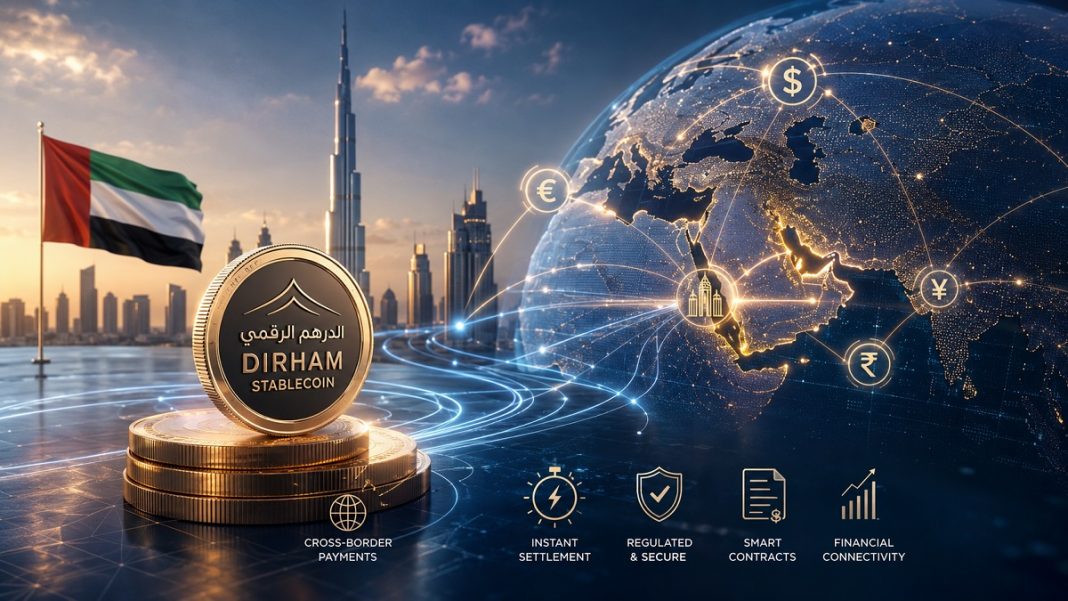
The emergence of AE Coin — the UAE’s first regulated stablecoin approved in late 2024 — marked the beginning of this transition. Since then, major institutions including First Abu Dhabi Bank, Zand Bank and Al Maryah Community Bank have either launched or explored dirham-backed digital currencies.
What appears at first glance to be a niche fintech development may in fact signal a deeper transformation in international finance.
Historically, cross-border payments have remained surprisingly inefficient. Trade settlements can take days, remittances remain expensive, and liquidity is often immobilised inside correspondent banking systems designed for a pre-digital age. Stablecoins offer a potentially significant improvement: near-instant settlement, lower transaction costs and programmable escrow functions capable of automating contractual execution.
For a trading nation such as the UAE, these efficiencies are strategically attractive.
The Gulf sits at the intersection of Asia, Africa and Europe. Emirati policymakers understand that future competitiveness will depend not only on ports, airlines and logistics hubs, but increasingly on digital financial infrastructure. Stablecoins are becoming part of that broader economic positioning.
The UAE is therefore attempting something unusually sophisticated: combining the speed and flexibility of blockchain technology with the credibility of regulated sovereign finance.
This balancing act could give the Emirates a first-mover advantage.
Importantly, the momentum behind stablecoins in the Middle East is also rooted in broader regional realities. According to Chainalysis data published in 2025, stablecoins accounted for 52 per cent of all cryptocurrency transaction volume across the Mena region — the highest share globally. In countries facing inflationary pressure and currency depreciation, stablecoins increasingly function as practical financial tools rather than speculative assets.
Turkey and Egypt provide obvious examples, where local currency instability has fuelled digital dollarisation. But the UAE’s case is different. The dirham is already stable and pegged to the US dollar. Emirati interest in stablecoins is therefore less defensive and more strategic.
In effect, the UAE is positioning itself as a neutral financial bridge in an increasingly multipolar world.
This geopolitical dimension should not be underestimated. As global trade fragments into competing spheres of influence, many countries are seeking alternatives to overdependence on traditional dollar-clearing systems. Stablecoins issued within trusted regulatory jurisdictions could eventually become instruments of financial diplomacy.
That prospect partly explains why the UAE is investing heavily in digital payment corridors linking India, China and Africa. Several UAE-based companies are already piloting stablecoin-enabled settlement systems across those regions.
Yet enthusiasm should be tempered by realism.
Stablecoins still face substantial structural risks. The collapse of TerraUSD in 2022 demonstrated how quickly confidence can evaporate when reserves or stabilisation mechanisms prove inadequate. The Bank for International Settlements has also warned that many stablecoins historically struggled to maintain parity with their underlying peg and often lacked transparency regarding reserves and audits.
Regulation therefore becomes the decisive variable.
The UAE’s advantage lies precisely in its willingness to regulate early rather than merely encourage innovation rhetorically. The combination of the Central Bank, Dubai’s Virtual Assets Regulatory Authority and Abu Dhabi Global Market has created one of the world’s most coherent digital asset frameworks.
That institutional seriousness distinguishes the UAE from many earlier crypto hubs that prioritised rapid growth over financial safeguards.
Still, difficult questions remain unresolved. To what extent will state-backed stablecoins coexist with decentralised finance? Will sovereign digital currencies ultimately reinforce dollar dominance or gradually fragment it? Can programmable money preserve privacy while satisfying regulatory oversight?
No country has yet fully answered these questions.
But the UAE has recognised something many others still underestimate: stablecoins are not merely a crypto story. They are becoming part of the future plumbing of global commerce.
The broader implication is that the next phase of financial competition may not revolve solely around interest rates, reserve currencies or stock exchanges. It may centre on who controls the rails through which digital value moves.
For the Gulf, this represents a rare strategic opening.
The Emirates built global relevance through aviation, logistics and energy connectivity. Now it is attempting to do the same through financial infrastructure. If successful, stablecoins could become not only a fintech innovation, but a geopolitical instrument — one that strengthens the UAE’s role as a trusted intermediary between East and West, North and South.
The next global contest may not be fought over oil fields or shipping lanes alone, but over who controls the movement of digital money itself. In that contest, the UAE is determined not merely to participate, but to shape the rules of the game.
This article was originally published in Arabic on the Asswak Al-Arab website