Gabriel G. Tabarani
When Iranian authorities shut down internet access during the latest wave of protests, they were not merely disrupting communication. They were controlling visibility.
A protest that cannot be filmed, shared or seen beyond national borders becomes easier to contain. A government that controls the flow of information controls, at least in part, the public understanding of reality itself.
For years, scenes like this seemed to belong to a familiar category: authoritarian governments using technology to suppress dissent. China built the Great Firewall. Russia tightened its grip on digital platforms. Iran repeatedly turned to internet blackouts during moments of political unrest.
The democratic world, by contrast, presented itself as the defender of an open internet — a borderless space where information could move freely and citizens could hold power to account.
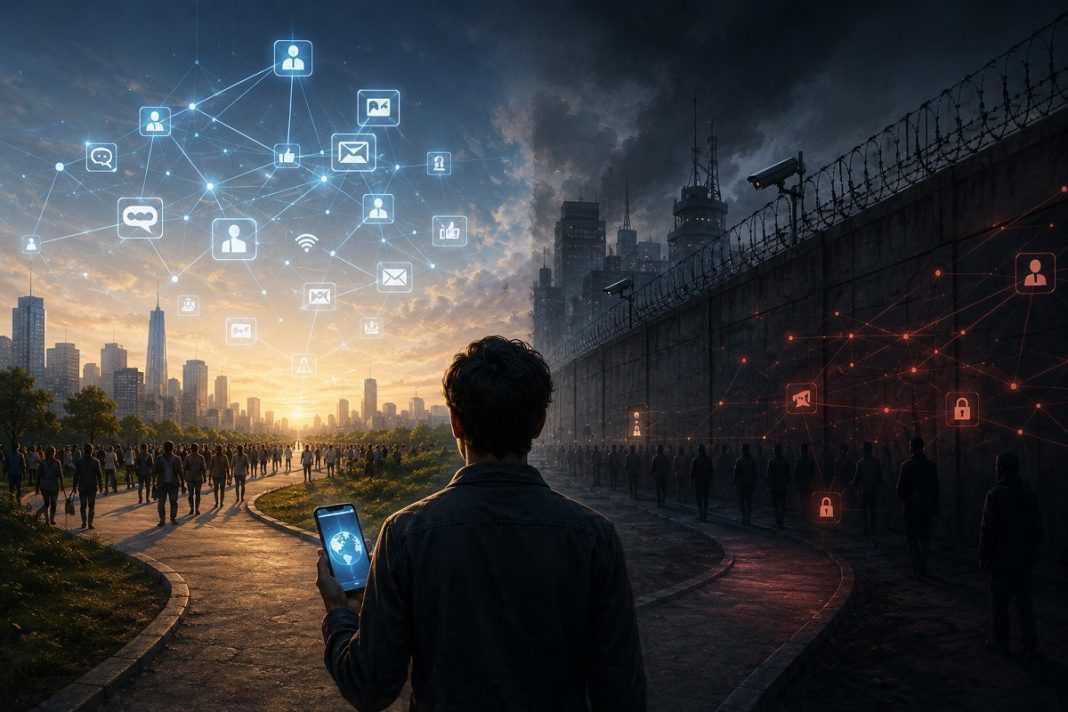
That distinction is becoming less clear.
The most significant victory achieved by China and Russia in the battle over the internet may not be technological at all. It may be intellectual. Increasingly, democratic governments are beginning to speak the language that authoritarian states have spoken for years: the language of control, digital sovereignty and information management.
The change did not happen overnight.
A little more than a decade ago, the internet was widely seen as a force for liberation. Social media helped activists organize protests during the Arab Spring. Digital platforms lowered barriers to participation in public life. Information that once passed through governments, broadcasters and newspaper editors could suddenly travel directly from one citizen to another.
In 2012, the United Nations Human Rights Council affirmed a simple principle: the same rights people enjoy offline should also be protected online. At the time, it felt less like an aspiration than an emerging reality.
Then came the backlash.
The same technologies that empowered democratic movements also amplified conspiracy theories, extremism and foreign propaganda. Social media platforms became engines of polarization. Elections across Europe and the United States were shadowed by fears of online manipulation. The Covid pandemic exposed how quickly false information could spread at a global scale. More recently, advances in artificial intelligence have raised new concerns about fabricated content that is increasingly difficult to distinguish from reality.
The internet that once appeared to be a vehicle of democratic renewal now looked, to many policymakers, like a source of instability.
And so the conversation changed.
Across Europe, the focus has shifted from internet freedom to what is often called “digital sovereignty.” Governments argue that they need stronger tools to regulate platforms, limit harmful content and protect democratic institutions from manipulation. The European Union’s Digital Services Act reflects this new approach, placing greater obligations on large technology companies to police content and manage systemic risks.
Many of these concerns are legitimate. No serious person believes that digital platforms should operate entirely without rules. Democracies have every right to protect citizens from fraud, harassment, child exploitation and coordinated foreign interference.
The question is not whether rules are necessary.
The question is where regulation ends and control begins.
Consider Hungary. During the years in which Prime Minister Viktor Orbán consolidated influence over much of the country’s traditional media landscape, independent journalists increasingly relied on digital platforms to reach audiences. For many of them, the internet was not a threat to democracy. It was one of the last remaining spaces where democratic accountability could still function.
That distinction matters.
Policies designed to combat disinformation today may also shape the boundaries of legitimate political debate tomorrow. Tools created to suppress harmful content do not arrive with guarantees about who will wield them in the future.
In fact, the most important question is often the one least discussed.
Many contemporary proposals assume that current governments will exercise new powers responsibly. But democratic history offers little reason for such confidence. Laws outlive politicians. Institutions survive elections. Authorities granted to one administration inevitably become available to the next.
The issue, therefore, is not how today’s leaders intend to use these powers. It is how tomorrow’s leaders might.
This is where the debate becomes uncomfortable.
China does not describe its digital model as censorship. It describes it as stability, security and sovereignty. The vocabulary is different from that used in Europe or North America, and the political systems are fundamentally different. Yet the underlying logic — that governments should play a larger role in managing the information environment — is becoming increasingly familiar across ideological boundaries.
To be clear, Europe is not China, and the comparison should not be exaggerated. European citizens enjoy freedoms that remain unimaginable under authoritarian rule. The difference remains profound.
But trends deserve attention before they become destinations.
Last year, a widely shared video on the social platform “X” sparked competing narratives among politicians, media organizations and government officials. Within hours, users participating in the platform’s Community Notes system had attached context and corrections to a number of misleading claims. The process was imperfect. It did not eliminate misinformation. But it offered a glimpse of an alternative model: one in which errors are challenged through transparency, open debate and collective scrutiny rather than through centralized control.
That model is not a cure-all. Neither is the opposite.
The choice facing democracies is not between chaos and censorship. It is between different ways of building trust in an age of information abundance.
Governments can require transparency from platforms. They can support independent fact-checking. They can invest in media literacy and digital education. They can strengthen privacy protections and demand accountability from powerful technology companies.
What they should be careful about building is a permanent infrastructure for deciding which ideas deserve visibility and which do not.
The open internet was never as utopian as its early advocates imagined. It brought confusion alongside freedom, noise alongside knowledge. But it also gave ordinary citizens unprecedented access to information and unprecedented power to challenge institutions.
That achievement is easy to take for granted.
The real test for democracies in the coming years will not be whether they can control the internet. It will be whether they can preserve its essential freedoms while addressing its undeniable risks.
Because if they fail, the greatest victory won by authoritarian systems may not be the construction of closed networks within their own borders.
It may be convincing democracies that an open internet is something to fear.
This article was originally published in Arabic on the Asswak Al-Arab website