Gabriel G. Tabarani
Somalia’s problem is not that democracy is absent. It is that democracy may be arriving before the state is ready for it.
At first glance, the political crisis now unfolding in Mogadishu appears to be a familiar dispute over elections, constitutional reform and presidential power. Armed clashes between government forces and militias aligned with opposition leaders have raised fears of renewed instability, while political rivals accuse each other of undermining the country’s democratic future.
But to view Somalia’s crisis merely as a struggle over electoral rules is to miss the larger story. What is unfolding today is not simply a conflict about democracy. It is a conflict about the state itself — its legitimacy, its authority and the foundations upon which political power should rest.
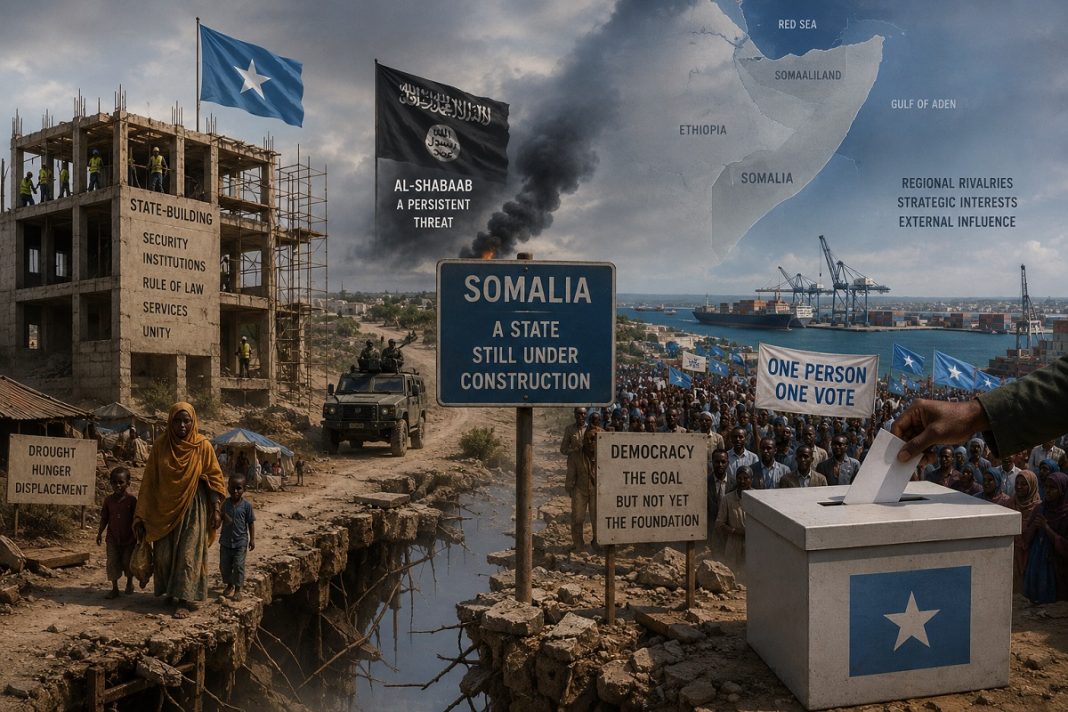
The immediate dispute centers on President Hassan Sheikh Mohamud’s push to replace Somalia’s indirect clan-based electoral model with a system of universal suffrage. Under the current arrangement, clan elders and delegates select members of parliament, who in turn elect the president. Mohamud argues that the system has outlived its usefulness and that Somalia must finally move toward the principle of one person, one vote.
His critics see something different. They accuse the government of using democratic reform as a pretext to consolidate power and extend its political advantage. The controversy has only intensified following constitutional changes that lengthened the mandates of key institutions and postponed elections.
Yet reducing the crisis to a contest between reformers and obstructionists would be misleading.
To understand what is at stake, one must look beyond the latest political confrontation and consider Somalia’s modern history. Since the collapse of President Mohamed Siad Barre’s regime in 1991, Somalia’s central challenge has not been how to organize democratic competition but how to rebuild a functioning state.
For much of the past three decades, Somalia has struggled with state fragmentation, armed conflict and competing centers of authority. Regional administrations emerged with varying degrees of autonomy. Clan structures remained more influential than formal institutions in many areas. The militant group al-Shabab expanded its reach across large swaths of territory. In some respects, the challenge facing Somalia was more fundamental than the challenges confronting many developing democracies: it had to reconstruct the state before it could fully democratize it.
That reality helps explain why Somalia adopted its unusual political system after the reestablishment of federal institutions. The clan-based power-sharing model was never intended to be a permanent democratic arrangement. It was designed as a pragmatic mechanism to prevent renewed conflict in a deeply fragmented society.
For a time, it served that purpose.
But transitional arrangements often become victims of their own longevity. What once provided stability increasingly came to be viewed as an obstacle to political development. Critics argued that the system empowered elites, encouraged corruption and kept ordinary citizens at a distance from political decision-making. Calls for direct elections became louder with each passing political cycle.
From that perspective, Mohamud’s reform agenda is not only understandable but arguably necessary. No country can indefinitely rely on institutions designed for an emergency phase. A modern state ultimately requires a direct relationship between citizens and political authority.
The problem is that democracy does not begin with ballot boxes alone.
Democracy is rarely the first institution that post-conflict societies build. More often, it is among the last. It depends on stable institutions, widely accepted political rules and a sufficient degree of trust among competing actors. Those foundations remain fragile in Somalia.
The federal government still struggles to project authority throughout the country. Relations between Mogadishu and some federal member states remain tense. And al-Shabab continues to pose a significant security threat despite years of military campaigns against it.
Indeed, the militant Islamic group’s presence is not merely a security concern. It lies at the heart of the debate over electoral reform itself. Opponents of a rapid transition to direct elections question whether a nationwide vote can be conducted fairly and safely while parts of the country remain outside effective government control or under persistent militant threat. For them, the issue is not whether direct elections are desirable, but whether the state currently possesses the capacity to administer them credibly.
Supporters of reform respond that waiting for perfect conditions could become an excuse for preserving an increasingly dysfunctional political order indefinitely.
Both arguments contain an element of truth.
That is what makes the current crisis so difficult to resolve. The government may be right that the existing system has exhausted its usefulness. The opposition may be right that major constitutional changes require broader political consensus. Yet both sides sometimes behave as though this dispute were taking place within a fully consolidated state capable of absorbing political shocks without destabilizing itself.
Somalia is not there yet.
The danger is heightened by the broader context. Millions of Somalis continue to face severe food insecurity amid recurring droughts and declining international aid. The fight against al-Shabab remains unfinished. And the Horn of Africa is undergoing profound geopolitical change.
Somalia today sits at the center of a region increasingly shaped by competition over strategic ports, maritime trade routes and access to the Red Sea. The controversial understanding between Ethiopia, Israel and Somaliland has added new tensions to an already volatile environment. Gulf states, regional powers and international actors all have growing stakes in the future of the Horn.
In such circumstances, Somalia’s stability is no longer merely a domestic concern. The weaker the Somali state becomes, the greater the opportunity for external actors to shape its political trajectory. Internal fragility inevitably carries regional consequences.
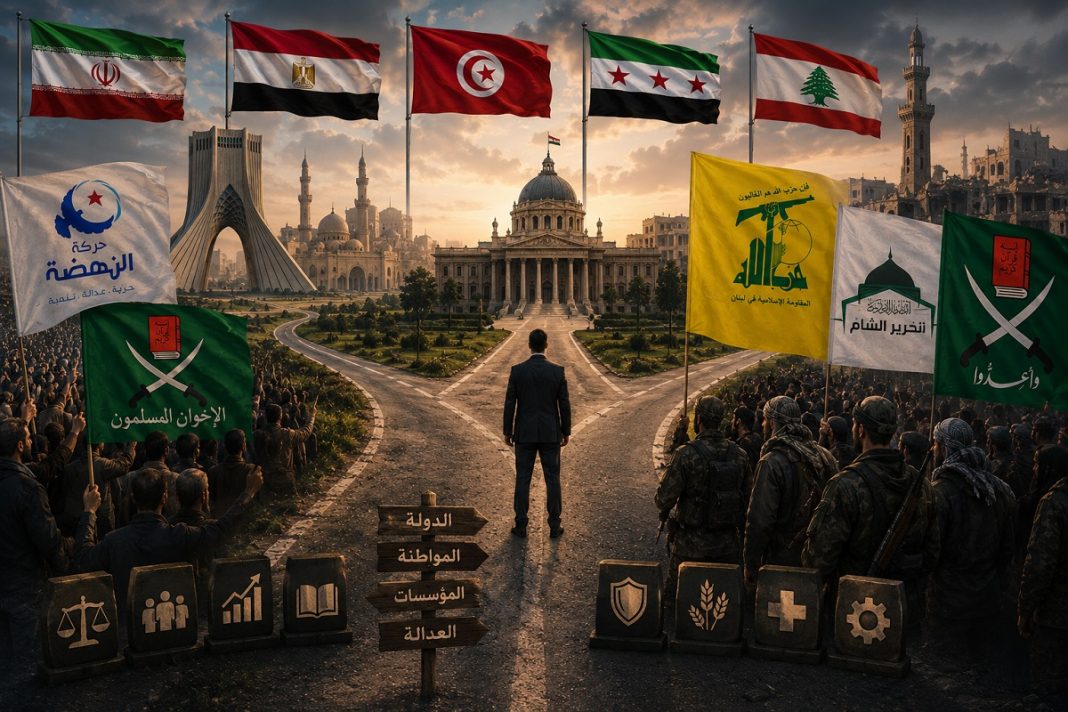
There is also a broader lesson here that extends beyond Somalia. Across parts of the Arab world and beyond, recent decades have demonstrated that elections alone cannot create legitimacy where political consensus is absent. Ballots matter. But institutions matter too. So does agreement on the rules of the game.
Ultimately, Somalia’s future will be determined not only by the electoral system it adopts but by whether its political leaders can build sufficient consensus to manage that transition peacefully.
More than three decades after the collapse of the Somali state, the country does not suffer from a shortage of democratic aspirations. It suffers from the gap between the ambition to build democracy and the capacity to sustain it.
The real danger facing Somalia today is not that elections may be delayed for another year. It is that the struggle over democracy could become a new source of instability for a state that is still trying to complete the work of rebuilding itself.
Democracy does not flourish in the absence of a state. It flourishes on its foundations.
This article was originally published in Arabic on the Asswak Al-Arab website