Gabriel G. Tabarani
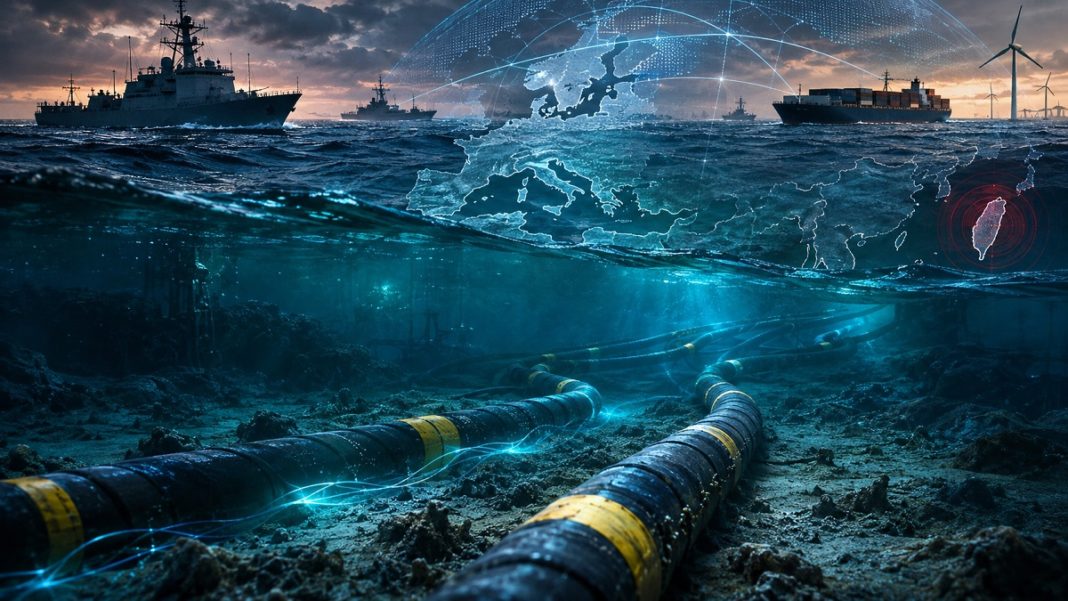
Far beneath the ocean’s surface lies the infrastructure that keeps the modern world running. Submarine cables carry the data that connects financial markets, governments, businesses and billions of people. Underwater pipelines and power connections help sustain economies across continents. Yet these largely invisible networks are becoming increasingly entangled in geopolitical rivalries, raising a troubling question: What happens when the international rules governing the seas begin to give way to the ambitions of powerful states?
The danger is not simply that an underwater cable might be damaged or a pipeline disrupted. It is that the infrastructure on which global prosperity depends is becoming a potential instrument of political coercion. As governments contest maritime boundaries, challenge established legal interpretations and seek strategic advantages beneath the waves, the seabed is emerging as another arena in the struggle between international law and raw power.
For decades, the oceans have been governed by a delicate balance between national interests and internationally recognized freedoms. That balance has never been perfect. Maritime boundaries remain disputed, and states have long disagreed over the extent of their rights offshore. But the expansion of underwater infrastructure has raised the stakes dramatically. A confrontation that once concerned fishing rights or offshore resources can now threaten projects essential to energy security, digital connectivity and economic development.
Consider the Great Sea Interconnector, an ambitious European-backed project designed to connect the electricity grids of Greece and Cyprus through an undersea cable. Its purpose is straightforward: to end Cyprus’s electricity isolation, strengthen regional energy security and facilitate the integration of European power markets.
Its geopolitical implications are anything but straightforward.
The project has become entangled in longstanding disputes between Greece and Turkey over maritime jurisdiction in the Eastern Mediterranean. Athens and Nicosia rely on their interpretation of the United Nations Convention on the Law of the Sea, while Ankara, which is not a party to the convention, challenges aspects of that interpretation, particularly concerning the maritime entitlements of islands.
Turkey has sought a greater say over activities in waters where it asserts maritime rights. Greece, meanwhile, maintains that lawful cable-laying activities cannot be subjected to unilateral restrictions based on contested claims.
The legal distinctions matter. International maritime law recognizes rights to lay submarine cables beyond territorial waters, subject to specific rules and the legitimate rights of coastal states. It does not give every government claiming an interest in a maritime area an automatic veto over such projects.
Yet the practical problem remains. Companies laying cables are not international courts. They cannot settle territorial disputes, and they are understandably reluctant to place expensive vessels and equipment in the middle of a confrontation between governments.
The result is a disturbing possibility: A state may be able to delay or complicate a civilian infrastructure project without formally changing a maritime boundary or establishing a new legal right. Political pressure alone can raise costs, discourage investment and make commercial decisions hostage to strategic rivalries.
That is a precedent with implications far beyond the Eastern Mediterranean.
In the Baltic Sea, a series of incidents involving underwater communications cables and energy infrastructure has heightened European concerns about what security analysts increasingly describe as shadow warfare: hostile activities conducted below the threshold of open military conflict.
Against the backdrop of Russia’s war in Ukraine and its confrontation with European governments, damage to undersea infrastructure has become a source of intense suspicion. But suspicion is not proof, and not every severed cable is evidence of sabotage.
Fishing equipment, ships’ anchors, natural events and technical failures account for many submarine cable disruptions. Establishing deliberate interference requires careful investigation, particularly when incidents occur in international waters, where jurisdiction and enforcement can be complicated.
That uncertainty is precisely what makes the underwater environment so strategically sensitive.
A damaged cable may disrupt essential services, yet investigators can struggle to determine whether the cause was negligence, accident or intentional interference. Even when a vessel is identified, proving that its crew acted deliberately can be difficult.
For governments, the consequences are unsettling. They may face serious economic damage without sufficient evidence to identify a responsible state or justify a response. For potential aggressors, the ambiguity creates opportunities to exert pressure while avoiding the political and military consequences of an openly acknowledged attack.
A similar vulnerability became apparent in 2023, when damage to submarine cables disrupted communications serving Taiwan’s Matsu Islands. The interruptions affected daily life and demonstrated how dependent even relatively small communities have become on infrastructure that is largely out of sight.
The incidents did not, by themselves, establish a deliberate attack. But in a region marked by growing tensions between China and the United States, they underscored the strategic importance of communications networks and the consequences of having too few alternatives.
Together, these developments reveal a larger problem. The distinction between peace and conflict is becoming harder to maintain when essential civilian infrastructure can be threatened, disrupted or exploited without the conventional signs of warfare.
This is precisely why the international maritime order matters.
The United Nations Convention on the Law of the Sea, adopted in 1982, represented an extraordinary diplomatic effort to establish common rules for the world’s oceans. It sought to reconcile coastal states’ rights with broader international interests, including navigation, communications and access to marine resources.
The convention did not eliminate maritime disputes. Nor did every major power join it. The United States, despite its longstanding support for many principles of freedom of navigation, has never ratified the treaty. Turkey also remains outside it, while other countries disagree over the interpretation or application of particular provisions.
Nevertheless, the convention helped establish a framework within which governments and businesses could operate with a degree of predictability.
That predictability is now under strain.
As strategic competition intensifies among the United States, China and Russia, and as regional powers seek to strengthen their positions, there is a growing temptation to treat contested waters as opportunities for unilateral advantage.
The danger is not necessarily the sudden collapse of maritime law. It is its gradual erosion through repeated challenges, selective interpretations and the use of political or military pressure to establish facts on the ground—or, increasingly, beneath the water.
Smaller and middle-ranking countries have the most to lose from such a development. They depend on predictable maritime rules but often lack the naval capabilities to defend their interests across distant waters. For them, international law is not an abstract diplomatic ideal. It is an essential safeguard against a world in which access to the seas depends on the preferences of stronger states.
The Arab world has a direct stake in this debate.
The Red Sea, the Arabian Gulf, the Suez Canal and the Bab el-Mandeb Strait sit at the intersection of global trade, energy transportation and international communications. Their importance extends well beyond the economies of the countries bordering them.
Any weakening of maritime rules, or growing willingness to use civilian infrastructure as an instrument of coercion, threatens the stability of these vital corridors. Arab governments therefore have an interest not only in protecting their own facilities and shipping routes but also in supporting an international order that preserves lawful access to the seas.
The answer cannot be military protection alone. Better surveillance, stronger maritime security and more resilient infrastructure are necessary, but they cannot substitute for effective legal rules, credible investigations and diplomatic mechanisms for resolving disputes.
Nor should every unexplained incident be transformed into a geopolitical accusation. Doing so risks accelerating the very instability that governments should be trying to prevent.
What is needed is a renewed commitment to protecting civilian maritime infrastructure, improving international cooperation and ensuring that disagreements over maritime rights are addressed through law rather than intimidation.
The world spent decades constructing a system that allows countries to trade, communicate and transport energy across the oceans without negotiating every route under the shadow of military force. That achievement should not be taken for granted.
And if the rules begin to unravel, even the countries with the largest navies may discover that they cannot insulate themselves from the consequences. Global commerce depends on interconnected networks, and disruptions rarely respect political boundaries.
The greatest danger in the emerging wars beneath the waves is not simply that submarine cables may be severed. It is that the rules that have kept the oceans open and broadly accessible may be severed along with them.
When international law can no longer protect what lies beneath the sea, the world above it will not remain untouched.
This article was originally published in Arabic on the Asswak Al-Arab website