Gabriel G Tabarani
As missiles crossed the skies of the Gulf and global markets braced for another Middle Eastern shock, a quieter transformation was unfolding far from the headlines. Across North Africa and the Arabian Peninsula, a new Arab geography has been taking shape — one defined less by ideology than by ports, sovereign wealth funds, logistics corridors, food security and strategic survival.
For decades, the Arab world imagined itself through the language of grand political projects. Pan-Arabism, resistance, revolutionary solidarity and regional unity dominated the rhetoric of summits and state television alike. Yet behind the slogans, regional integration rarely materialized in meaningful economic or institutional form.
Today, that era is fading.
In its place, a more pragmatic order is emerging — transactional, flexible and driven by mutual necessity. The growing relationship between the Gulf monarchies and the countries of the Maghreb is no longer merely diplomatic or symbolic. It is becoming one of the defining geopolitical shifts in the contemporary Arab world.
The recent Gulf war accelerated this transformation. The confrontation involving the United States, Israel and Iran exposed the fragility of the region’s traditional security architecture and reinforced a reality Gulf capitals have increasingly come to accept: military alliances alone are no longer sufficient to guarantee strategic security.
Economic resilience, supply-chain control, maritime access and regional influence have become equally central to national survival.
That realization helps explain why Gulf states are now looking westward with unprecedented intensity.
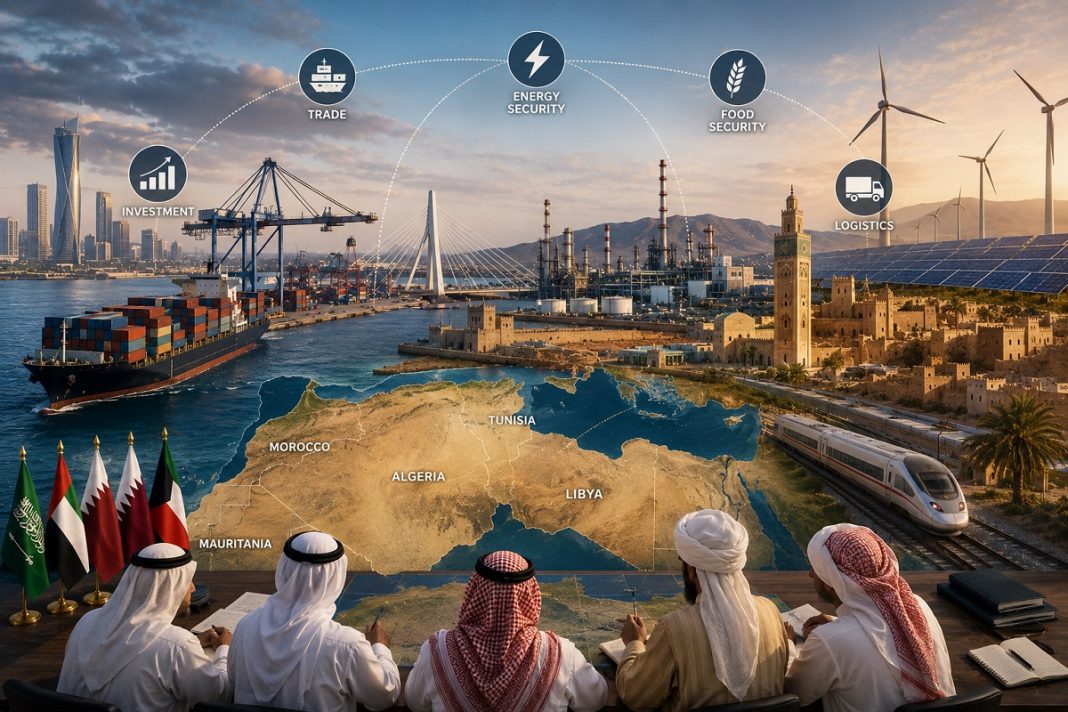
Saudi Arabia, the United Arab Emirates and Qatar increasingly see North Africa not as a distant Arab periphery, but as a strategic extension of their own geopolitical space. The Maghreb offers what the Gulf needs in a rapidly changing world: agricultural land, Atlantic access, industrial platforms, demographic depth, energy cooperation and entry points into African markets.
At the same time, the Maghreb itself is undergoing a profound reorientation.
Europe — historically the region’s primary economic and political partner — is struggling with economic stagnation, domestic political fragmentation and declining strategic coherence. The United States remains engaged mainly through narrow security concerns linked to migration, counterterrorism and energy stability.
Faced with mounting debt pressures, sluggish growth and rising social demands, North African governments increasingly view Gulf capital as a critical source of financial stability and long-term investment.
The numbers alone reveal the scale of the shift.
Over the past decade, Gulf investments in Africa have exceeded $100 billion, with the UAE alone accounting for nearly $59 billion. A significant portion of this capital has flowed toward North Africa, targeting sectors ranging from ports and logistics to renewable energy, agribusiness, infrastructure and manufacturing.
Yet what makes this emerging relationship particularly significant is that it does not resemble the rigid alliance structures that once defined regional politics.
Instead, it operates through what political analysts increasingly describe as “flexible regionalism” — selective cooperation shaped by specific national interests rather than ideological alignment.
Each Maghreb country has developed its own formula for engaging with the Gulf.
Morocco represents the most advanced and institutionalized version of this partnership. Leveraging political stability, Atlantic geography and strong diplomatic ties with Gulf monarchies, Rabat has positioned itself as a gateway between the Gulf and West Africa.
Saudi Arabia, the UAE, Qatar and Kuwait have invested billions of dollars in Moroccan infrastructure, tourism, renewable energy and port development. A Gulf support package worth roughly $5 billion helped finance major development projects over the past decade.
For Gulf investors, Morocco offers more than political alignment. It offers strategic geography.
As competition over maritime trade routes intensifies globally, Morocco’s Atlantic coastline and logistical infrastructure have become increasingly valuable to Gulf states seeking broader access to African markets and transatlantic commercial networks.
Algeria, by contrast, has pursued a more cautious and selective approach.
Deeply attached to doctrines of sovereignty and non-interference, Algeria remains wary of external political influence, particularly in Libya and the Sahel. Yet even Algiers recognizes the strategic necessity of economic engagement with Gulf partners.
Energy cooperation has become the cornerstone of this relationship.
In one of the largest Gulf-related deals in North Africa, Algeria signed a $5.4 billion agreement with a Saudi company to develop oil and gas fields, while Qatar has expanded major investments in Algerian steel, agriculture and industrial production.
Still, Algeria’s relationship with the Gulf remains carefully calibrated. Economic pragmatism does not automatically translate into geopolitical alignment.
Tunisia illustrates another dimension of this emerging order.
Facing one of the most severe economic crises in its modern history, Tunis has increasingly relied on Gulf financial support to avoid fiscal collapse. Qatari investments in Tunisia have exceeded $1 billion, while Saudi Arabia provided direct financial support worth approximately $500 million in loans and grants in 2023.
Yet Tunisian authorities continue to resist becoming fully integrated into any regional axis.
The country’s fragile political environment and widespread public suspicion toward external influence have encouraged successive governments to maintain a posture of strategic neutrality. Gulf assistance is welcomed as an economic necessity, but not as a vehicle for political dependency.
Libya remains the most complicated arena in Gulf-Maghreb relations.
The Libyan conflict exposed the extent to which Gulf rivalries themselves can shape North African instability. Competing regional interventions transformed Libya into both a battlefield and a laboratory for competing visions of regional order.
Although overt Gulf competition inside Libya has diminished in recent years, the legacy of that period continues to shape regional security calculations — especially in neighboring Algeria.
Further west, Mauritania has quietly gained strategic importance within Gulf thinking.
Long viewed as peripheral to Arab geopolitics, Mauritania’s location between the Atlantic and the Sahel has suddenly become a major strategic asset. Gulf investments and security cooperation with Nouakchott have expanded steadily, particularly in infrastructure, maritime security, agriculture and counterterrorism.
For Gulf capitals, Mauritania offers something increasingly rare in the Sahel region: relative stability.
For Mauritania, Gulf engagement provides both international visibility and economic support without forcing the country into rigid geopolitical alignments.
The broader significance of these developments extends beyond economics.
What is emerging between the Gulf and the Maghreb is not simply a network of investments. It is a redefinition of Arab regionalism itself.
The old Arab order was built around ideological narratives and centralized political leadership. The new one is being shaped through infrastructure, energy corridors, maritime logistics and sovereign wealth strategies.
This transformation carries opportunities, but also serious risks.
Gulf capital can stabilize economies, finance infrastructure and reinforce regime resilience. But it cannot, on its own, resolve the structural crises affecting many North African states — unemployment, weak productivity, corruption, institutional fragility and growing social inequality.
Nor is there any guarantee that this new regionalism will produce genuine long-term stability.
Indeed, there is a growing danger that the Arab world could evolve into a fragmented landscape of competing economic corridors and overlapping spheres of influence rather than a coherent regional system.
Libya has already demonstrated how external competition can deepen state fragmentation instead of containing it. Similar dynamics could emerge elsewhere if economic influence becomes disconnected from broader political stabilization.
Yet despite these contradictions, one reality is increasingly difficult to ignore.
The center of gravity in Arab politics is shifting.
The future of the Arab world may no longer be defined primarily in traditional capitals of ideological politics, but across a strategic axis stretching from the Gulf to the Atlantic — from ports and energy hubs to supply chains and investment networks.
After decades dominated by speeches and slogans, the Arab world appears to be entering the age of maps, markets and strategic geography.
And unlike the grand projects that once defined the region, this transformation is unfolding quietly — not through declarations, but through infrastructure, capital and necessity.
This article was originally published in Arabic on the Asswak Al-Arab website